Image above: AI-generated mood image, not a real place.
Driving to the mountains this winter means dealing with a patchwork of rules. France and Italy use fixed periods, Germany and Austria look at the weather, and in Switzerland, Spain and Portugal the road sign often decides. Belgium and the United Kingdom have no requirement at all. Below you will find, country by country, what applies to winter tyres, snow chains and studded tyres, and what to bring on a winter road trip.
Last checked on 24 November 2026. Rules change: check the official source listed at the bottom just before you leave.
At a glance: the rules by country
| Country | Winter tyres required? | When | Snow chains |
|---|---|---|---|
| Belgium | No | – | Only allowed on snow or black ice |
| France | In designated mountain municipalities | 1/11 to 31/3 | On board unless you have 3PMSF tyres. Fit them at sign B26 |
| Germany | Yes, in wintry conditions | No fixed period | Mandatory where a sign says so |
| Switzerland | No, but liability applies | Recommended October to Easter | Mandatory where a sign says so |
| Austria | Yes, in wintry conditions | 1/11 to 15/4 | Alternative on a snow-covered road, mandatory at a sign |
| Italy | On designated roads | 15/11 to 15/4, sometimes longer | Winter tyres or chains on board |
| Spain | At snow code red or a sign | According to the DGT colour codes | Mandatory where a sign says so |
| Portugal | No | – | Mandatory at sign D9 |
| Norway | At least 3 mm tread, no summer tyres on wintry roads | 1/11 to the first Sunday after Easter Monday (north: 16/10 to 30/4) | Carry them if snow or ice is expected |
| United Kingdom | No | – | Not required |
M+S or 3PMSF: which tyres count?
Winter tyres carry two kinds of marking. M+S (mud and snow) is applied by the manufacturer itself. The 3PMSF symbol, a three-peaked mountain with a snowflake (also called the Alpine symbol), is only given to a tyre after a test on snow. That difference increasingly decides whether your tyre counts as a winter tyre.
- Germany: only tyres with the 3PMSF symbol count, since 1 October 2024.
- France: only 3PMSF tyres are treated as equivalent to chains. With M+S tyres without the symbol, you also need chains or snow socks on board in the mountain zones.
- Austria: M+S tyres with at least 4 mm of tread, or tyres with the snowflake symbol.
- Italy: M+S is enough, 3PMSF is recommended.
- Norway: at least 3 mm of tread in the winter period.
- All-season tyres count as long as they carry the right marking and have enough tread.
The rules by country
Belgium
- Winter tyres are not mandatory and may be used all year. If your winter tyre has a lower speed rating than prescribed, that is only allowed from 1 October to 30 April, with a visible sticker.
- Snow chains may only be used on roads with snow or black ice. No separate speed limit applies, but you adapt your speed.
- Studded tyres are banned.
- Note: the Ardennes and the High Fens can be wintry while it rains in Brussels.
More on Belgium, with routes and seasons: driving in Belgium.
France
- The Loi Montagne applies from 1 November to 31 March in the municipalities designated by the prefects of 34 mountain departments. There you need either four 3PMSF tyres, or chains or snow socks on board for at least the driven wheels.
- There is no fine for this requirement yet: the decree introducing it has not been published. The requirement itself does apply.
- Separately, you must fit chains as soon as you see sign B26. That applies all year and is fined.
- With chains fitted, the maximum speed is 50 km/h.
- The Route des Crêtes in the Vosges is closed from 16 November 2026 until early April.
More on France, with routes and seasons: driving in France.
Germany
- There is no fixed period. In black ice, snow, slush, ice or frost you need winter tyres on all four wheels. This also applies to foreign cars.
- Since 1 October 2024 only tyres with the 3PMSF symbol count. Tyres marked M+S only are no longer enough.
- Fine: €60 to €100, depending on whether you obstruct or endanger others.
- Snow chains are mandatory where a sign says so. Studded tyres are banned.
- If you drive through Germany to Austria or Switzerland, this rule applies along the way too.
More on Germany, with routes and seasons: driving in Germany.
Switzerland
- Winter tyres are not required by law. But if you have an accident in a car that is not ready for winter, you can be held (partly) liable and your insurer can reduce its payout. Recommended: from October to Easter.
- Ignoring the “snow chains mandatory” sign costs CHF 100.
- Many high passes are closed in winter, usually from November to May or June: among them the Furka, Grimsel, Susten, Nufenen, Gotthard and Klausen. The Julier, Maloja, Bernina and Ofen passes stay open all year.
- Alternatives when a pass is closed: the car trains Realp–Oberwald (Furka) and Vereina, or the tunnels under the Gotthard and the San Bernardino.
More on Switzerland, with routes and seasons: driving in Switzerland.
Austria

- From 1 November to 15 April you need winter tyres on all wheels in wintry conditions (snow, slush or ice).
- Valid are M+S tyres with at least 4 mm of tread (5 mm for cross-ply) and tyres with the snowflake symbol. All-season tyres count if they meet those requirements.
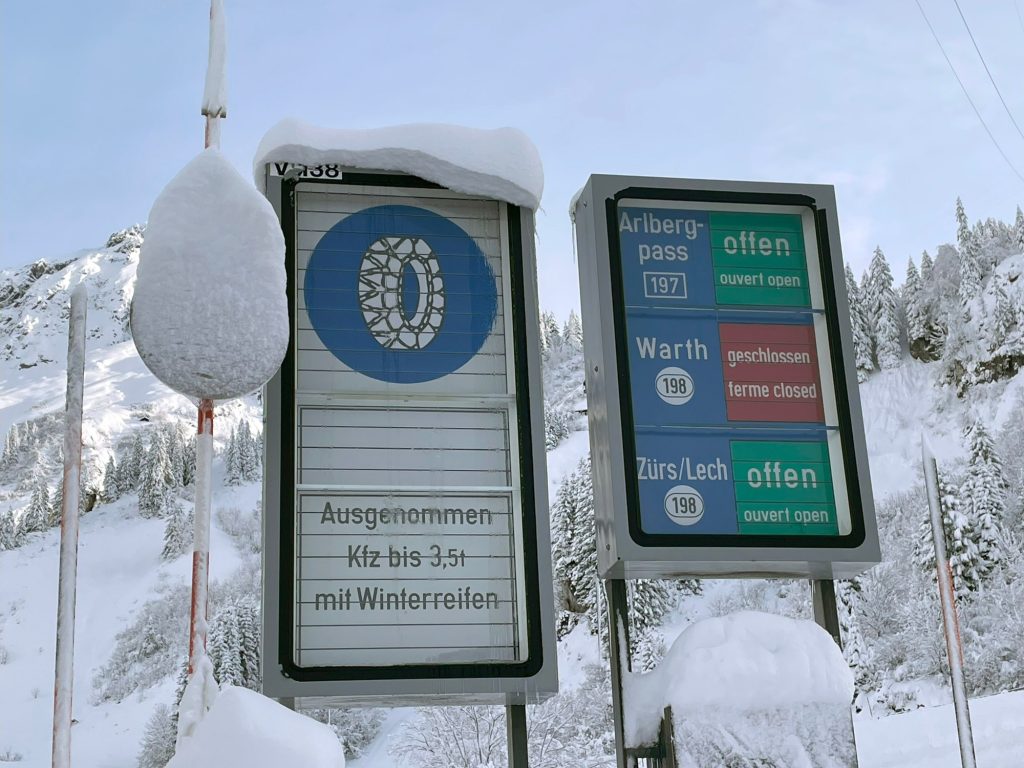
- Snow chains on at least two driven wheels are allowed as an alternative, but only on a (nearly) fully snow-covered or icy road. At the “Schneeketten” sign they are mandatory.
- Fine: around €100. According to the ÖAMTC it can rise to €10,000 if you endanger others, and your liability insurer can claim back up to €11,000.
- The Großglockner High Alpine Road is open from early May to early November.
More on Austria, with routes and seasons: driving in Austria.
Italy
- From 15 November 2026 to 15 April 2027 you need winter tyres (M+S, 3PMSF recommended) or snow chains on board on roads where the road authority requires it. In some mountain areas the period starts in mid-October or on 1 November and runs until 30 April.
- On some stretches the requirement also applies without snow, such as part of the A4.
- Snow socks are allowed if they meet the UNI EN 16662-1:2020 standard.
- Fine: €80 to €318 outside built-up areas, €41 to €169 inside.
- In any kind of precipitation the limit drops to 110 km/h on the autostrada and to 90 km/h on main roads outside built-up areas.
- High passes such as the Stelvio are usually only open from June to September.
More on Italy, with routes and seasons: driving in Italy.
Spain
- There is no general winter tyre requirement. In snow, the DGT has used colour codes since 19 November 2026: yellow max. 100 km/h on motorways and 80 km/h elsewhere, orange max. 60 km/h, red max. 30 km/h and only with chains or winter tyres, black road closed.
- On the tunnel-heavy A-23, A-67, A-6 and AP-66, chains are banned at code red. There you may only continue with winter tyres.
- Chains are mandatory where a sign says so.
More on Spain, with routes and seasons: driving in Spain.
Portugal
- Winter tyres are not mandatory.
- Sign D9 makes snow chains mandatory on the two driven wheels. Sign H5 recommends them.
- Whether snow socks are enough at a D9 sign is unclear: the regulation only mentions chains. If you head into the mountains, take chains.
- In the Serra da Estrela, the road to the Torre (EN338) closes in snow, as it did on 21 January 2026.
More on Portugal, with routes and seasons: driving in Portugal.
Norway
- From 1 November to the first Sunday after Easter Monday your tyres need at least 3 mm of tread. In Nordland, Troms and Finnmark that period runs from 16 October to 30 April.
- Summer tyres are not allowed on wintry roads. Outside the period, too, you use winter tyres or chains if grip requires it.
- Studded tyres are allowed in the same periods, on all wheels. In Oslo, Bergen and Trondheim you pay a fee for them.
- On mountain crossings you often drive in a convoy behind a snowplough in bad weather (kolonnekjøring). Never drive around a closed barrier.
More on Norway, with routes and seasons: driving in Norway.
United Kingdom
- Winter tyres and snow chains are not mandatory. In the Scottish Highlands and rural areas, winter tyres may still be needed.
- What you must do: clear all windows of snow and ice before you set off.
More on Scotland, with routes and seasons: driving in Scotland.
What to pack for a winter road trip
Our conclusion from the rules above. It is not legal advice, but a practical summary.
- Four tyres with the 3PMSF symbol (winter or all-season) with enough tread: at least 4 mm in Austria, at least 3 mm in Norway. That meets the tyre rules in Germany, France, Austria and Italy.
- Snow chains that fit your tyres, and know how to fit them. You need them at a sign (France, Germany, Switzerland, Austria, Spain, Portugal) and at code red in Spain.
- Snow socks are handy, but not a full alternative everywhere. They are allowed in France and (with the right standard) in Italy; in Portugal it is unclear.
- Before you leave, check the road information and whether the passes on your route are open.
What else your car must carry, such as a warning triangle or hi-vis vest, is in the packing list by country. Vignettes and tolls for the Alps are best sorted out in advance: see vignettes, tolls and low-emission zones in Europe.
Frequently asked questions
Can I drive to the Alps on summer tyres?
In dry weather it is allowed in Germany, Austria and Switzerland. As soon as conditions turn wintry you are in breach of the rules in Germany and Austria, and in Switzerland you risk trouble with your insurer. In the French mountain zones you need chains or snow socks on board from 1 November to 31 March regardless. In practice we advise against it.
Will I be fined in France without winter tyres?
Not yet for the Loi Montagne requirement itself: the fine has not been introduced. If you ignore sign B26 (chains mandatory), you can be fined.
Are all-season tyres good enough?
Yes, if they carry the 3PMSF symbol and have enough tread. Tyres marked M+S only are no longer enough in Germany, and in the French mountain zones you then also need chains or socks.
Official sources
- Belgium: Touring – winter tyres and snow chains in Belgium (Dutch)
- France: Service Public – pneus hiver et chaînes
- Germany: ADAC – traffic rules in Germany
- Switzerland: ch.ch – winter tyres
- Austria: ÖAMTC – winter equipment requirement
- Italy: Motor1 – gomme invernali 2026
- Spain: DGT – road status codes (19/11/2026)
- Norway: Statens vegvesen – tyre requirements
- United Kingdom: Traffic Scotland – winter tyres guide