Image above: AI-generated mood image, not a real place.
A warning triangle and a hi-vis vest are in almost every car boot. But is that enough for France, Austria or Spain? Mostly, yes: a basic kit of triangle, vest, first-aid kit and fire extinguisher covers almost every requirement in the ten countries we looked at. The differences are in the details: who has to wear the vest, whether a rule also applies to a foreign-registered car, and what Spain’s new V-16 light means for you. Below you will find, country by country, what is mandatory, which documents to bring, and one packing list that works everywhere.
Last checked on 24 November 2026. This guide assumes a car registered in an EU country (we checked it with a Belgian-registered car), without a trailer. For a UK-registered car the number plate and headlamp rules on the continent differ, and we have not covered them here. Rules change: check the official source listed at the bottom just before you leave.
At a glance: what is mandatory by country?
| Country | Warning triangle | Hi-vis vest | First-aid kit | Fire extinguisher | Watch out |
|---|---|---|---|---|---|
| Belgium | Mandatory | Mandatory | Belgian-registered cars | Belgian-registered cars, min. 1 kg | From 1/6/2027 hazard lights first (press reports) |
| France | Mandatory, approved | Mandatory, CE, within reach | Recommended | Recommended | Breathalyser not required |
| Germany | Conflicting | Conflicting | Conflicting | Not required | Does it apply to foreign plates? |
| Switzerland | Mandatory | Recommended | Recommended | Recommended | Daytime lights mandatory |
| Austria | Mandatory | Mandatory (driver) | Mandatory | Not required | Original documents |
| Italy | Mandatory | Mandatory, within reach | Recommended | Recommended | Triangle at least 50 m back |
| Spain | Mandatory (V-16 only for Spanish plates) | Mandatory | Recommended | Not required without a trailer | Panel for a protruding bike rack |
| Portugal | Conflicting | Conflicting | Recommended | Only with LPG or natural gas | A V-16 does not replace the triangle |
| Norway | Mandatory | Mandatory, within reach | Not required | Buses only | Daytime lights mandatory |
| United Kingdom | Not required, never on a motorway | Not required | Not required | Not required | Headlamps must not dazzle |
“Conflicting” means the sources disagree on whether the requirement also applies to a foreign-registered car. More on that under Germany and Portugal.
Which rules apply to your car?
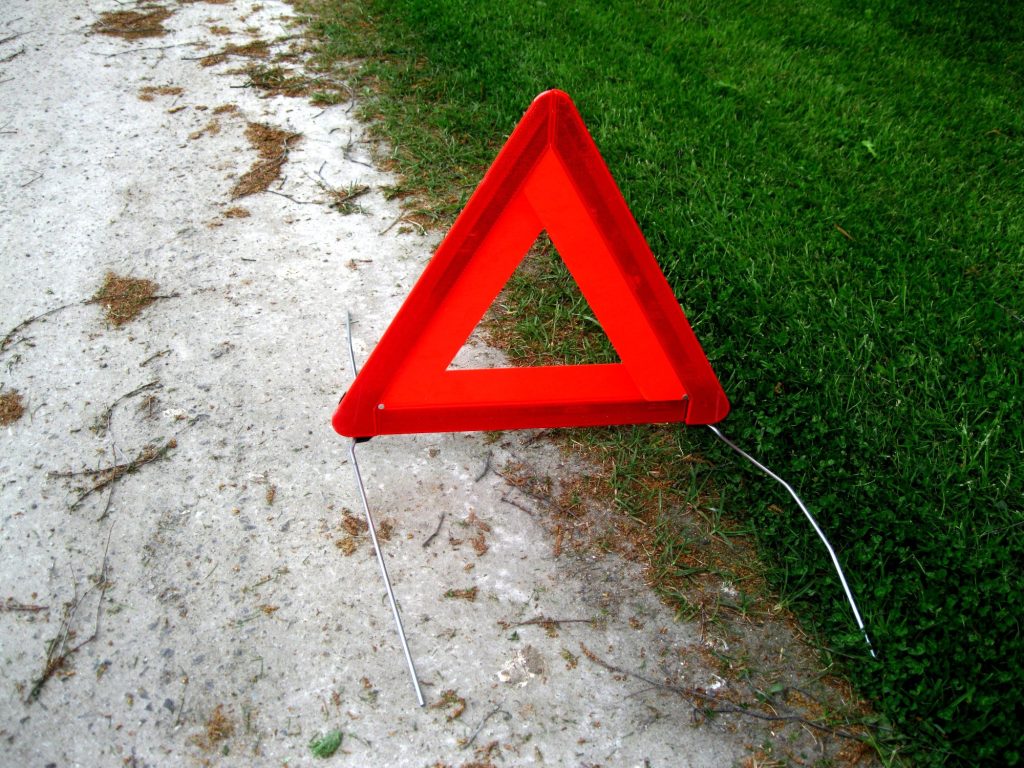

Two sets of rules overlap. Your car has to meet the requirements of the country where it is registered, also abroad. And the country you drive in can impose its own equipment, sometimes only for cars registered there.
Spain says so explicitly: foreign cars may keep using a warning triangle. According to the Spanish traffic authority DGT, the Vienna Convention allows a triangle or any other equally effective device prescribed by the country of registration. For Germany and Portugal the sources contradict each other. In practice, the combined packing list further down covers you either way.
The rules by country
Belgium
- A Belgian-registered car must carry four items: a warning triangle, a hi-vis vest, a first-aid kit and an approved fire extinguisher of at least 1 kg (for vehicles up to 3.5 tonnes).
- For a foreign-registered car, according to the Dutch motoring club ANWB, a triangle is mandatory and the driver wears a vest after a breakdown. The first-aid kit and fire extinguisher are only mandatory for Belgian plates, although the ANWB recommends carrying them.
- Keep the vest within reach, not in the boot. That is what the insurer KBC says; we have not seen it in the legal text itself.
- According to Your Europe you wear it after a breakdown on motorways and expressways. The German motoring club ADAC says outside built-up areas, with a fine from €58.
- New from 1 June 2027 (new highway code): after a breakdown you switch on your hazard lights first. Only if that is not possible do you place the triangle, and then only on motorways and expressways, 100 metres back. That is reported by New Mobility News (June 2026); we could not open the official page. The source says nothing about carrying the triangle, so keep it in the car.
- Children shorter than 135 cm travel in a suitable child seat.
More on Belgium, with routes and seasons: driving in Belgium.
France
- Mandatory: a CE-marked hi-vis vest within reach, and an approved warning triangle.
- If you have to get out on the carriageway or the verge after an emergency stop, the driver wears the vest. Motoring clubs such as the TCS and the ÖAMTC speak of a vest for every occupant, but the legal requirement according to Service Public applies to the driver.
- If your car is stopped in a dangerous spot, such as a junction, a bend or in poor visibility, you place the triangle at least 30 metres back, with your hazard lights on. You do not have to if it would put your life at risk.
- Fines: not being able to show the vest or triangle costs up to €38. Not wearing the vest or not signalling your car usually costs €135 (up to €750).
- A breathalyser is not required, and neither is a spare wheel. A first-aid kit and a fire extinguisher are recommended.
- In French low-emission zones (ZFE) you need a Crit’Air sticker, also with foreign plates. See our page on vignettes, tolls and low-emission zones in Europe.
More on France, with routes and seasons: driving in France.
Germany
- § 53a StVZO requires a warning triangle and a vest in a passenger car. According to ADAC and ANWB, a first-aid kit meeting the DIN 13164 standard is also required.
- Sources disagree on whether this applies to foreign plates. Your Europe, the European Commission’s site, lists the first-aid kit, triangle and vest as mandatory. ADAC, ANWB and TCS say the requirement only applies to German-registered cars.
- The legal text itself is silent. § 31d StVZO, the article on foreign vehicles, does mention weight, dimensions, seat belts, speed limiters and tread depth, but not the triangle, vest or first-aid kit. Our reading: that supports the clubs. We found no confirmation from a German authority.
- In practice: carry all three anyway. The ANWB recommends a vest for every occupant.
- Children up to 12 years or 150 cm travel in a child seat.
More on Germany, with routes and seasons: driving in Germany.
Switzerland
- Only the warning triangle is mandatory. Without one you pay CHF 40. ÖAMTC and Touring say it must be within reach.
- A hi-vis vest, first-aid kit and fire extinguisher are not mandatory, but recommended.
- Daytime lights are mandatory. Driving without lights costs CHF 40.
- We rely on the TCS, the insurer Mobiliar, the ÖAMTC and Your Europe. We could not consult the Swiss legal text itself.
- Children up to 12 years or 150 cm travel in a child seat, according to the ÖAMTC.
More on Switzerland, with routes and seasons: driving in Switzerland.
Austria
- The law (§ 102 KFG) requires the driver to carry three things: first-aid material in a sturdy, dust-tight container, a suitable warning device (in practice the triangle) and warning clothing meeting EN 471 or EN ISO 20471.
- The driver wears that clothing when placing the triangle, and when outside the car on a motorway or Autostraße. Put the vest on before you get out. The ADAC mentions a fine from €14.
- The law makes no exception for foreign cars. Our reading: the requirement applies to you too.
- Carry your driving licence and registration certificate in the original; a copy is not enough, says the ÖAMTC.
- Children under 14 and shorter than 135 cm travel in a child seat. The government still recommends one up to 150 cm.
More on Austria, with routes and seasons: driving in Austria.
Italy
- Mandatory: a warning triangle and a hi-vis vest. You place the triangle at least 50 metres behind your car.
- Keep the vest within reach. You wear it when you get out outside built-up areas, at night or in poor visibility, including on the hard shoulder.
- Who has to wear it is not clear-cut: according to the ADAC the driver and whoever places the triangle, according to the ÖAMTC every occupant. The ADAC mentions a fine from €42.
- A first-aid kit and a fire extinguisher are recommended.
- Children shorter than 150 cm travel in a seat suited to their weight and height. The alarm requirement for seats for children up to 4 only applies to cars registered in Italy.
More on Italy, with routes and seasons: driving in Italy.
Spain
- The V-16 light: since 1 January 2026, a connected V-16 warning light is the only legal way to signal a stopped Spanish-registered car. It replaces the triangle and automatically sends your exact location to the DGT 3.0 platform. Only certified lights on the DGT’s official list count.
- With foreign plates you do not need a V-16. According to the Spanish government, foreign-registered cars in international traffic may keep using triangles. According to the ANWB, one triangle is enough.
- If you rent a car with Spanish plates, it must carry a V-16. Without one the fine is €80, the same as it used to be without triangles.
- A hi-vis vest is mandatory. According to the ADAC the driver wears it; according to the ANWB every occupant needs one. The ADAC mentions a fine of up to €200.
- A fire extinguisher is not required for a passenger car without a trailer. Your Europe and the ANWB also mention a spare wheel or a tyre repair kit; whether that applies to foreign cars we could not establish.
- If a bike rack or load sticks out at the back, it needs a red-and-white panel of 50 x 50 cm.
More on Spain, with routes and seasons: driving in Spain.
Portugal
- Sources disagree on whether a triangle and a hi-vis vest are mandatory with foreign plates. Your Europe lists both as mandatory. According to the Portuguese site auto.moto.pt, article 88 of the highway code requires them in every motor vehicle, without distinguishing by number plate.
- On the other side are the ANWB (only for Portuguese plates), the TCS (vest mandatory, triangle only for Portuguese cars) and the Portuguese site Pplware (a foreign car follows the rules of its country of registration).
- In practice: carry both. According to the ADAC the driver wears the vest outside built-up areas, with a fine from €60.
- A V-16 light does not replace the triangle in Portugal.
- A fire extinguisher is only mandatory in cars running on LPG or natural gas. Spare bulbs, a first-aid kit and a torch are recommended.
More on Portugal, with routes and seasons: driving in Portugal.
Norway
- Mandatory: a warning triangle and a hi-vis vest.
- The Norwegian road authority Statens vegvesen asks for at least one approved vest that is easy to reach, for example in the door pocket. According to the ADAC the driver wears it outside built-up areas.
- A fire extinguisher is only mandatory in buses.
- Daytime lights are mandatory. We found no requirement to carry spare bulbs.
More on Norway, with routes and seasons: driving in Norway.
United Kingdom
- A hi-vis vest and a warning triangle are not mandatory. The Highway Code only gives advice on them. If you read elsewhere that a vest is compulsory: that is not in the Highway Code.
- Place a triangle at least 45 metres behind your car, but never on a motorway. If you stop on a motorway, put on a hi-vis vest if you have one to hand.
- Headlamps: dazzling other road users is banned (rule 114). The headlamps of a car built for driving on the right point the wrong way in the UK. We found no explicit requirement to adjust or mask them. Our reading: adjust them (with LED lights this is often possible via the menu) or fit headlamp beam deflectors, and you dazzle no one.
- An EU number plate with the country letter is recognised as the national identifier.
More on Scotland, with routes and seasons: driving in Scotland.
Documents: what to bring
- Driving licence: an EU licence is recognised in all EU countries. In Norway an EU licence is valid as long as it is valid itself. In the UK you may drive on it for up to 12 months from arrival, and in Switzerland you may drive on a foreign licence from age 18 for up to a year, according to MySwitzerland. Old-style EU licences must be exchanged by 2033 at the latest.
- Vehicle registration certificate. In Austria you are legally required to carry it, and the ÖAMTC asks for licence and registration certificate in the original.
- Proof of insurance: the green card, or another document from your insurer showing the insurer’s name, your number plate or VIN and the period of cover. The UK asks for this explicitly.
- UK: also a passport (Belgians, for example, cannot enter on an ID card) and an ETA of £20 per traveller, children included.
International Driving Permit? With an EU licence you do not need one in any of the 10 countries: none of the sources we consulted asks for it. Your Europe also notes that international driving permits are not regulated at EU level and may not be recognised everywhere. If your licence was issued outside the EU/EEA, check the rules separately.
Country identifier and number plate
- Within the EU, a number plate with the blue EU band and your country letter is enough. An EU regulation (2411/98) requires countries that demand a country identifier to recognise that symbol. A separate sticker is then not needed.
- The UK recognises it too, according to the British version of the same regulation. You only need temporary Q plates if the characters on your plate are not recognisable there.
- For Switzerland and Norway we found no source on whether the EU band is enough. Our advice: keep a separate country sticker in the glovebox for those two.
Child seats
Young children need a suitable seat everywhere, but the threshold differs:
- Belgium and Austria: shorter than 135 cm (in Austria up to age 14).
- Germany and Switzerland: up to 12 years or 150 cm.
- Italy: shorter than 150 cm.
- France: up to age 10, a seat suited to weight and height, with a €135 fine (according to the ÖAMTC).
For Spain, Portugal, Norway and the UK we have not checked the threshold. Our conclusion: a seat up to 150 cm, and in France up to age 10, covers the countries we did check.
Winter equipment
In winter, a few countries add equipment. In France, from 1 November to 31 March, you need tyres with the 3PMSF symbol, or chains or snow socks on board, in the mountain zones of 34 departments. Germany requires winter tyres as soon as conditions turn wintry. Austria does too, but only from 1 November to 15 April. Italy requires them on designated roads from 15 November to 15 April. Where a sign says so, you fit chains. All the details by country are in our guide to winter tyres and snow chains in Europe.
The packing list: covered in all 10 countries
This is our conclusion from the rules above, not legal advice. Pack this and you meet every requirement we found in the 10 countries:
- One approved warning triangle.
- Hi-vis vests with CE marking and meeting EN ISO 20471: one within reach of the driver, and ideally one per occupant. The sources for France, Italy and Spain disagree on who has to wear one.
- A first-aid kit, ideally meeting the German DIN 13164 standard.
- A fire extinguisher of at least 1 kg if your car is registered in Belgium. Elsewhere only Portugal requires one, and only for LPG or natural gas.
- A child seat up to 150 cm, in France up to age 10.
- Your documents: driving licence, original registration certificate and proof of insurance. For the UK also your passport and an ETA.
- Your number plate with the EU band. For Switzerland and Norway, possibly a country sticker.
- For the UK: beam deflectors or adjusted headlamps.
- In winter: tyres with the 3PMSF symbol and snow chains.
What you do not need: a breathalyser (France) and a V-16 light (Spain, with foreign plates). Spare bulbs are not mandatory anywhere. In countries with mandatory daytime lights, such as Switzerland, Norway and Italy, they are handy though.
Practical tips
- Vest in the door pocket, not in the boot. Then you put it on before you get out, as Austria requires.
- Triangle within reach. If your boot is full of luggage or camping gear, put the triangle on top or behind a seat.
- Distance for the triangle: at least 30 metres in France, 50 metres in Italy and 45 metres in the UK (never on a motorway). In Belgium from June 2027, 100 metres on motorways and expressways (according to press reports).
- Bike rack at the back? In Spain a protruding rack needs a red-and-white panel of 50 x 50 cm. According to the ADAC, driving without one risks at least €200 in Spain, at least €87 in Italy and from €120 in Portugal.
- Hire car in Spain? Check that the V-16 is on board.
Frequently asked questions
Do I need a V-16 light in Spain?
Not with foreign plates. Foreign-registered cars may keep using the triangle. Only Spanish-registered cars, hire cars included, have needed a connected V-16 since 1 January 2026. If you buy one anyway: in Portugal it does not replace the triangle, so keep that in the car.
Is a breathalyser mandatory in France?
No, as the French government site Service Public confirms. A CE-marked vest and an approved triangle are mandatory.
Do I need a vest for every passenger?
Legally, usually not. In France and Austria the requirement lies with the driver, and Norway asks for at least one vest. For France, Italy and Spain, motoring clubs do speak of every occupant. So bring one vest per person and you are covered everywhere.
Do I need an International Driving Permit?
Not with an EU licence. It is recognised in the EU countries, Norway, Switzerland and the UK. In the UK you may drive on it for up to 12 months from arrival.
Does Germany’s equipment requirement apply to my foreign car?
That is not certain. Your Europe, the European Commission’s site, lists the triangle, vest and first-aid kit as mandatory. The German and Dutch motoring clubs say the requirement only applies to German-registered cars. Carry a triangle, vest and first-aid kit anyway. To be completely safe, choose a first-aid kit meeting DIN 13164.
Official sources
- Belgium: Belgian police – mandatory equipment (Dutch, pdf), Your Europe – Belgium
- France: Service Public – équipements obligatoires en voiture
- Germany: § 53a StVZO, § 31d StVZO
- Switzerland: TCS – Warnweste obligatorisch?, Your Europe – Switzerland
- Austria: oesterreich.gv.at – Warneinrichtung und Warnkleidung, § 102 KFG, oesterreich.gv.at – child seats
- Italy: Italia.it – driving in Italy
- Spain: DGT – V-16 beacon, La Moncloa – V-16 and foreign cars
- Portugal: Your Europe – Portugal
- Norway: Statens vegvesen – refleksvest
- United Kingdom: Highway Code – breakdowns and incidents, Highway Code – rule 114, GOV.UK – driving on an EU/EEA licence
- EU: Your Europe – driving licence recognition, Regulation 2411/98, art. 3
- Fines and child seats (motoring clubs): ADAC – Warnweste und Warntafel im Ausland, ÖAMTC – Kindersicherung in Europa