Image above: AI-generated mood image, not a real place.
Pitching your tent by a lake with nobody around: for many road trippers that is the highlight of the journey. But wild camping is not a right that applies everywhere in Europe. Norway and Scotland have a broad right of access, Germany bans it in principle, and elsewhere the region or municipality often decides. Below you can read, country by country, what is allowed with a tent or bivvy bag, what you risk and when you may not light a fire.
Last checked on 24 November 2026. Rules differ by region, municipality and protected area, and they change: check the official source listed at the bottom before you leave.
What counts as wild camping?
This page covers camping with a tent or bivvy bag outside a campsite. If you sleep in your car, campervan or roof tent, other rules apply. You will find them on our page about sleeping in your car, campervan or roof tent.
The ten countries fall into four groups:
- Ban: camping outside campsites is not allowed, sometimes with exceptions such as bivouac zones.
- Tolerated: not explicitly allowed, but accepted under conditions.
- Right of access: a legal right of access that allows a tent, with conditions.
- Regulated regionally: the region, state or municipality decides.
Almost everywhere, the landowner’s permission opens many doors, and nature reserves and national parks are stricter. Rights of access cover people on foot, by bike or by canoe, not your car.
At a glance by country
| Country | Rule | Main conditions | Confirmed fine |
|---|---|---|---|
| Belgium | Regulated regionally | Flanders: bivouac zones. Wallonia: in the forest only at designated spots. Brussels: not in green spaces | Wallonia €25–100 (sometimes doubled); Brussels up to €350 |
| France | Allowed with the land user’s consent | Not on the coast, at protected sites or near drinking water catchments; own rules in each national park | Not officially confirmed |
| Germany | Banned in principle | Trekkingplätze; one night in Brandenburg and Mecklenburg-Vorpommern without a car | By state, not officially confirmed |
| Switzerland | By canton; partly tolerated | One night above the tree line tolerated; never in reserves or the National Park | National Park CHF 200; game reserve CHF 150 |
| Austria | By state; banned in forests | Banned in Tyrol, Carinthia, Burgenland, Lower Austria and Vienna; elsewhere municipalities can ban it | Tyrol €600; Lower Austria €7,300; city of Salzburg €10,000 (max.) |
| Italy | Regulated regionally | Short bivouac often tolerated, many regions ban camping (not officially confirmed) | Not officially confirmed |
| Spain | Regulated regionally | Banned in e.g. Andalusia, Asturias and Extremadura; with conditions in Aragon, the Basque Country and Cantabria | Extremadura up to €600 |
| Portugal | Banned without a permit | Municipal permit and the landowner’s consent | €150–200 (2002 legal text) |
| Norway | Right of access | At least 150 m from inhabited houses, max. 2 nights | No amount found |
| United Kingdom | Scotland: right of access. England and Wales: permission needed | Scotland: 2 or 3 nights; permit at Loch Lomond from 1/3 to 30/9 | Cairngorms: fires up to £500 |
The rules by country
Belgium
- Flanders: in forests and nature areas you may only camp in an official bivouac zone. You book it for free via Natuur en Bos, the Flemish nature agency. You stay one night (from 6 pm to 10 am), with no more than 3 tents and 10 people. You cannot drive up to the zone. All zones, including those in Wallonia, are in our overview of bivouac zones in Belgium.
- Elsewhere in a forest you need the permission of the owner or manager and an authorisation from the Agency for Nature and Forests (Forest Decree). We found no fine amount.
- Wallonia: in the forest you may only stay at designated aires, with authorisation and the owner’s consent (Code forestier). Two nights in a row at the same spot are not allowed. The fine is €25 to €100, doubled at night, in a group, between 1 March and 30 June and in protected nature areas. Bivouac zones are listed on bivakzone.be.
- Brussels: camping in parks and green spaces is banned without permission, with an administrative fine of up to €350.
- Fire: in Flanders, banned in forests, within 25 m of the forest edge and within 100 m of heathland. Elsewhere the fire danger code decides: at orange only a gas or pit fire, at red nothing at all. In bivouac zones fires are only allowed in the fire basket. In Wallonia fires are banned in the forest, except at designated spots.
More on Belgium, with routes and seasons: driving in Belgium.
France
- Camping outside a campsite is allowed with the consent of whoever uses the land (Code de l’urbanisme). Roads and public highways are explicitly excluded.
- Banned: on the coast, at protected sites, near listed monuments and within 200 m of drinking water catchments. Mayors can also ban it with a published order and signs.
- A bivouac with a light tent for one night is often tolerated. That is a practice, not a right.
- National parks have their own rules. In the Écrins a new order has applied since June 2026: a small tent, one night from 7 pm to 9 am, at least an hour’s walk from the park boundary, roads and car parks, and no open fire. According to secondary sources, camping is banned outright in the Calanques and on Port-Cros.
- Corsica: wild camping is banned. On the GR20 you camp in the bivouac zones by the mountain huts, after booking.
- Fine: secondary sources mention €135, up to €1,500 for damage or litter. Not officially confirmed.
- Fire: in and within 200 m of forests, anyone other than the owner may not light a fire, barbecues included (Code forestier). That costs at least €135. In the fire season whole massifs can be closed, as in the Bouches-du-Rhône in August 2026.
More on France, with routes and seasons: driving in France.
Germany
- Wild camping is not covered by the right of free access. It is banned in forests, Naturschutzgebiete (nature reserves) and national parks; each state regulates the rest.
- Brandenburg: if you travel on foot, by bike, on horseback or by canoe, you may pitch a tent in the open countryside for one night. In the forest only with the owner’s written permission.
- Mecklenburg-Vorpommern: walkers without a motor vehicle may camp for one night, but not in national parks or nature reserves. If you travel by car, these rules do not cover you in either state.
- Bavaria requires the owner’s permission; in the German Alps even a planned bivouac is not allowed. Baden-Württemberg explicitly bans camping in the forest.
- Legal alternative: the Trekkingplätze, for example in the Palatinate Forest, the Eifel, the Black Forest and Saxon Switzerland. You book online, stay one night and only get the exact location after booking. You can only reach them on foot. Most are open from spring to autumn.
- Fine: by state; according to a private overview, up to €5,000 in Mecklenburg-Vorpommern. Not officially checked.
- Fire: banned in principle in the forest, except at designated spots. In Brandenburg also within 50 m of the forest edge. In Baden-Württemberg you keep 100 m away, and smoking in the forest is banned from 1 March to 31 October.
More on Germany, with routes and seasons: driving in Germany.
Switzerland
- There is no national rule: the canton and municipality decide. According to the TCS and the Swiss Alpine Club, the following is generally tolerated: one night with a small tent above the tree line, in a small group; an emergency bivouac; and camping on private land with permission.
- Always banned: nature reserves, the National Park, federal game reserves (CHF 150) and wildlife rest zones.
- Cantons: Valais always requires a permit. Appenzell Innerrhoden bans it, but allows a bivouac with the owner’s permission. In Uri, municipalities such as Andermatt and Realp ban it.
- National Park: visits during daylight only. Bivouacking costs CHF 200, lighting a fire CHF 300.
- Fire: only at official fireplaces, never in wind. In dry spells the cantons announce fire bans; check waldbrandgefahr.ch.
More on Switzerland, with routes and seasons: driving in Switzerland.
Austria
- Staying overnight in the forest is banned everywhere without the owner’s permission. Outside the forest the state decides, often the municipality too. There is no general one-night tolerance rule.
- Tyrol: banned outside campsites, except in zones the municipality opens up and for a bivouac above the tree line. Fine up to €600. Galtür has such a zone, from 1 May to 31 October, for up to 6 days.
- Carinthia and Burgenland: no tents in the open countryside outside built-up areas. Vienna bans a tent, and even a sleeping bag, in public places.
- Lower Austria: no tents in the open countryside outside campsites, and municipalities can ban camping (fine up to €7,300).
- Salzburg, Upper Austria and Vorarlberg: allowed unless the municipality bans it. The city of Salzburg bans camping in all public places (fine up to €10,000). Styria has no rule.
- In the Hohe Tauern National Park, wild camping and fires are banned. Other fine amounts that circulate online are not officially confirmed.
- Fire: in the forest and in the zone between the forest line and the tree line only with the owner’s written permission. Fine up to €3,630, in serious cases €7,270.
More on Austria, with routes and seasons: driving in Austria.
Italy
- Regions and municipalities decide. We found no official overview; what follows comes from Italian and German-language outdoor sources.
- A short bivouac, from sunset to sunrise and outside built-up areas, is often tolerated. Yet many regions ban camping outside designated places, including Valle d’Aosta, Trentino-South Tyrol, Veneto and Friuli. In Lombardy and Tuscany the municipality decides.
- Bivouacking is banned in the Gran Paradiso National Park.
- Legal alternative: an agricampeggio, on private land with permission.
- Fine and fire: we could not officially confirm the amounts. Do not light an open fire at a bivouac; regions impose their own fire bans in high-risk periods.
More on Italy, with routes and seasons: driving in Italy.
Spain
- Each autonomous community regulates acampada libre itself; municipalities and natural parks can be stricter. We checked the regional decrees.
- Banned: Andalusia, Asturias and Extremadura. In Extremadura it is an offence with a fine of up to €600.
- Aragon bans it, but allows camping on a route: max. 3 tents and 9 people, max. 3 nights in one place, at least 1 km from a village and 5 km from a campsite, with the owner’s consent and notified in advance to the comarca (district).
- The Basque Country exceptionally allows max. 3 tents and 10 people, for max. 3 days and at least 2 km from a campsite.
- Cantabria has no total ban on tents under the decree of May 2026. A tent is banned there with more than 3 tents, within 500 m of a village, 1 km of a campsite or 100 m of a river or road.
- Navarre attaches conditions to it in a 1993 decree; we could not confirm those conditions.
- No regional rule found: Galicia (its ban was lifted in 2013), Castilla y León and Catalonia (not confirmed). Municipalities and parks can still ban it there. Other regions, such as Valencia and Madrid, were not researched.
- Fire: at very high or extreme fire risk, outdoor fires are banned. In Castilla y León a fire within 400 m of a forest needs a permit: that often-quoted 400 m is about fire, not about camping.
More on Spain, with routes and seasons: driving in Spain.
Portugal
- A tent outside a campsite always needs a permit from the municipality; by the letter of the law, even for one night. You need the landowner’s express consent, and the municipality asks the health service and the police for advice. Apply in good time: Cascais, for example, counts on at least 5 working days.
- Fine: €150 to €200, according to the original 2002 legal text. Whether that amount has changed since, we could not verify.
- The well-known 48-hour rule only applies to officially registered campervans, not to a tent or an ordinary car.
- Peneda-Gerês: overnight stays are only allowed on a trek of more than 15 km, more than 3 km from a road, with no more than 2 tents and with permission from the nature institute ICNF. Fires are always banned there.
- Fire: during the período crítico, usually from 1 July to 30 September, stricter rules apply. At very high or maximum fire risk, campfires are banned. The daily fire risk is on ipma.pt.
More on Portugal, with routes and seasons: driving in Portugal.
Norway
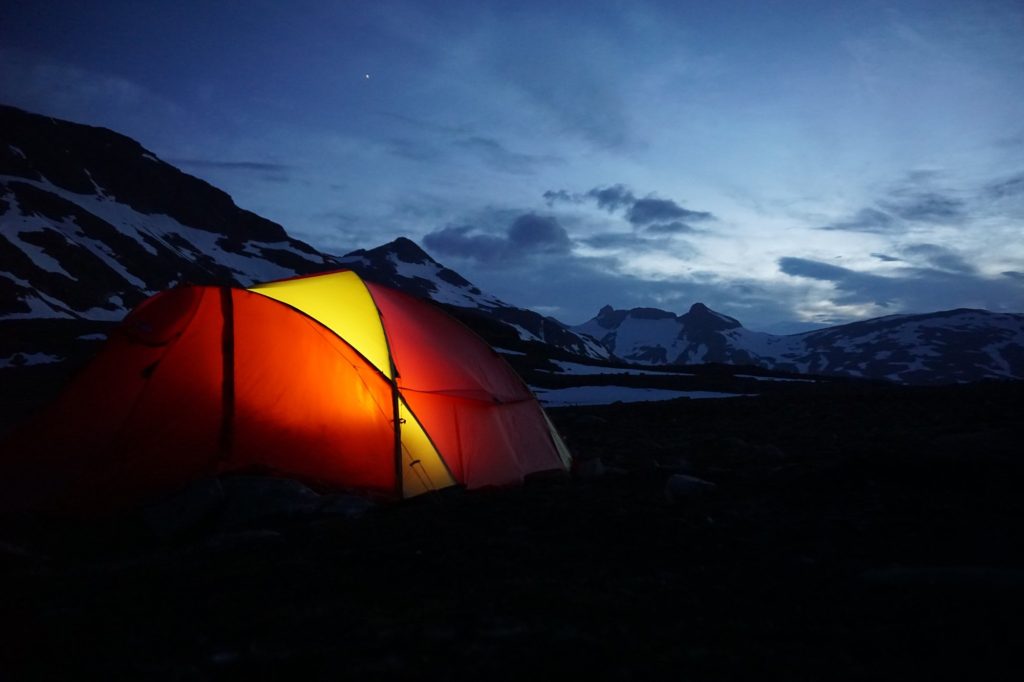

- The allemannsretten (right to roam) lets you pitch a tent in forests, mountains and along the coast, at least 150 m from an inhabited house or cabin. Without permission you stay no more than 2 nights in the same place; in the high mountains it may be longer. On farmyards, fields and meadows you camp only with permission.
- The right does not cover motor vehicles: you may not drive into nature to camp. What you may do by car, you can read in our guide to legal off-road driving in Europe.
- In nature reserves and national parks the protection rules can ban camping or fires. In busy parts of Lofoten and Fjord Norway, Visit Norway recommends campsites.
- Fire: from 15 April to 15 September no fires in or near forests and open country without the municipality’s permission, disposable barbecues included. Official fireplaces (via UT.no) are fine. Many protected areas ban fires all year, and in dry spells the municipality can ban everything.
More on Norway, with routes and seasons: driving in Norway.
United Kingdom
- Scotland: the Scottish Outdoor Access Code allows lightweight camping with a tent: in small numbers, no more than two or three nights in one place, well away from buildings and roads. The right does not cover motor vehicles.
- Loch Lomond & The Trossachs: from 1 March to 30 September you need a permit in the camping management zones: £4.50 per tent per night, up to 3 nights per permit area, bookable up to 4 weeks ahead.
- These rules are under review. The Park Authority Board considers the proposals between December 2026 and February 2027, they go to Scottish Ministers by 1 March 2027 and any changes apply from 1 March 2028 at the earliest. Proposals include allowing fires only in a metal container off the ground, and keeping the same zones and dates. As of 24 November 2026 no decision had been taken.
- Cairngorms: since 2026 a fire ban applies every year from 1 April to 30 September, including wood and charcoal barbecues. Gas and meths stoves are allowed. Fine up to £500.
- Fire elsewhere in Scotland: no open fires in dry weather, and never near forests, peaty ground or buildings.
- England and Wales: only with the landowner’s permission. The exception is backpack camping in designated areas on Dartmoor, upheld by the Supreme Court in 2025.
More on Scotland, with routes and seasons: driving in Scotland.
Fire and season: the fixed dates
- 1 March – 30 June: doubled fine for camping in a Walloon forest.
- 1 March – 30 September: permit needed in the Loch Lomond zones.
- 1 March – 31 October: smoking ban in the forest in Baden-Württemberg.
- 1 April – 30 September: fire ban in the Cairngorms National Park.
- 15 April – 15 September: general fire ban in the Norwegian countryside.
- Usually 1 July – 30 September: the período crítico in Portugal; the government can extend it.
In dry spells, authorities can always add extra bans, such as Swiss cantons, Norwegian municipalities and French prefects.
Practical tips
- Leave the car on the road. Driving off-road is banned in all ten countries. Park legally and walk the last stretch.
- Ask the landowner. Permission opens doors almost everywhere. Networks such as Welcome to my Garden (Belgium), Schau aufs Land (Austria, tents included) and Wild With Consent (UK) can help.
- Start with a bivouac zone or a German Trekkingplatz: a simple, legal way in.
- Check the fire risk on the day itself, and bring a stove instead of counting on a campfire.
Leave No Trace
Wild camping only stays possible as long as campers leave little behind. Arrive late, leave early and stay no longer than the rules allow. Take all your rubbish with you, food scraps and toilet paper included. Urinate at least 30 m from lochs, lakes and rivers, as the Scottish Access Code advises. Leave deadwood where it lies and keep your distance from houses, livestock and wildlife. This is not a detail: the review of the Loch Lomond rules explicitly covers litter, fires and toileting.
Frequently asked questions
Where is wild camping most freely allowed?
Of these ten countries, in Norway and Scotland. There a right of access lets you pitch a tent in nature, with conditions on distance and number of nights. At Loch Lomond you do need a permit in summer.
Can I pitch my tent next to my car?
Usually not. Rights of access do not cover motor vehicles, and a tent in a car park counts as camping on the public road. If you want to sleep by your car, read the rules on our page about sleeping in your car or roof tent.
What do I risk?
Usually a fine. Confirmed examples: €25 to €100 in a Walloon forest, up to €350 in a Brussels park, €150 to €200 in Portugal, up to €600 in Tyrol and Extremadura, and up to €10,000 in the city of Salzburg.
Can I light a campfire?
Rarely without restrictions. Fires in and near forests are banned almost everywhere, and Norway, the Cairngorms and Portugal add extra bans in summer. Use an official fireplace or a stove.
Official sources
- Belgium: Natuur en Bos – bivouac zones (Dutch), Codex Vlaanderen – Forest Decree (Dutch), Vlaanderen.be – lighting fires (Dutch), Wallex – Code forestier (French)
- France: Banque des Territoires – camping sauvage, Parc national des Écrins – bivouac order 2026, Feux de forêt – emploi du feu
- Germany: Brandenburg – Forest Act, Baden-Württemberg – barbecues in the forest, DAV – Zelt-Trekking
- Switzerland: TCS – Wild campen in der Schweiz, Swiss National Park – protection regulations
- Austria: oesterreich.gv.at – Campen, oesterreich.gv.at – Feuer machen, Salzburg Camping Act § 15
- Italy: no official national overview found; check the region or park. Secondary: Bergwelten – Wildcampen in Italien (German)
- Spain: BOE – Extremadura tourism act, Cantabria – Decreto 35/2026, Basque Country – Decreto 396/2013
- Portugal: Decreto-Lei 310/2002, Peneda-Gerês – regulations
- Norway: Miljødirektoratet – right to roam, Statsforvalteren – fire rules
- United Kingdom: Scottish Outdoor Access Code – camping, Loch Lomond & The Trossachs – permits, Loch Lomond & The Trossachs – byelaws review, Cairngorms – fire byelaw