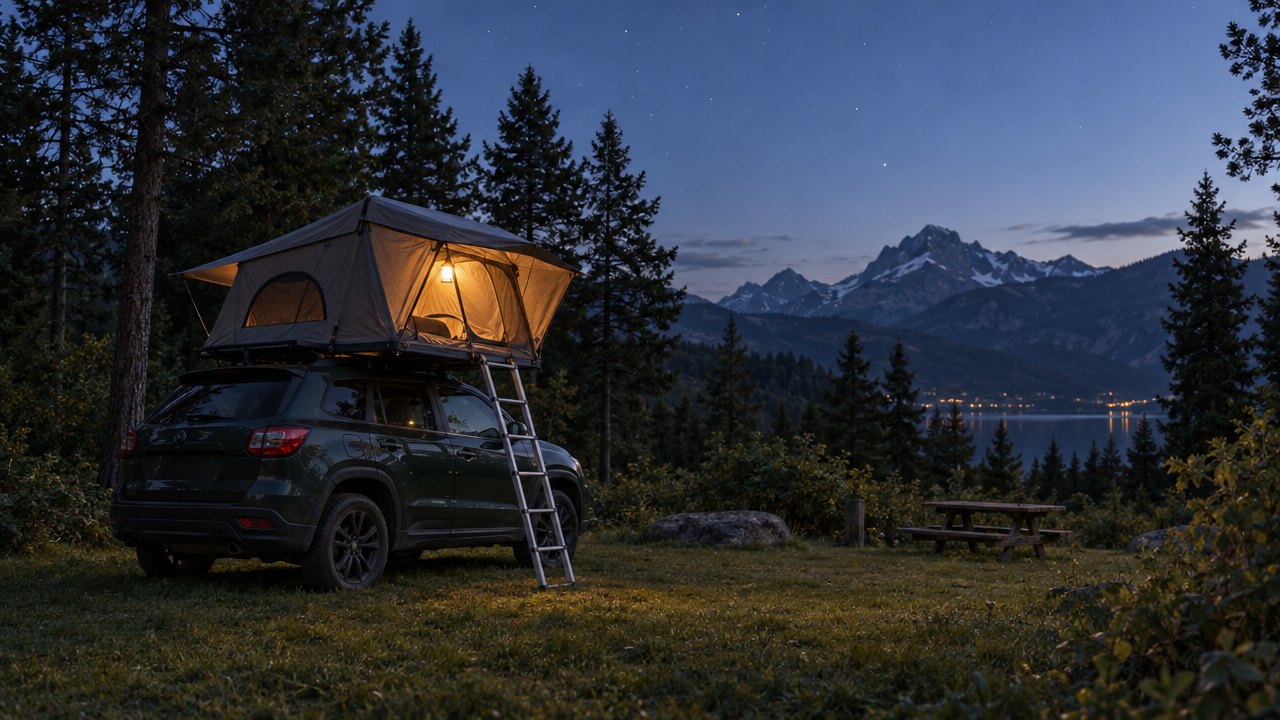
Image above: AI-generated mood image, not a real place.
Fold the seats down, close the curtain and carry on at first light: sleeping in your car is the essence of a road trip. But is it allowed? Almost everywhere in Europe the same rule of thumb applies: parking is fine, camping is not. The difference lies in what you put outside your vehicle. The roof tent is the big grey area. Below you can read, country by country, what applies, what we do not know for sure, and where you are sure to be legal.
Last checked on 24 November 2026. Rules often differ by region or municipality: always check the signs on site.
The rule of thumb: parking or camping?
In most countries you may sleep in a legally parked vehicle, as long as you do nothing that looks like camping. This counts as camping behaviour almost everywhere:
- rolling out an awning, or putting a table and chairs outside;
- lowering stabiliser legs or putting your vehicle on levelling blocks (wheel chocks are tolerated in Spain);
- cooking outside;
- emptying water or waste;
- taking up more space than your closed vehicle.
Spain’s traffic authority DGT puts it most clearly: you are parked as long as your vehicle touches the ground only with its wheels, takes up no more space than when closed, and emits nothing. Italy uses the same criteria.
The roof tent: a grey area
Most laws say nothing about roof tents. Across ten countries we found a clear rule in only a few cases:
- Scotland: the Highland Council and the Cairngorms National Park treat a roof tent as a motor vehicle, not as a tent. So the rules for campervans apply.
- Norway: allowed, as long as the car stands on the road or a lay-by and not in the open terrain.
- Tyrol: banned outside campsites and designated zones, also in a car or roof tent.
- Italy: an unfolded roof tent counts as camping.
In Belgium, France, Germany, Switzerland, Spain and Portugal the rules say nothing about it. From the definition of camping, though, it follows that a roof tent that unfolds beyond the outline of your car probably counts as camping. That is our interpretation, not a written rule. To be safe, pitch your roof tent at a campsite, a motorhome area that accepts roof tents, or a farm stay.
At a glance by country
| Country | Sleeping in a car or campervan | Roof tent |
|---|---|---|
| Belgium | Differs by region and municipality; Brussels max. 24 h | No rule (probably camping) |
| France | Allowed without camping behaviour, max. 7 days in the same spot | No rule (probably camping) |
| Germany | One night to rest, without camping behaviour | No rule (probably camping) |
| Switzerland | By canton and municipality | The TCS counts it as wild camping |
| Austria | By state; banned in Vienna and Tyrol | Banned in Tyrol, unclear elsewhere |
| Italy | Allowed as long as your vehicle stands only on its wheels | Counts as camping |
| Spain | Allowed; municipalities can ban camping | Probably camping if it unfolds beyond the outline |
| Portugal | Registered campervans max. 48 h per municipality | No rule |
| Norway | By the road, at least 150 m from houses, max. 2 nights | Allowed on the road or a lay-by |
| United Kingdom | Scotland: lay-bys, with nothing set up outside | Scotland: counts as a vehicle |
The rules by country
Belgium
- Flanders: there is no regional rule. You may sleep in your car if you are legally parked, unless the municipality bans it. Ghent, for example, bans overnight stays in a motorhome on the public road.
- Wallonia: camping on the public road is banned, except at motorhome areas. In the forest you may only stay at designated aires. The fine is €25 to €100, doubled at night, in a group, between 1 March and 30 June and in protected areas.
- Brussels: in all 19 municipalities you may stay in a vehicle on public space for 24 hours at most. Camping in parks and green spaces is banned, with an administrative fine of up to €350.
- For a tent in nature there are bivouac zones. In Flanders you book them for free via Natuur en Bos.
More on Belgium, with routes and seasons: driving in Belgium.
France
- No traffic rule bans sleeping in your car. A campervan may park wherever a car may. As soon as you put a table, chairs, awning or stabilisers outside, you are camping.
- You may stay in the same spot on the public road for 7 days in a row at most.
- Municipalities may only ban campervans with a reasoned decision limited in time and space. A general ban for the whole municipality is not allowed.
- On Corsica, overnight stays in a car or campervan outside designated zones are banned from 10 pm to 6 am.
- Legal alternative: the aires de service for motorhomes, and France Passion, a network of some 2,200 farmers and winegrowers where you may stay for up to 24 hours.
More on France, with routes and seasons: driving in France.
Germany
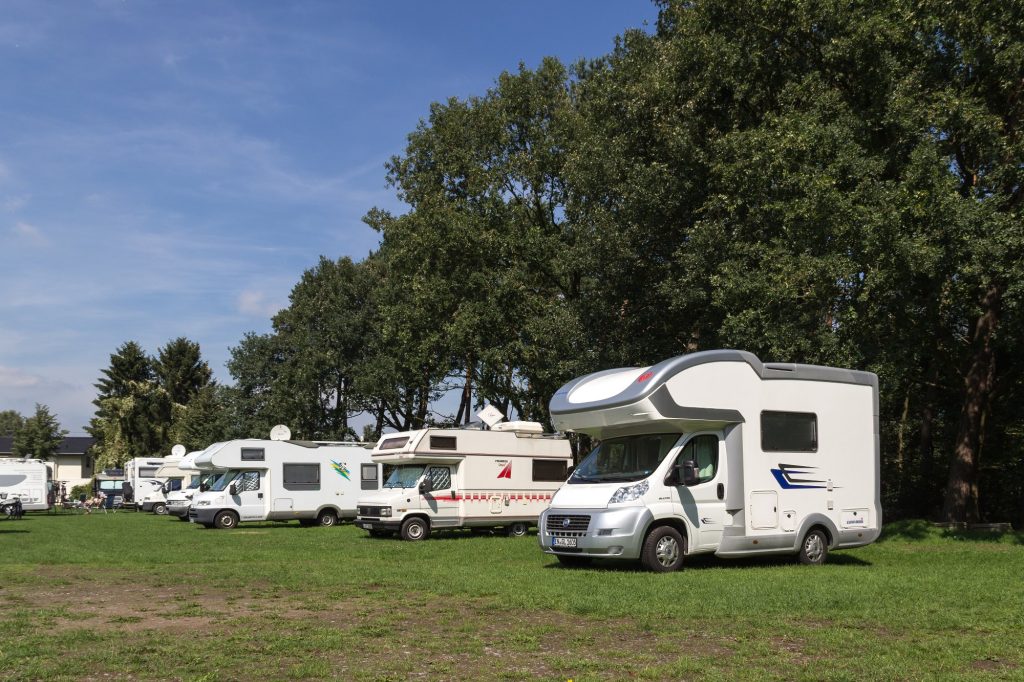

- You may sleep one night in a public car park or by the road to become fit to drive again (Wiederherstellung der Fahrtüchtigkeit), unless a sign bans it. The well-known “10-hour rule” is not in any law.
- Your vehicle must always be ready to leave: no awning, chairs, levelling blocks or lowered legs.
- Overnight stays are banned in nature reserves and national parks. Supermarket car parks are private property.
- An unfolded roof tent means your vehicle is not ready to leave. Use a Stellplatz or campsite for that.
More on Germany, with routes and seasons: driving in Germany.
Switzerland
- There is no national rule: the canton and municipality decide. Your vehicle must fit within a parking bay, and camping behaviour is not allowed.
- A few examples: in Aargau you may stay one night in a public car park unless a sign bans it, in Ticino not at rest areas and car parks, in Fribourg only at official motorhome areas, and in Geneva not without a permit.
- In the Swiss National Park, staying the whole night in a car park costs CHF 150.
- The TCS counts staying overnight with a roof tent outside a campsite as wild camping, and says Stellplätze are not meant for roof tents.
More on Switzerland, with routes and seasons: driving in Switzerland.
Austria
- Each state decides for itself, and a general “one night to rest” rule does not exist in Austria.
- Banned: in Vienna, even in an ordinary car, and in Tyrol, also in a car or roof tent (except in zones the municipality opens up). In the city of Salzburg, camping in public places is banned, with fines of up to €10,000.
- Allowed unless the municipality bans it: Upper Austria and the rest of Salzburg. Local bans are possible in Vorarlberg; Styria has no rule.
- Unclear: in Carinthia and Burgenland you may park briefly, but whether a whole night still counts as brief is not stated anywhere. In Lower Austria there is a ban in the open countryside, and municipalities can ban camping (fine up to €7,300).
- Staying overnight in the forest is banned everywhere without the owner’s permission.
- Legal alternative: Schau aufs Land, a network of some 900 farms where you may stay for up to 24 hours, roof tents included.
More on Austria, with routes and seasons: driving in Austria.
Italy
- Under article 185 of the highway code, a campervan is parked as long as it stands only on its wheels, emits nothing and stays within its outline. Legs, an awning, chairs or an unfolded roof tent turn it into camping.
- At motorway service areas you may stay for 24 hours at most (fine €42 to €173).
- In South Tyrol the municipalities regulate it, using the same criteria. A total ban in Selva/Wolkenstein was overturned by the court in April 2026.
- In Trentino you may stay at the aree di sosta for 48 hours at most, without awning, chairs or blocks.
More on Italy, with routes and seasons: driving in Italy.
Spain
- A campervan may park like any other vehicle. Municipalities can limit parking time and ban camping on the public road.
- You are camping as soon as you use an awning, open windows outward, put out tables or chairs, cook outside or empty water. A pop-up roof that stays within the vehicle’s outline is fine.
- At motorhome areas the maximum stay differs by region, for example 48 hours in Cantabria and 72 hours in Extremadura.
- In the Bardenas Reales, overnight stays are banned everywhere, campervans included.
More on Spain, with routes and seasons: driving in Spain.
Portugal
- The 2021 campervan law only applies to vehicles officially registered as campervans. They may stay overnight (between 10 pm and 7 am) in the same municipality for 48 hours at most, outside protected areas, Natura 2000 and coastal zones. Fines: €60 to €300, €120 to €600 in protected areas.
- An ordinary car or an unconverted van falls outside that law. There is no national rule for simply sleeping in a car; the municipality decides.
- At motorhome service areas (ASA) you may stay for 72 hours at most, without unpacking anything.
- A tent outside a campsite always requires a permit from the municipality.
More on Portugal, with routes and seasons: driving in Portugal.
Norway
- The right to roam (allemannsretten) does not cover motor vehicles: you may not drive into nature to camp.
- By the road or in a lay-by you may stay overnight, at least 150 metres from an inhabited house and for 2 nights at most. Car parks usually have a 48-hour limit, rest areas usually one day.
- A roof tent is allowed, as long as the car stands on the road or a lay-by.
- Local restrictions may apply in busy parts of Lofoten and Fjord Norway.
More on Norway, with routes and seasons: driving in Norway.
United Kingdom
- Scotland: the well-known right to wild camp covers tents, not motor vehicles. In official lay-bys you may rest overnight, as long as everything stays inside the vehicle.
- With the Highland Campervan Scheme (£40 for 7 days) you may stay from 10 pm to 8 am at 12 designated car parks, including in Ullapool, Durness and Gairloch.
- In Loch Lomond & The Trossachs you need a permit in the camping management zones from 1 March to 30 September (£4.50 per night). Lay-bys there are for short breaks only.
- In Scotland a roof tent counts as a vehicle, so the campervan rules apply.
- England and Wales: staying overnight outside a campsite is only possible with the landowner’s permission.
More on Scotland, with routes and seasons: driving in Scotland.
Where are you sure to be legal?
- Campsites: the safest choice everywhere, and the only place where a roof tent is never in question.
- Motorhome areas: aires de service (France), Stellplätze (Germany), áreas de autocaravanas (Spain), aree di sosta (Italy). Check whether roof tents are welcome.
- Farm networks: France Passion in France and Schau aufs Land in Austria and surroundings.
- Apps: Park4Night and CamperContact show motorhome areas, rest areas and private spots.
- Special schemes: the Highland Campervan Scheme and Stay the Night at forest car parks of Forestry and Land Scotland.
Pitching a tent outside a campsite falls under other rules: see wild camping in Europe. For gravel roads and unpaved routes to your spot, read legal off-road driving in Europe.
Frequently asked questions
Can I sleep at a motorway service area?
In Germany you may rest there for one night, in Italy you may stay for 24 hours at most. In France, motoring clubs recommend motorway rest areas as a place to sleep. Never put anything outside your vehicle.
Does it matter whether I travel by car or campervan?
Sometimes it does. In Portugal the 48-hour rule only applies to officially registered campervans, while in Vienna the ban also covers ordinary cars. So read what applies in each country.
What do I risk?
Usually a fine. Some examples: €25 to €100 in a Walloon forest, up to €350 in Brussels, €42 to €173 at an Italian motorway service area, and up to €10,000 in the city of Salzburg.
Official sources
- Belgium: Natuur en Bos – bivouac zones (Dutch), City of Brussels – parking camper vans
- France: Roole – dormir dans sa voiture
- Germany: promobil – Wohnmobil parken und übernachten
- Switzerland: TCS – Wild campen in der Schweiz
- Austria: oesterreich.gv.at – Campen
- Italy: Codice della Strada, art. 185
- Spain: DGT – motorhome instruction (2026)
- Norway: Miljødirektoratet – right to roam
- Scotland: Highland Council – Campervan and Motorhome Scheme, Loch Lomond & The Trossachs – motorhomes