Image above: AI-generated mood image, not a real place.
A gravel road along a mountain ridge, a dusty track across a semi-desert: for many road trippers, a stretch of unpaved road is the highlight of the trip. But where can you legally take your car off the tarmac? The honest answer: driving off the road is banned in all ten countries. The difference lies in which unpaved roads are legally open. Below you will find, country by country, what is allowed, what it costs and when it is open.
Last checked on 24 November 2026. Rules, fees and opening days change every year: check the official source listed at the bottom just before you leave.
The basic rule: only on roads that are open
Everywhere in Europe, a motor vehicle belongs on a road that is open to traffic. Almost everywhere, these places are closed too, even if there is a track:
- forests and forest roads, unless they have been expressly opened;
- footpaths, bridleways and firebreaks;
- beaches and dunes;
- private roads without the owner’s permission.
A road on a map or a GPX track does not prove that you may drive there. Both the French environment administration and the Lake District National Park stress this. What counts is what applies on the spot.
Ordinary car or 4×4?
You do not need an off-roader for everything. Many legal options are gravel and mountain roads meant for ordinary cars: the chemins ruraux in France, the Norwegian mountain toll roads, the Gasterntal in Switzerland and the strade bianche in Tuscany.
You need a 4×4 or an SUV with enough ground clearance for off-road parks and training courses (the Swiss TCS asks for at least 20 cm), and for rougher tracks. In doubt, choose an off-road park or a guided tour.
At a glance: the rules by country
| Country | Off the road | What is allowed | Watch out |
|---|---|---|---|
| Belgium | Banned in forests and nature areas | Wallonia: organised drives on temporarily waymarked routes | No public list of 4×4 sites |
| France | Banned, up to €1,500 | Public roads and chemins ruraux, unless closed | Col du Parpaillon tunnel closed since 2023 |
| Germany | Banned, forest roads included | Off-road parks, training and events | Parks often open on selected weekends only |
| Switzerland | Forests banned, CHF 100 | Gasterntal gravel road (CHF 20 a day), TCS training | Gasterntal open in summer only |
| Austria | Forest roads only with permission | Sites such as Stotzing and the Red Bull Ring | Many gravel roads have a barrier |
| Italy | Forest and alpine pasture roads banned unless the region opens them | Strade bianche, paid military mountain roads | Mountain roads open in summer and autumn only |
| Spain | Banned, from €100 | By region: Aragón, Catalonia; Bardenas Reales; Les Comes | Andalusia: forest tracks closed by default |
| Portugal | Protected areas: existing roads only | No national ban on unpaved public roads found (not confirmed) | Forest roads close in high fire risk |
| Norway | Banned, forest and tractor roads included | Private mountain toll roads | Usually May/June to October/November |
| United Kingdom | Banned without vehicular rights | England and Wales: green lanes; Scotland: private land only | Local closures |
The rules by country
Belgium
- Flanders: recreational motor vehicles are not allowed in forests and nature areas.
- Unpaved municipal roads: we found no general ban on driving them outside forests and nature areas. A ban can still come from a road sign or a municipal regulation. That it is “therefore allowed everywhere” is something we cannot confirm: check the sign and the municipality’s rules.
- Wallonia: in forests you may only drive on paved roads, not on chemins (earth or gravel) or sentiers. For an offence, the Walloon authorities can propose a settlement of €50 to €150.
- The legal way in: temporarily waymarked routes, marked with an official sign showing a date and an authorisation number. An organiser applies at least 45 days in advance to the Walloon forest service, and the municipality and the landowners must agree too. For you, that means joining an organised drive.
- Off-road sites: there is no public list of approved 4×4 sites. What we did find: a club weekend by the Land Rover Club Adventures in 2025, on a rented site in Bertrix.
More on Belgium, with routes and seasons: driving in Belgium.
France
- Motor vehicles may only use roads open to public traffic. Driving off the road can cost up to €1,500, and you also risk immobilisation of the vehicle, suspension of your licence or confiscation.
- Open: public roads and chemins ruraux, unless they are closed. An unpaved road that is wide and passable enough for an ordinary passenger car counts as open.
- Closed: footpaths, fire service tracks (DFCI), towpaths and dykes, tracks that have formed on their own, private roads without permission, and driving among the trees.
- Closures: the mayor or the prefect closes a road by decree and with sign B7b. We found no public map of open roads in any department; in doubt, ask at the mairie.
- Well-known tracks: the Col du Parpaillon tunnel has been closed since the storm damage of 2023, with a ban in place since 12 July 2024; no reopening has been announced. The track to Saleccia (Corsica) ends at a paid car park (€6 per car under the 2023 arrangement); once it is full, no more vehicles may go down. We did not find the arrangement for 2026.
- Organised: 4×4 courses with an instructor, and guided drives at the Salon du Tout-Terrain et du Voyage in Valloire.
More on France, with routes and seasons: driving in France.
Germany
- Under the forest laws of the federal states, driving a car on forest roads is banned without a permit. In Brandenburg the fine can reach €20,000.
- In practice, legal off-road driving is only possible at off-road parks, training courses and events. Some parks where you can bring your own vehicle, at 2026 prices:
- Böser Wolf, Knüllwald (Hesse, on the A7): €35 per vehicle per day, €60 per weekend, camping €13 per person per night. Open on selected weekends; a roof or roll bar and liability insurance are mandatory. Winter break until 26 March 2027.
- Karenz and Steinhagen (Mecklenburg-Western Pomerania): €40 and €20 a day with your own vehicle.
- Training and events: Bilster Berg (training in your own car), Offroad am Nürburgring and the ADAC Offroad Event in Malente, with a roadbook drive on gravel roads.
More on Germany, with routes and seasons: driving in Germany.
Switzerland
- Forests are off limits to motor vehicles. The fixed fine is CHF 100, and up to CHF 20,000 in ordinary criminal proceedings. Cantons only grant permits for a good reason, and recreation is not one of them.
- Gasterntal (Kandersteg): a private gravel road for CHF 20 a day, paid at the ticket machine or via PayByPhone (annual permit CHF 60). Through the gorge, traffic is one-way in time slots every hour. Open in summer, roughly from mid-May to mid-November.
- TCS: from 1 January 2027 the courses are called Offroad Standard and Advanced (6 hours, in your own off-roader or SUV). Offroad Expert takes place at Offroadpark Geisingen, just across the German border. Note: your vehicle is not insured through the TCS during the course.
- Roadbook drive: the TCS Jura section organises the yearly “Aventure 4×4” for your own registered 4×4.
More on Switzerland, with routes and seasons: driving in Switzerland.
Austria
- On a forest road (Forststraße) you may only drive with the permission of the owner or whoever maintains the road. For the public, that permission usually shows from a sign. In practice, many gravel roads have a no-entry sign or a barrier.
- Driving on a clearly closed forest road can cost up to €730, and up to €3,630 in serious cases.
- In Carinthia, driving off roads and car parks is expressly banned.
- Off-road sites: the ÖAMTC Offroad Zentrum Stotzing in Burgenland (always with an instructor), SUV courses in your own car at the ÖAMTC centres, and the Red Bull Ring in Spielberg. There you can drive your own 4×4 freely from €132 for 3 hours. No 2027 dates are listed yet.
More on Austria, with routes and seasons: driving in Austria.
Italy
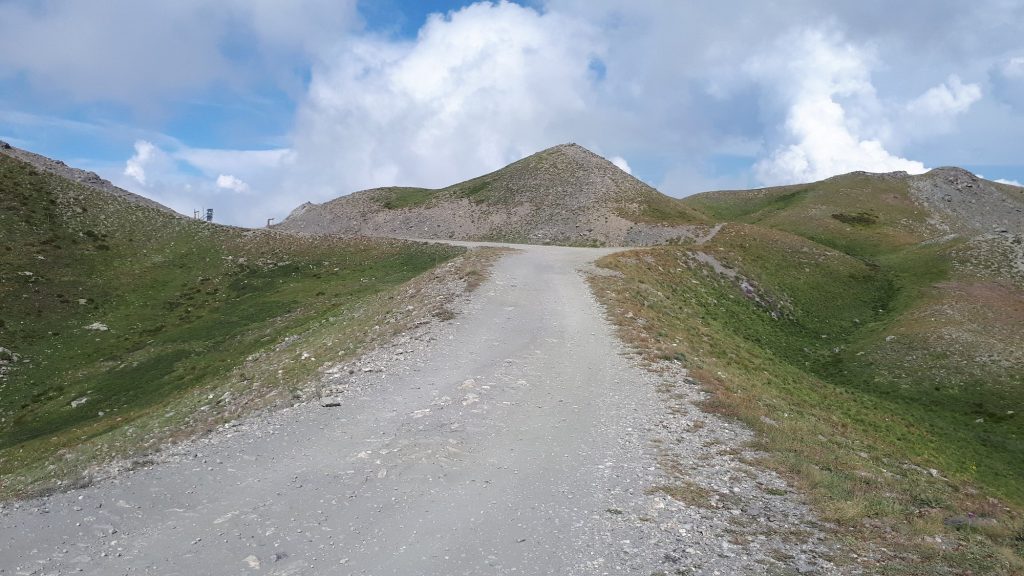

- A 2021 ministerial decree bans ordinary traffic on forest and alpine pasture roads; the regions decide on exceptions. A “2.5-metre rule” on path width does not appear in the decree.
- The regions are strict: Piedmont, Veneto (fine €100 to €1,000), Trentino and Tuscany ban paths, forest roads or firebreaks, among others. In South Tyrol, paths not suitable for an ordinary two-wheel-drive car are banned.
- What is allowed: public gravel roads such as the strade bianche in Tuscany, routes that have been expressly opened, and a few paid military mountain roads in Piedmont.
- Alta Via del Sale (Limone Piemonte–Monesi): in 2026 a day ticket of €20 per car. Closed to motor vehicles on Tuesdays and Thursdays, maximum 20 km/h, and no wider than 2.3 m or heavier than 3.5 t. Campervans, caravans, buses, trailers and noisy vehicles are not allowed, and your vehicle may be at most 2.5 m high and 5.5 m long.
- Strada dei Cannoni (Valle Maira): paid since 2026. Motor vehicles only on Tuesdays and Thursdays, from 6 am to 9 pm, with a mandatory online ticket of €20 per car. The Valle Maira tourism site states the days the other way round; follow the official site.
- Strada dell’Assietta: no ticket mentioned. Maximum 30 km/h, no wider than 2 m. In July and August closed to motor vehicles on Wednesdays and Saturdays from 9 am to 5 pm.
- Handy: the Alta Via del Sale is closed on exactly the days the Strada dei Cannoni is open.
- Sleeping in your car after the drive? In South Tyrol that does not automatically count as wild camping. A German news site claimed it does, but we found no legal basis for it. More in our guide to sleeping in your car, campervan or roof tent.
More on Italy, with routes and seasons: driving in Italy.
Spain
- Nationally, driving cross-country is an offence (Ley de Montes, art. 67 k), from €100. The regions set the conditions for forest tracks.
- The well-known rule “tracks at least 4 metres wide” does not apply throughout Spain, only in Catalonia.
- Catalonia: outside specially protected areas, on paved tracks or tracks at least 4 metres wide, at no more than 30 km/h. In protected areas only on designated tracks, with at most 4 cars together.
- Aragón: on tracks in public forests that are open to general traffic, you need no permit, with at most 5 vehicles in convoy and 30 km/h. Other tracks and organised routes require a permit.
- Andalusia: since the forest law of April 2026, forest tracks in public forests are closed to recreational traffic by default, unless they have been expressly opened.
- Navarre and Madrid: not confirmed. The Navarre forest law can be read as a general ban in public forests, but that cannot be confirmed. For Madrid we found no clear rules on public forest tracks.
- Bardenas Reales (Navarre): only on the signposted tracks, at no more than 40 km/h and with at most 4 vehicles together. Overnight stays and camping are banned throughout, in a campervan too, as are drones and fires. Open from 8 am until one hour before sunset.
- Check the notices on the Bardenas website before you go: in late November 2026 the access via El Paso was closed after heavy rain.
- Sites and tours: Les Comes near Barcelona, a Land Rover Experience centre with more than 60 km of tracks (courses from €300), and guided 4×4 drives by Terranatur in Madrid.
More on Spain, with routes and seasons: driving in Spain.
Portugal
- We found no national ban on unpaved public roads. Our reading of the highway code is that you may simply drive them, but we have no confirmation from the nature agency ICNF or the GNR police. So this is not officially confirmed.
- Protected areas: recreational off-roading only on existing roads and paths, organised drives only with permission. The fine is still stated in escudos, roughly €250 to €2,500 (our conversion).
- Beaches and dunes are off limits outside access roads and car parks. In Peneda-Gerês, only approved operators may drive unpaved roads in certain zones, with ICNF permission.
- Fire risk: at danger level “muito elevado” or “máximo”, public forest areas and forest roads are off limits. The Trans Euro Trail advises riding in Portugal from October to May.
- If you want to be sure, book a tour with a registered and insured operator.
More on Portugal, with routes and seasons: driving in Portugal.
Norway
- Driving in the countryside (utmark) is banned. Forest and tractor roads not built for ordinary cars count as countryside too. A new law was sanctioned in June 2026 but is not yet in force; the ban remains.
- Private roads may be used unless a sign or barrier forbids it, and on a toll road (bomvei) you drive for a fee. The toll roads below are open to ordinary cars. Whether the surface is gravel is usually not stated.
- Peer Gynt Vegen: 57 km in two toll sections of NOK 95 and NOK 85 per car. Open in summer, normally from early June.
- Jotunheimvegen: 45 km from Skåbu to Bygdin, NOK 120 per passage. Closed since 12 November 2026, usually until early June.
- Aursjøvegen: a narrow gravel road, not recommended for caravans and large campervans, open from June until the first snow. Tindevegen (32 km) is open from early May to November; Grimsdalen can close at night for crossing wild reindeer.
- Two common mistakes: Tyin–Eidsbugarden is county road fv 252, not a private toll road. And Mjølkevegen is a cycle route, not a gravel route for cars.
More on Norway, with routes and seasons: driving in Norway.
United Kingdom
- England and Wales: you may only drive on routes with vehicular rights. On a BOAT (Byway Open to All Traffic) you may; on a UCR (unclassified county road) the right is presumed, but check it. A green dotted line on an OS map is not a right to drive.
- Banned: footpaths, bridleways and restricted byways, as well as moorland, dunes and beaches.
- Routes can be closed by a traffic regulation order: in the Lake District, Rusland Pool is closed from 1 October to 31 May. You can find routes through TrailWise2 by the Green Lane Association (GLASS).
- Scotland: the well-known right of access does not cover motor vehicles. Driving off the road is only allowed with the landowner’s express permission, and in case of nuisance the police can seize your vehicle. Off-road driving there means private land, for example at the Land Rover Experience near Dunkeld.
More on Scotland, with routes and seasons: driving in Scotland.
Seasons: what is open when?
The finest mountain roads are only open a few months a year. As a guide:
- Italy: in 2026 the Assietta was open from 1 July to 31 October and the Strada dei Cannoni from 5 July to 31 October. In 2026 the Alta Via del Sale was open to motor vehicles from 20 June to 18 October (the third Saturday in June to the third Sunday in October) and has been closed since 4 November. The Assietta stays closed until 30 June 2027 at the earliest. Check the 2027 dates at altaviadelsale.it, stradadeicannoni.it and the Città metropolitana di Torino.
- Switzerland: the Gasterntal is open from roughly mid-May to mid-November. Check the 2027 dates at gasterntal.ch.
- Norway: the toll roads open between May and June and close in October or November. Check the 2027 dates with the road operator.
- Germany: check the 2027 dates with the park; Knüllwald has a winter break until 26 March.
- Spain and Portugal: in summer, forest roads can close because of fire risk.
Practical tips and etiquette
Our practical summary of the rules and codes of conduct above. It is not legal advice: rules change, so check the official source before you leave.
- Stay on the track. Do not create new tracks and do not drive over verges or vegetation, not even to avoid a muddy patch.
- Drive slowly and keep to the limits (20 to 40 km/h on the roads above). Slow down for walkers and cyclists, and switch off your engine when horses pass.
- Keep it quiet. No loud exhausts or music, and no night drives.
- Travel in small groups: at most 4 vehicles in the Bardenas, 5 in Aragón, and around 4 under the English green lane code.
- Respect every sign and every barrier, even if your GPX track runs straight through. Temporary closures for fire, rain or wildlife apply too.
- Private land only with permission. Greet residents and leave gates as you found them.
- Check your insurance for drives at an off-road site.
- Staying overnight after the drive: in nature this is allowed almost nowhere, and in the Bardenas not even in a campervan. Read our guide to wild camping in Europe.
Frequently asked questions
Can I take an unpaved road if there is no prohibition sign?
It depends on the country. In France usually yes, if it is a public road or chemin rural that an ordinary car can drive. In Flanders we found no general ban outside forests and nature areas. Forest roads are closed in Belgium, Germany and Switzerland, and in Austria you need permission.
Is a GPX track or a road on the map enough?
No. A map does not prove that a road is open, and the well-known Trans Euro Trail was made for motorbikes. What counts is the situation on the spot.
What do I risk if I drive off the road anyway?
A fine, and sometimes more: up to €1,500 and possible confiscation in France, a settlement of €50 to €150 in a Walloon forest, up to €20,000 in Brandenburg, CHF 100 in a Swiss forest and from €100 in Spain.
Official sources
- Belgium: Wallonie.be – Circuler en forêt (French), Wallonie.be – temporary waymarking (Dutch), Vlaanderen.be – visiting nature (Dutch)
- France: DREAL – circulation des véhicules motorisés, PNR Monts d’Ardèche – mémento
- Germany: Waldgesetz Brandenburg, Offroadpark Knüllwald – prices
- Switzerland: Gasterntal – Zufahrt, Forstamt Thurgau – Fahrverbote auf Waldstrassen, TCS – Offroad Standard
- Austria: oesterreich.gv.at – Betreten des Waldes, Red Bull Ring – free driving
- Italy: Gazzetta Ufficiale – DM 28/10/2021, Alta Via del Sale – terms, Strada dei Cannoni, Città metropolitana di Torino – Assietta
- Spain: BOE – Ley 43/2003 de Montes, BOE – Ley 3/2026 Andalucía, BOE – Montes de Aragón, Bardenas Reales – normativa
- Portugal: Diário da República – DL 218/95
- Norway: Miljødirektoratet – kjøre på barmark, Peer Gynt Vegen, Jotunheimvegen
- United Kingdom: Lake District – unsealed roads, ScotWays – motor vehicles