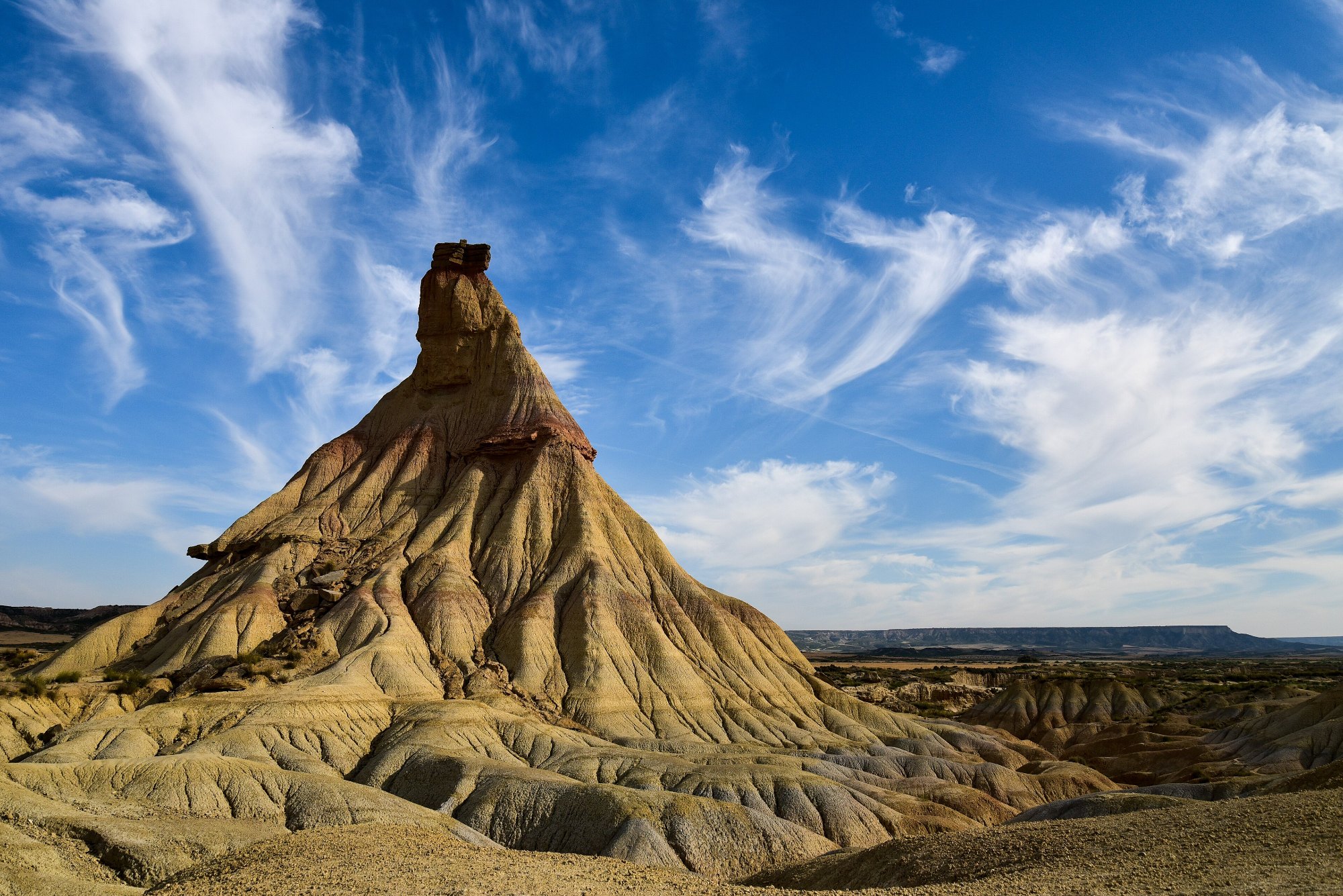
Photo above: Castildetierra in the Bardenas Reales. Ant°AM, Wikimedia Commons, CC BY-SA 4.0, cropped.

Spain is the country of the long drive south: first the Pyrenees and the green north coast, then high plateaus, white mountain villages and semi-deserts. You switch between motorways and winding national roads and, in a few places, legal tracks such as those in the Bardenas Reales. From Brussels, the north and the Pyrenees are two days’ drive away; for Andalusia, count on three.
- From BrusselsSan Sebastián in 11h55
- TollsNo vignette, tolls on some AP roads
- Motorway120 km/h
- Low-emission zonesZBE in more than 50 cities
On this page: Regions Road trip Rules When to go Food Questions
The best regions and routes for a road trip
Six places where the road itself is the reason to go, with the driving time from Brussels to a town nearby.
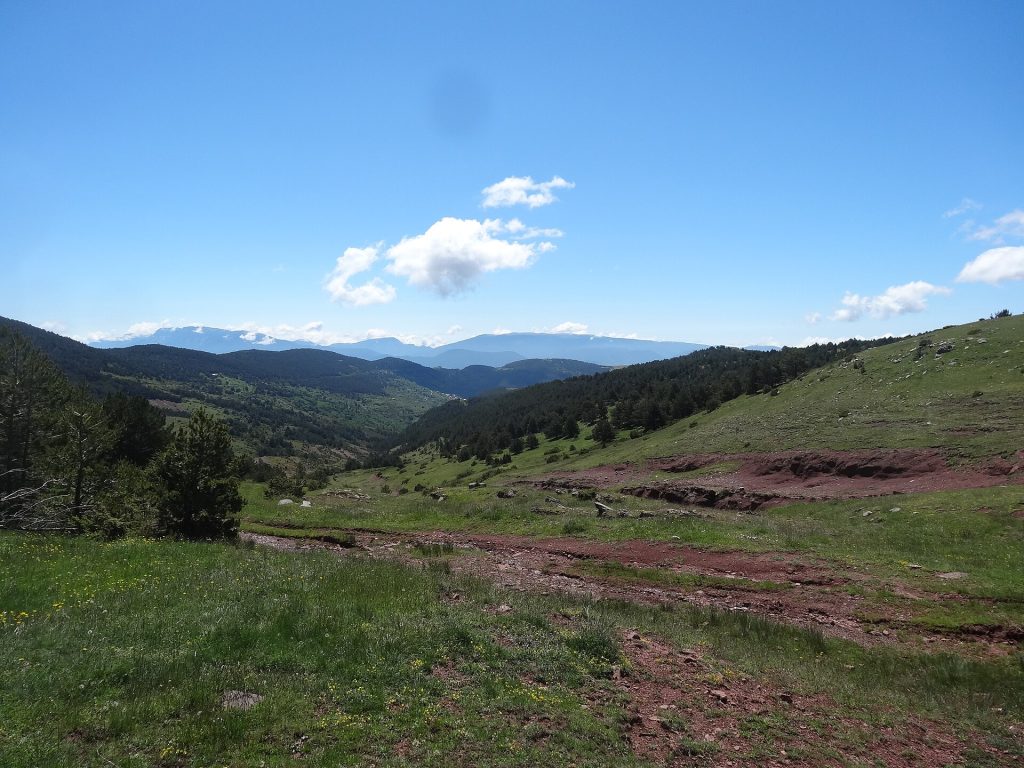

13h05
Eje Pirenaico: the N-260 through the Pyrenees
Some 490 km of Pyrenean road from Portbou to Sabiñánigo, over passes such as the Port de Cantó. Drive it from June to October.
More about this region
From Portbou on the Mediterranean via Puigcerdà, Sort and Aínsa to Sabiñánigo: some 490 km of Pyrenean road, over passes such as the Port de Cantó (1,725 m). Drive it from June to October. Girona is 13h05 from Brussels, Jaca in the Aragonese Pyrenees 13h25.
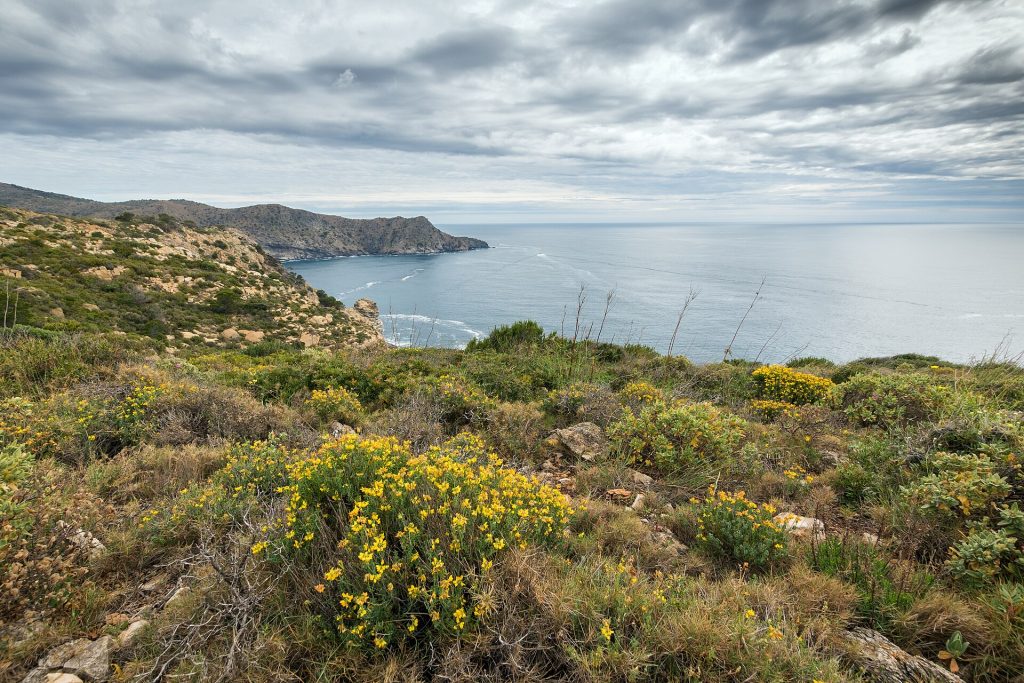

50 km
Cap de Creus
A short coastal drive of about 50 km via El Port de la Selva and Cadaqués to Roses. Go in spring or autumn.
More about this region
A short coastal drive also starts in Portbou: via El Port de la Selva and Cadaqués to Roses, about 50 km. The Cap de Creus natural park covers 13,855 ha, on land and at sea. Go in spring or autumn.
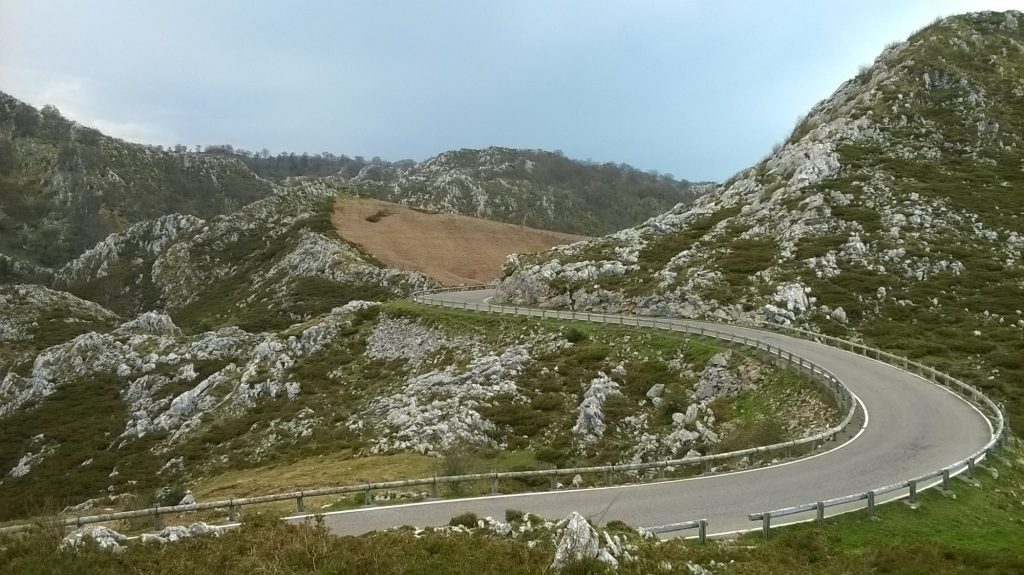

15h30
Picos de Europa
Some 105 km along the Cares gorge to the Fuente Dé cable car. The best period is May to October.
More about this region
From Cangas de Onís via Arenas de Cabrales and Potes to Fuente Dé: some 105 km along the Cares gorge, ending with the Fuente Dé cable car up to 1,823 m. The best period is May to October. The road to the Lagos de Covadonga is closed to private cars for about half the year, in the high season; then you take the bus from Cangas de Onís. Cangas de Onís is 15h30 away.

13h35
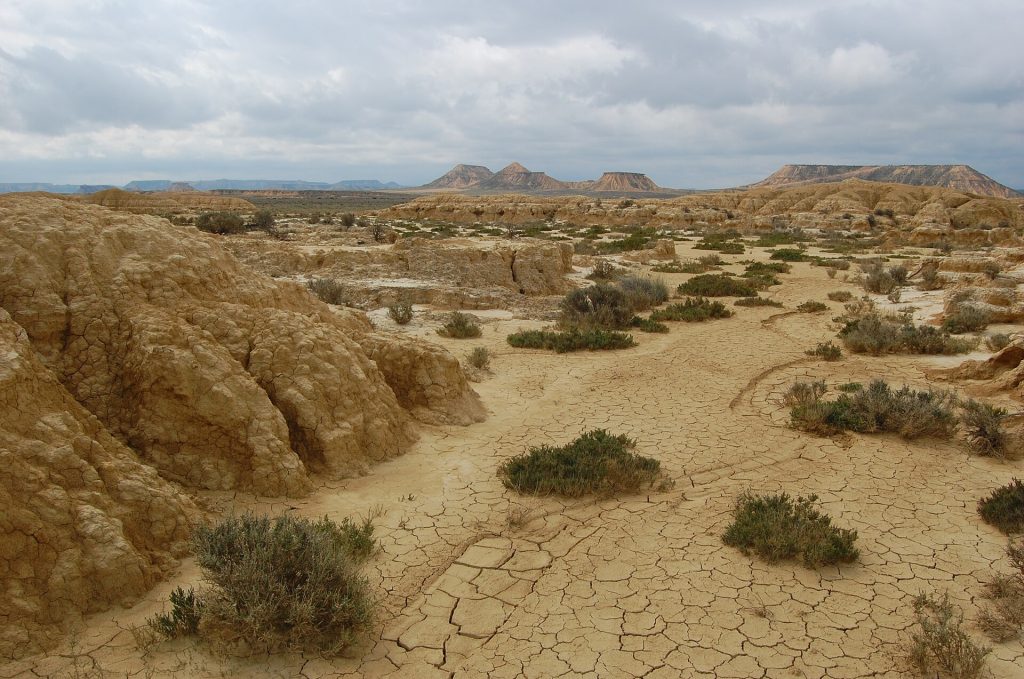
Bardenas Reales
A semi-desert you may legally enter in your own car: a 25 km loop track, at no more than 40 km/h.
More about this region
A semi-desert in Navarre that you may legally enter in your own car. The loop track from Arguedas is 25 km long and takes about two hours. You stay on the signposted tracks, at no more than 40 km/h and with at most 4 vehicles together. Overnight stays, fires and drones are banned, and the area is open from 8 am until one hour before sunset. Check the notices on the official website before you go: in late November 2026 the access via El Paso was closed after heavy rain. Arguedas is 13h35 away.

21h20
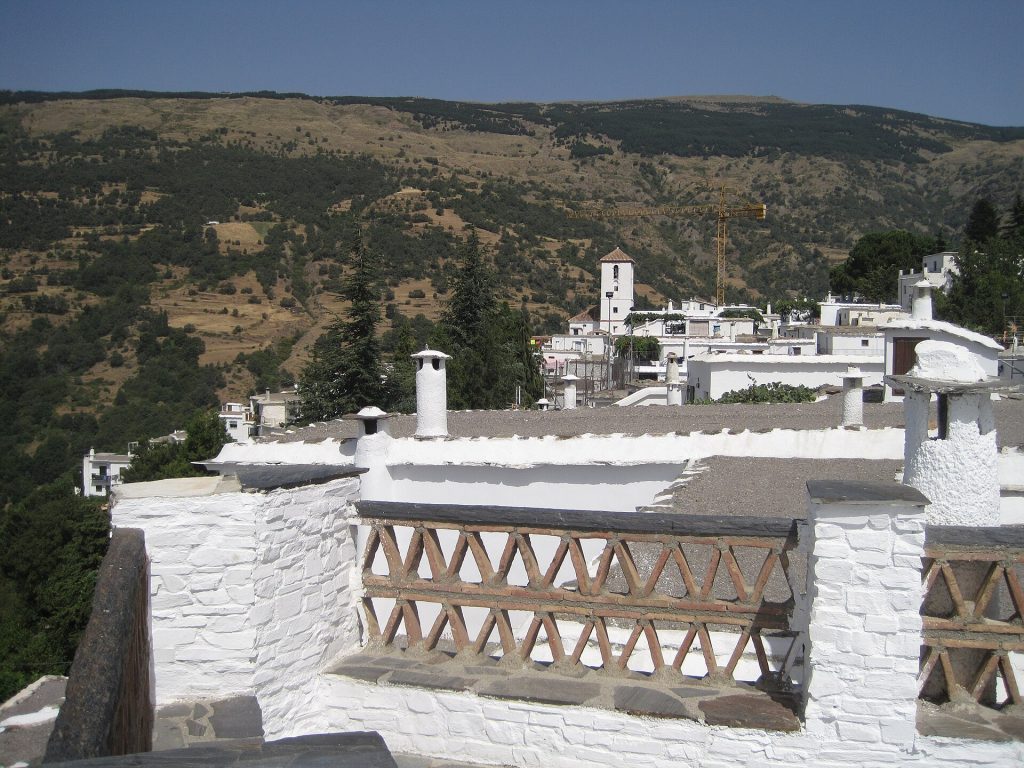
Alpujarra
Mountain villages on the southern flank of the Sierra Nevada, from Lanjarón to Trevélez: some 60 km. Best in spring and autumn.
More about this region
On the southern flank of the Sierra Nevada you string mountain villages together: Lanjarón, Pampaneira, Capileira and Trevélez, together some 60 km or two hours’ driving. Best in spring and autumn. Granada is 21h20 away.

22h25
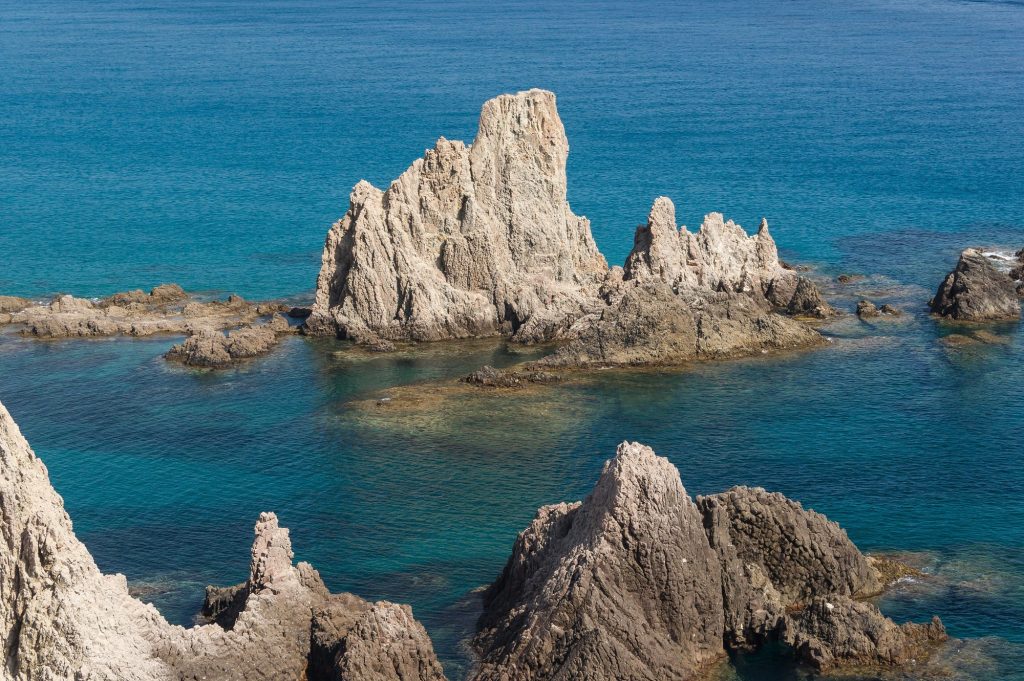
Cabo de Gata and Tabernas
The driest area in Spain: coast and western desert in a loop of some 140 km. At its best from October to April.
More about this region
Almería holds the driest area in Spain: the coast of Cabo de Gata and the western desert of Tabernas, with more than 300 films to its name. A loop of some 140 km, at its best from October to April. Almería is 22h25 away.
Road trip guide
Bardenas Reales in 3 days
3 days · by car through the semi-desert of Navarre
Day by day through the Bardenas: driving times, the rules on the tracks and where to sleep nearby.
The rules at a glance
Last checked on 24 November 2026. Rules change, often by region or city: check the official source listed at the bottom just before you leave.
On the road in Spain
Motorways 120, ordinary roads 90
50 in built-up areas, 30 on streets with one lane each way. Never hold your phone.
All rules
- Speed: 120 km/h on motorways and 90 on ordinary roads. In built-up areas you drive 50 on streets with two or more lanes each way, 30 on streets with one lane each way and 20 where road and pavement are on the same level. Signs always take precedence. With a caravan or trailer the limits are 80 outside built-up areas and 90 on motorways.
- Alcohol: 0.5 g/l, and 0.3 g/l for anyone who has held a licence for less than two years and for professional drivers. The fine is €500 or €1,000; from 0.6 mg/l in exhaled breath it is a criminal offence. A cut to 0.2 g/l is being prepared, but when we checked on 24 November 2026 we found no approval. The safest choice: don’t drink and drive at all.
- Phone: holding it is not allowed, not even in a traffic jam or at a red light. Hands-free calling is fine, earphones and headphones are not. Set your route before you leave.
- Roundabouts: traffic on the roundabout has priority. You leave it from the outer lane; if you cannot, go round again. Signal every manoeuvre.
- Cyclists: leave at least 1.5 m of space when overtaking.
- On-the-spot fines: pay within 20 days and you get a 50% discount. If you do not pay, the police can ask for a deposit or hold your car.
- Safety: so-called “highway pirates” claim something is wrong with your car. Only stop in a well-lit, public place, and watch out for fake plain-clothes police officers.
- Place names: besides Castilian, there are regional official languages. That is why signs and maps show double names, such as Mugía/Muxía and Finisterre/Fisterra.
Vignettes, tolls and low-emission zones
No vignette, tolls on some AP roads
More than 50 cities have a low-emission zone. Each city decides how foreign cars may enter.
All rules
Spain has no vignette, and a toll tag is handy but not required. Tolls only remain on some AP motorways, such as the AP-6, AP-51 and AP-61 around Madrid, the AP-9 in Galicia, the AP-66 León–Asturias and the AP-7 Málaga–Guadiaro. Since 11 November 2026 the AP-68 between Zaragoza and the La Rioja–Álava border has been toll-free. In Bizkaia and Álava tolls remain, with large discounts.
More than 50 cities enforce a low-emission zone (zona de bajas emisiones, ZBE). The DGT environmental label only exists for Spanish cars, so each city decides how foreign cars can enter. In Barcelona you register your car in advance in the metropolitan register; if it does not meet the standards, you can apply for up to 10 day passes a year. In Madrid registration is often required, and the fine is €200. All the details, and the other countries, are on our page about vignettes, tolls and low-emission zones.
What you need in your car
Warning triangle and hi-vis vest
With a Belgian plate your triangle is enough. The V-16 light only applies to Spanish cars.
More details
- Triangle or V-16: since 1 January 2026 a connected V-16 warning light is the only legal way to signal a stopped Spanish-registered car. With foreign plates your triangle is enough. If you hire a car with Spanish plates, it must carry a V-16; without one the fine is €80.
- Hi-vis vest: mandatory. According to the ADAC the driver wears it; according to the ANWB every occupant needs one. One vest per occupant covers both readings.
- Fire extinguisher: not required for a passenger car without a trailer.
- Bike rack: if it or your load sticks out at the back, it needs a red-and-white panel of 50 x 50 cm.
The full packing list is on our page about mandatory car equipment by country.
Winter
No general winter tyre requirement
At snow code red you may only continue with chains or winter tyres.
More details
Winter: there is no general winter tyre requirement. In snow, the DGT has used colour codes since 19 November 2026: yellow (max. 100 km/h on motorways and 80 elsewhere), orange (max. 60), red (max. 30, only with chains or winter tyres) and black (road closed). On the tunnel-heavy A-23, A-67, A-6 and AP-66, chains are banned at code red; there you may only continue with winter tyres. Chains are mandatory where a sign says so. More on our page about winter tyres and snow chains.
Where to sleep
Sleeping in your car is allowed
As long as you put nothing outside your vehicle. Each region regulates wild camping itself.
All rules
Campsites are the safest choice for a tent; each region sets its own wild camping rules (see below). For campervans and cars there are motorhome areas (áreas de autocaravanas). The maximum stay differs by region, for example 48 hours in Cantabria and 72 hours in Extremadura. Waste disposal points carry the S-128 sign. Apps such as park4night show campsites, motorhome areas and private spots.
- In your car or campervan: a campervan may park like any other vehicle. Municipalities can limit parking time and ban camping on the public road. You are camping as soon as you use an awning, open windows outward, put out tables or chairs, cook outside or empty water. A pop-up roof that stays within the vehicle’s outline is fine.
- Roof tent: the rules say nothing about it. If it unfolds beyond the outline of your car, it probably counts as camping. That is our interpretation of the DGT criteria, not a written rule.
- Bardenas Reales: overnight stays are banned everywhere, campervans included.
- Wild camping: each autonomous community regulates it itself. Banned in Andalusia, Asturias and Extremadura, among others (in Extremadura a fine of up to €600). Aragon, the Basque Country and Cantabria allow a tent under strict conditions.
All the conditions are on our pages about sleeping in your car, campervan or roof tent and wild camping in Europe.
Off-road and unpaved roads
Driving cross-country is banned
On forest tracks the region decides. Certainly legal: the Bardenas Reales or a site such as Les Comes.
All rules
Driving cross-country is an offence throughout Spain (Ley de Montes, art. 67 k), from €100. The regions decide what is allowed on forest tracks. The well-known rule “tracks at least 4 metres wide” does not apply throughout Spain, only in Catalonia.
- Catalonia: outside specially protected areas, on paved tracks or tracks at least 4 metres wide, at no more than 30 km/h. In protected areas only on designated tracks, with at most 4 cars together.
- Aragón: on tracks in public forests that are open to general traffic, you need no permit, with at most 5 vehicles in convoy and 30 km/h.
- Andalusia: since the forest law of April 2026, forest tracks in public forests are closed to recreational traffic by default, unless they have been expressly opened.
- Navarre and Madrid: not confirmed. Go by the signs on site.
- Sites and tours: Les Comes near Barcelona, a Land Rover Experience centre with more than 60 km of tracks (courses from €300), and guided 4×4 drives by Terranatur in Madrid.
In summer, forest roads can close because of fire risk. The rules for all ten countries are in our guide to legal off-road driving in Europe.
Everything in one table: Spain at a glance
| Topic | What applies |
|---|---|
| Driving time from Brussels | San Sebastián 11h55 · Bardenas Reales (Arguedas) 13h35 · Madrid 16h50 |
| Speed limits | Built-up areas 50 (30 on streets with one lane each way) · outside built-up areas 90 · motorways 120 |
| Alcohol limit | 0.5 g/l; novice drivers (licence held for less than 2 years) and professional drivers 0.3 g/l |
| Vignette and tolls | No vignette; tolls on some AP motorways; AP-68 toll-free since 11/11/2026 |
| Low-emission zones | ZBE in more than 50 cities, rules per city |
| Mandatory in the car | Warning triangle (V-16 only for Spanish plates) and hi-vis vest; fire extinguisher not required without a trailer |
| Winter rules | No general requirement; at snow code red or a sign, chains or winter tyres (DGT colour codes) |
| Sleeping in a car or roof tent | Allowed; municipalities can ban camping. Roof tent: probably camping if it unfolds beyond the outline |
| Wild camping | Regulated regionally: banned in e.g. Andalusia, Asturias and Extremadura; with conditions in Aragon, the Basque Country and Cantabria |
| Off-road | Banned off the road, from €100. By region: Aragón, Catalonia; Bardenas Reales; Les Comes. Andalusia: forest tracks closed by default |
| Emergency number | 112 |
Driving times are model values, calculated with OSRM on OpenStreetMap data, without breaks, traffic jams or waiting times.
When to go
best time
Details by region
- North coast (Galicia to the Basque Country): mild and wet, with rain all year and summers around 18–22 °C. Best from late spring to early autumn.
- Interior (Meseta): summers above 35 °C almost every year and long, cold winters. Go in spring or autumn.
- Seville and Córdoba: the hottest summers in Spain. Avoid July and August.
- Almería and Murcia: the driest part of the country, with very hot summers. Ideal from autumn to spring.
- Pyrenees and Sierra Nevada: cold, snowy winters and cool summers. Mountain passes are best in summer and early autumn.
In summer, forest roads can close because of fire risk, and at very high or extreme fire risk outdoor fires are banned.
Local flavours along the way
A selection from the Spanish agriculture ministry’s official PDO/PGI register (DOP/IGP), by region:
- Asturias and Cantabria: the cheeses Cabrales and Queso de Valdeón, Faba Asturiana and Sobao Pasiego.
- Basque Country and Navarre: Idiazábal, Roncal, Pimiento de Gernika and Pimiento del Piquillo de Lodosa.
- Catalonia: Calçot de Valls, Salchichón de Vic and Pa de Pagès Català.
- Aragón: Jamón de Teruel, Ternasco de Aragón and Melocotón de Calanda.
- Andalusia: Jamón de Trevélez (in the Alpujarra), Jabugo and olive oil from Jaén.
- La Mancha: Queso Manchego and Azafrán de La Mancha.
Frequently asked questions
Do I need a V-16 light in Spain?
Not with foreign plates. Foreign-registered cars may keep using the triangle. Only Spanish-registered cars, hire cars included, have needed a connected V-16 since 1 January 2026.
Can I sleep in my car in Spain?
Yes, as long as you are legally parked and put nothing outside your vehicle. Municipalities can limit parking time and ban camping on the public road, so watch the signs. In the Bardenas Reales overnight stays are banned everywhere.
Where can I legally drive off-road in Spain?
On tracks that are open to traffic, under the rules of the region. In Aragón you need no permit, with at most 5 vehicles at 30 km/h; in Catalonia, outside protected areas, on tracks at least 4 metres wide. In Andalusia forest tracks are closed by default. You are sure to be legal in the Bardenas Reales or at a site such as Les Comes.
Useful words
- área de autocaravanas: motorhome area
- vaciado: waste disposal point
- pernoctar: to stay overnight
- acampada libre: wild camping
- pista forestal: forest track
- peaje: toll
- cadenas: snow chains
Official sources
- Traffic rules: Your Europe – Spain, GOV.UK – Spain: safety and security
- Equipment: DGT – baliza V-16, La Moncloa – V-16 and foreign-registered cars
- Winter: DGT – road status codes (19/11/2026)
- Low-emission zones: Ajuntament de Barcelona – foreign number plates in the ZBE
- Overnight stays: DGT – motorhome instruction (2026)
- Wild camping: BOE – Extremadura tourism law, Cantabria – Decreto 35/2026, Basque Country – Decreto 396/2013
- Off-road: BOE – Ley 43/2003 de Montes, BOE – Ley 3/2026 Andalucía, BOE – Montes de Aragón, Bardenas Reales – normativa, Bardenas Reales – notices
- Local produce: MAPA – DOP/IGP register
- Emergency number: Your Europe – single emergency number 112
Driving on?