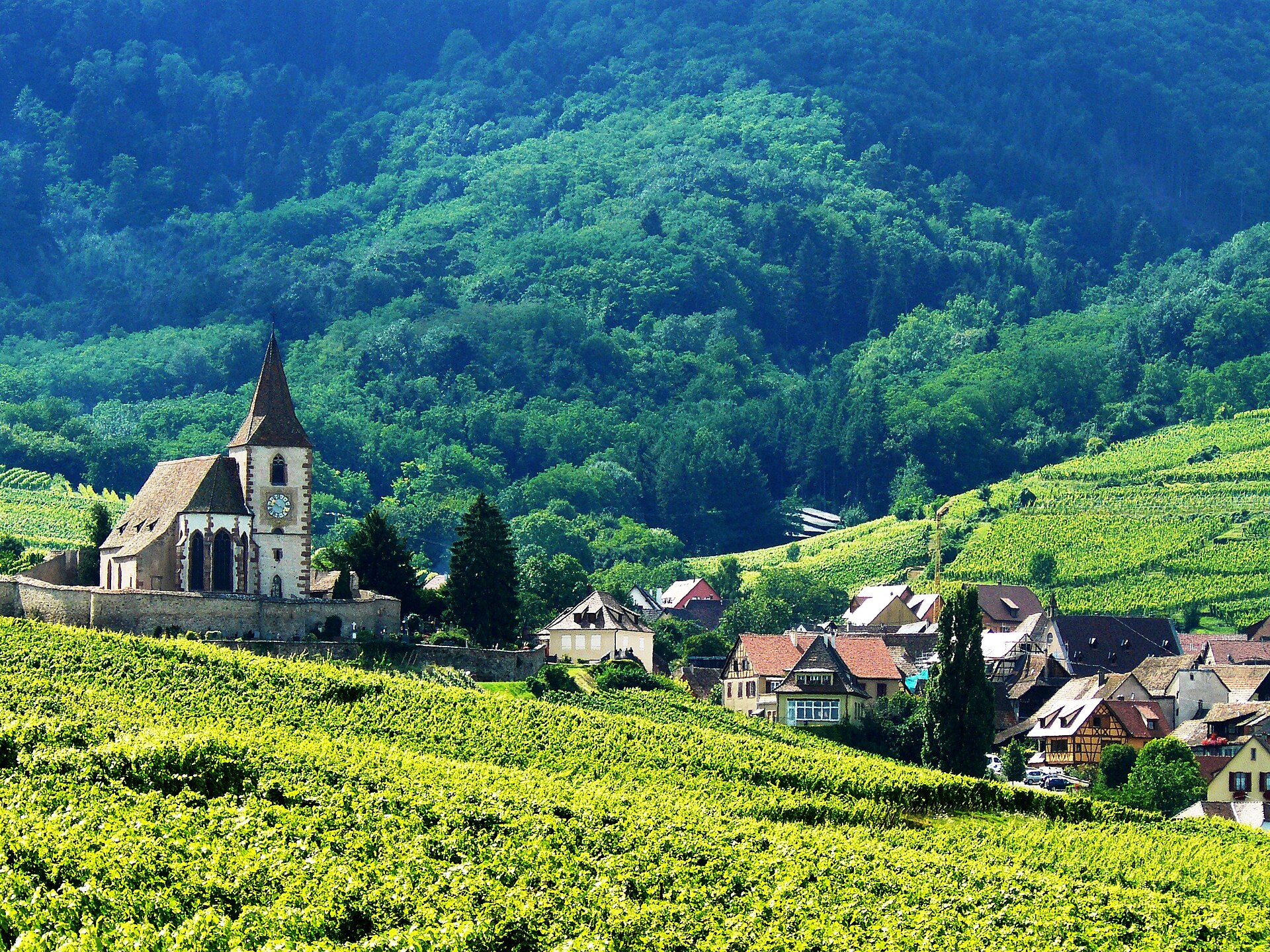
Photo above: Hunawihr and its church among the vineyards. Bernard Chenal, Wikimedia Commons, CC BY-SA 4.0, cropped.

The Alsace Wine Route winds for 170 km along the foot of the Vosges, from Marlenheim near Strasbourg to Thann near Mulhouse. You drive through some seventy wine villages with half-timbered houses, town walls and a castle high above the plain, and you taste Riesling, Gewurztraminer and Crémant at the winegrower’s own cellar along the way. From Brussels it is the nearest true food-and-wine road trip: Colmar is five and a half hours away, and three days are enough for the whole route.
Last checked on 25 November 2026. Opening hours, prices and dates change: check the official sources listed at the bottom just before you leave.
The route at a glance
| Topic | What you need to know |
|---|---|
| Start and finish | Marlenheim (near Strasbourg) – Thann (near Mulhouse) |
| Distance | The signposted route is 170 km; with the stops in this guide ± 185 km |
| Pure driving time | ± 4h25, spread over three days |
| Number of days | 3 days, plus the journey there and back. A long weekend also works (see Shorter or longer) |
| From Brussels | Marlenheim ± 4h35 (± 410 km); back from Thann ± 6h00 (± 485 km). Colmar is ± 5h30 away (± 500 km) |
| Best time | All year. Wine and harvest festivals from June to October, Christmas markets from late November to late December |
| Road type | Tarmac: narrow departmental roads through vineyards and villages, with a climb to the Haut-Koenigsbourg |
| Suitable for | Any car. With a campervan the old village centres are tight: park on the edge |
| Tolls, vignette and costs | No vignette in France; péage per section on the motorway getting there. Crit’Air only if you enter a low-emission zone, such as Strasbourg |
| Where to sleep | Campsites, aires de service, France Passion at winegrowers, chambres d’hôtes |
All driving times in this guide are model values from a route planner (OSRM), without breaks or traffic. With stops to taste and walk around, you will be on the road much longer.
Before you go
- Tasting and driving: the limit in France is 0.5 g/l in the blood. From 0.8 g/l it is a criminal offence, with a fine of up to €9,000 and up to 3 years in prison. Agree who drives, spit at tastings or take the bike: the Véloroute du Vignoble follows the wine route for some 130 km.
- Tolls: France has no vignette. On the motorway you usually take a ticket at the entrance and pay at the exit. If you drive via Metz on the A4, watch out at the Boulay junction: the toll there has no barrier and you pay within 72 hours, online, at a sales point or with a toll tag.
- Crit’Air: if you drive into Strasbourg, you need a Crit’Air sticker, also with foreign plates. It costs €5.11 and comes by post: read all about the Crit’Air sticker.
- In the car: a CE-marked hi-vis vest within reach and an approved warning triangle.
- Winter: the wine route itself runs through the plain and the foothills, but the Route des Crêtes above it is closed from 16 November 2026 until early April.
All the rules for driving, tolls and overnight stays in France are in our guide to driving in France. Read more about vignettes, tolls and low-emission zones and mandatory car equipment on our practical pages.
The route, day by day
We drive from north to south. Each day is short in kilometres: the time goes to the villages, the vineyards and the wine cellars.
Day 1: Marlenheim – Dambach-la-Ville (± 45 km, ± 1h05)
The route starts in Marlenheim, just west of Strasbourg. Via Molsheim you drive to Obernai and its half-timbered houses. Then come Barr and Mittelbergheim, one of the five villages on the wine route with the Plus Beaux Villages de France label. Via Andlau you end the day in Dambach-la-Ville, inside its town walls.
Enjoy: a first glass in a winstub, the Alsatian wine tavern, with flammekueche or choucroute.
Sleep: a campsite or chambre d’hôtes around Obernai or Barr, or a France Passion address at a winegrower if you travel in a self-contained campervan or van.
Day 2: Dambach-la-Ville – Kaysersberg (± 55 km, ± 1h20)
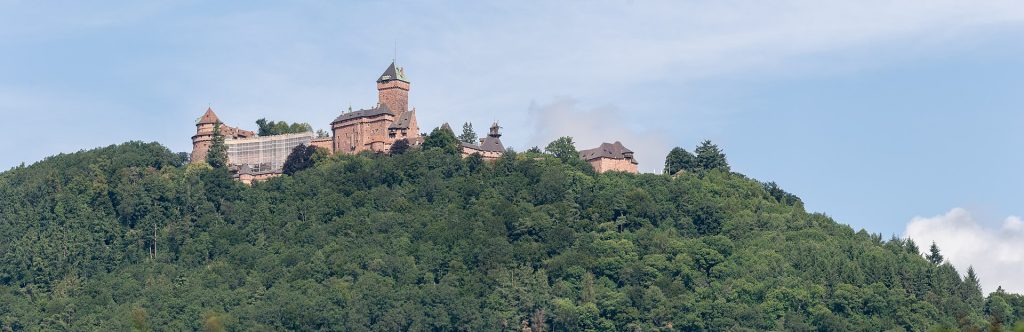

The day of the castle and the best-known villages. First you climb to the Haut-Koenigsbourg near Orschwiller, at almost 800 m, with views over the Alsace plain. The castle is open all year, except on 1 January, 1 May and 25 December. An adult ticket costs €12, the car park less than 200 m away is free, and at busy times you are better off buying your ticket online in advance.
Back in the vineyards you drive to Bergheim, another Plus Beau Village, and to Ribeauvillé, with the Geisberg and Osterberg grands crus on the slopes above. Hunawihr and its fortified church sit among the vines. Riquewihr, the best-known village on the route, has held the label since the association was founded in 1982. You end in Kaysersberg, in the Weiss valley.
Enjoy: taste at a winegrower in Riquewihr or Hunawihr. Each village has its grand cru: Schoenenbourg in Riquewihr, Rosacker in Hunawihr.
Sleep: a campsite, aire de service or chambre d’hôtes around Riquewihr and Kaysersberg, or in Colmar.
Day 3: Kaysersberg – Thann (± 85 km, ± 2h00)
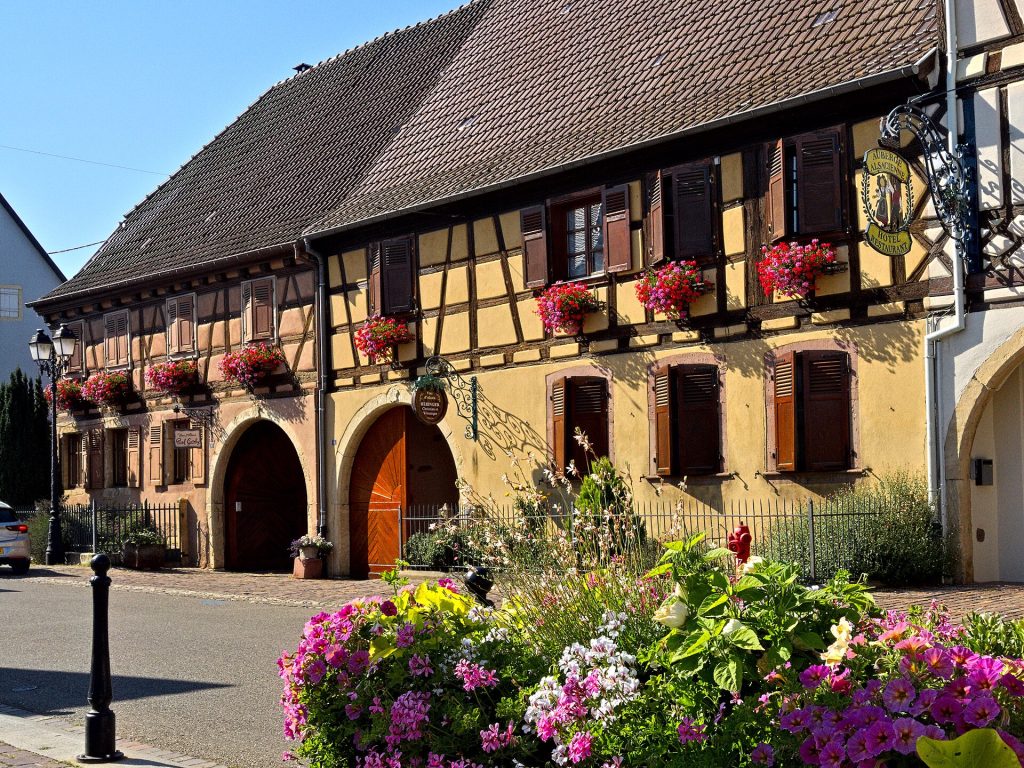

Via Kientzheim, with the Schlossberg grand cru, you drive to Colmar. Park on the edge and walk through the old centre and the Petite Venise along the Lauch. Then come Turckheim, at the foot of the Brand grand cru, and Eguisheim, where the streets run in rings around the centre. Via Rouffach and Guebwiller the route ends in Thann, below the vineyard of the Rangen grand cru.
Enjoy: Munster cheese from the valley just behind Colmar, and a bottle of Crémant to take home: the sparkling wine makes up about a third of what Alsace sells.
Sleep: a campsite around Thann or Guebwiller, or drive home: from Thann it is ± 6h00 to Brussels (± 485 km).
Tasting wine along the route
- What you taste: Alsace makes mostly white wine, about 90% of production. The best-known grapes are Riesling, Gewurztraminer, Pinot Gris and Muscat. Pinot Noir is the only red.
- 51 grands crus: delimited slopes whose name appears on the label. You pass them along the whole route.
- Crémant d’Alsace: sparkling wine made the same way as Champagne, and a good deal cheaper.
- At the winegrower’s: many winegrowers welcome visitors in their cellar. Check their website or call ahead to see when they are open, especially out of season.
Where to sleep
Along the route you will find campsites, aires de service for campervans and chambres d’hôtes. France Passion is a network of some 2,200 farmers, winegrowers and craftspeople where members can stay for up to 24 hours free of charge. It is meant for self-contained campervans and vans; ask whether a roof tent is welcome.
- In your car or campervan: no traffic rule forbids it. As soon as you put a table, chairs, an awning or levelling jacks outside, you are camping. You may stay in the same spot on a public road for no more than 7 days in a row.
- Roof tent: no rule mentions them. From the definition of camping, an unfolded roof tent probably counts as camping. That is our own reading, not a written rule. A campsite is always safe.
- Among the vines: vineyards are private land. You may only camp with the permission of whoever uses the land.
Read more in our guides to sleeping in your car, campervan or roof tent and wild camping in Europe.
When to go
- June to October: the villages hold wine and harvest festivals, with cellar visits and tastings.
- Christmas markets: in 2026 the market in Colmar runs from 23 November to 29 December, in Eguisheim from 27 November to 30 December and in Riquewihr until 20 December. Kaysersberg holds its market at weekends; that was the pattern in 2025. From 27 November to 20 December 2026, Christmas shuttle buses run from Colmar station to Eguisheim, Kaysersberg, Riquewihr and Ribeauvillé, among others: handy, because you do not have to park and you can taste.
- Winter: the wine route can be driven all year. The Route des Crêtes over the Vosges is closed from 16 November 2026 until early April.
- Crowds: in summer and during the Christmas markets the best-known villages are busy. Come early in the day, or choose the quieter villages in the north and south.
Shorter or longer
- Shorter: a long weekend around Colmar. Drive only day 2 and the start of day 3: from the Haut-Koenigsbourg via Ribeauvillé, Riquewihr and Kaysersberg to Colmar and Eguisheim (± 75 km, ± 2h10). You will then have seen four of the five Plus Beaux Villages.
- Longer: with the Route des Crêtes. From April to mid-November, combine the wine route with the Route des Crêtes, some 90 km along the ridges of the Vosges, from Sainte-Marie-aux-Mines to Cernay.
- Longer: with Strasbourg. Start or finish with a day in Strasbourg, close to Marlenheim. Remember your Crit’Air sticker.
Another road trip nearby? If you drive home via Germany, the Eifel and the German Volcano Route are on your way. For real mountains, read our guide to the Route des Grandes Alpes.
Frequently asked questions
How many days do I need for the Alsace Wine Route?
Three days for the whole stretch from Marlenheim to Thann. In a long weekend you can see the middle section around Colmar, with the best-known villages.
Can I taste wine if I am driving?
The limit in France is 0.5 g/l in the blood, and a few tasting glasses add up quickly. Agree who drives, spit at tastings, or take the bike or, in the Christmas period, the shuttle bus.
Do I need a vignette for the wine route?
Not a road vignette: France does not have one. On the motorway getting there you pay a toll per section. You need a Crit’Air sticker if you drive into Strasbourg or another low-emission zone.
When is the wine route at its best?
That depends on what you are after: wine and harvest festivals from June to October, Christmas markets from late November to late December. The route itself is open all year.
Official sources
- Route and wine: Alsace Wine Route (Vins d’Alsace), Vins d’Alsace – the wines, Les Plus Beaux Villages de France – on the wine route
- Visiting: Colmar tourist office – wine route, Sélestat Haut-Koenigsbourg – the castle, Christmas in the Pays de Colmar – markets and shuttles
- Driving and tolls: Service Public – drink-driving (French), Ministère de la Transition écologique – free-flow tolls (French), Certificat qualité de l’air (Crit’Air)
- Driving times: OSRM route planner (OpenStreetMap data)