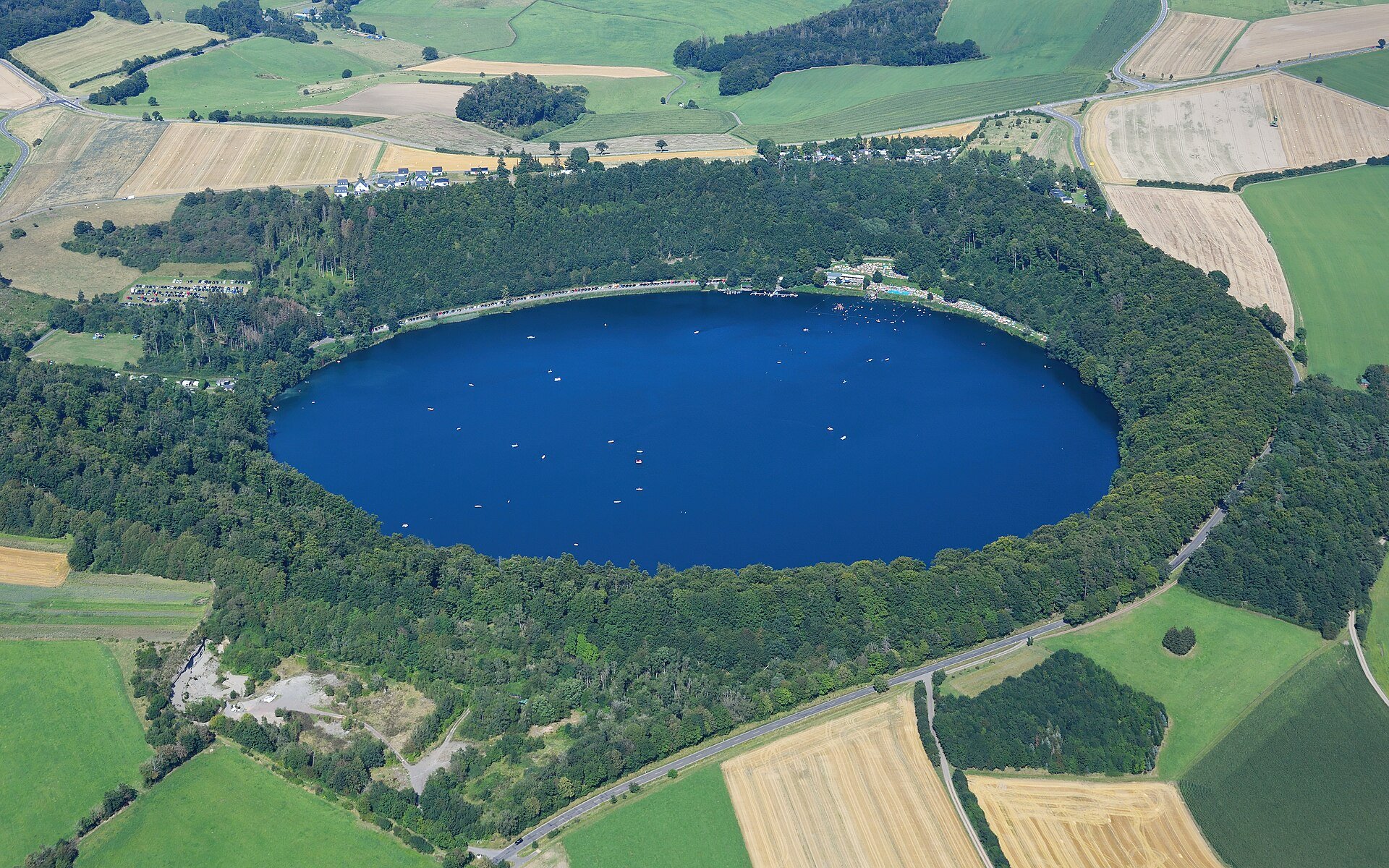
Photo above: The Pulvermaar near Gillenfeld, seen from above. Carsten Steger, Wikimedia Commons, CC BY-SA 4.0, cropped.

In the Volcanic Eifel you read the history of the earth from the roadside: crater lakes (Maare), craters and outcrops from ancient eruptions. The Deutsche Vulkanstraße, the German Volcano Route, takes you past them, and halfway along lies the Nürburgring, where you can legally drive the Nordschleife in your own car. From Brussels you reach the Laacher See in under three hours.
Last checked on 24 November 2026. Rules, prices and opening hours change: check the official source listed at the bottom just before you leave.
The route at a glance
| Topic | What you need to know |
|---|---|
| Start and finish | Maria Laach (Laacher See) – Gerolstein, via Mendig, the Nürburgring, Daun, Gillenfeld and Manderscheid |
| Distance | About 115 km for our selection, without detours; the full Volcano Route is 280 km |
| Pure driving time | About 2h15, without detours or laps of the Ring |
| Number of days | 3 days (2 nights) |
| From Brussels | To Maria Laach 2h50 (265 km); back from Gerolstein 2h40 (220 km). Nürburg is 3h05 away |
| Best time | Summer for the maars. Tourist drives on the Nordschleife: in 2026 from 7 March to 15 November; the 2027 dates had not been published when we checked |
| Road type | Tarmac: federal and regional roads through hills, forest and villages |
| Suitable for | Any ordinary car. For the Nordschleife your car must meet German technical rules and be able to exceed 130 km/h |
| Tolls, vignette and costs | No tolls and no vignette. Nordschleife in 2026: €30 per lap Monday to Thursday, €35 at weekends and on public holidays |
| Sleeping | Campsites and Stellplätze (motorhome areas); one night’s rest in your car in a public car park; Trekkingplätze if you want to continue on foot |
Driving times are model values from a route planner, without breaks or traffic. We use Brussels as the reference point; add your own journey to get there.
Before you go
- Vignette and tolls: there is no vignette and no toll for cars in Germany, apart from two private tunnels in the north.
- Umweltplakette: in 35 low-emission zones (Umweltzonen, as of October 2026) you need a green emissions sticker, foreign cars included. Without one you pay €100. The route itself runs through small towns, but if you plan a stop in a larger city on the way, check whether a zone applies. Order the sticker before you leave from an approved issuer such as TÜV or DEKRA. More in our guide to vignettes, tolls and low-emission zones in Europe.
- Equipment: § 53a StVZO requires a warning triangle and a hi-vis vest, and according to the ADAC and ANWB a first-aid kit to DIN 13164 belongs with them. Sources disagree on whether this applies to foreign-registered cars, so carry all three. A fire extinguisher is not compulsory in Germany. See our page on mandatory car equipment by country.
- Winter: there is no fixed period. In black ice, snow, slush, ice or frost you need winter tyres with the 3PMSF symbol on all four wheels, foreign cars included. The fine is €60 to €100. More in our guide to winter tyres and snow chains.
- Speed: 50 km/h in built-up areas, 100 outside them. On the Autobahn there is an advisory speed of 130. Speed camera warnings in your satnav or an app are banned.
- For the Nordschleife: bring your driving licence and your vehicle registration document. Drivers of cars not registered in Germany must also carry proof of insurance. You buy credit for laps through a personal profile on the Nürburgring website.
All the traffic rules, from the Rettungsgasse to the alcohol limit, are in our guide to driving in Germany.
The route, day by day
Day 1: Maria Laach – Mendig – Mayen (15 km, 0h20)
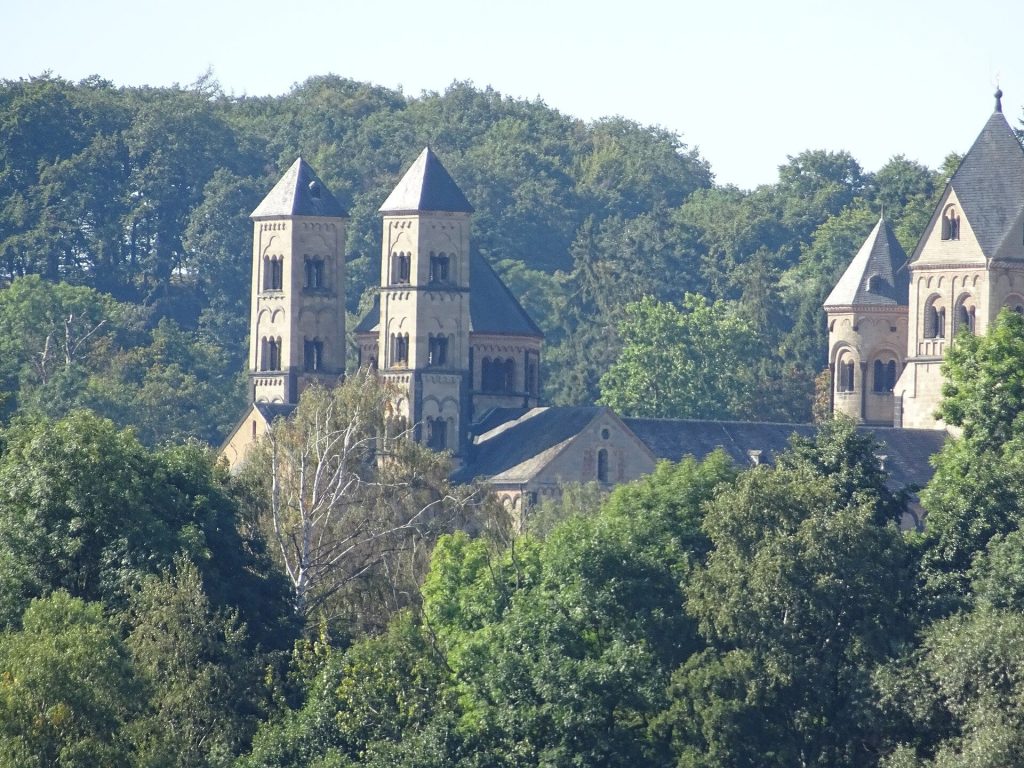

The Volcano Route officially starts at the Erntekreuz car park in Maria Laach, on the Laacher See. From Brussels it takes 2h50 (265 km). According to Eifel Tourismus, the full route is 280 km long with 39 highlights. We picked a selection you can drive at an easy pace in three days.
By the lake you will find the Vulkanregion Laacher See information point, with hiking and geology trails, and the abbey church of Maria Laach. Take time for a stretch of those trails before you drive on.
In Mendig (5 km, 0h10) is the Lava-Dome, the Deutsches Vulkanmuseum, with a 700 m² exhibition, a multimedia show and a round cinema. Also in Mendig is the Wingertsbergwand, an outcrop where researchers study the Laacher See eruption. From there it is another 10 km (0h10) to Mayen, the end of the first day.
Enjoy: near Bad Tönisstein (Burgbrohl), another stop on the Volcano Route, there are mineral springs.
Sleeping: at a campsite or a Stellplatz. The ADAC platform PiNCAMP and promobil’s free Stellplatz-Radar app show what is nearby. In your car you may rest for one night in a public car park, as long as you put nothing outside.
Day 2: Mayen – Nürburgring – Daun (50 km, 0h55)
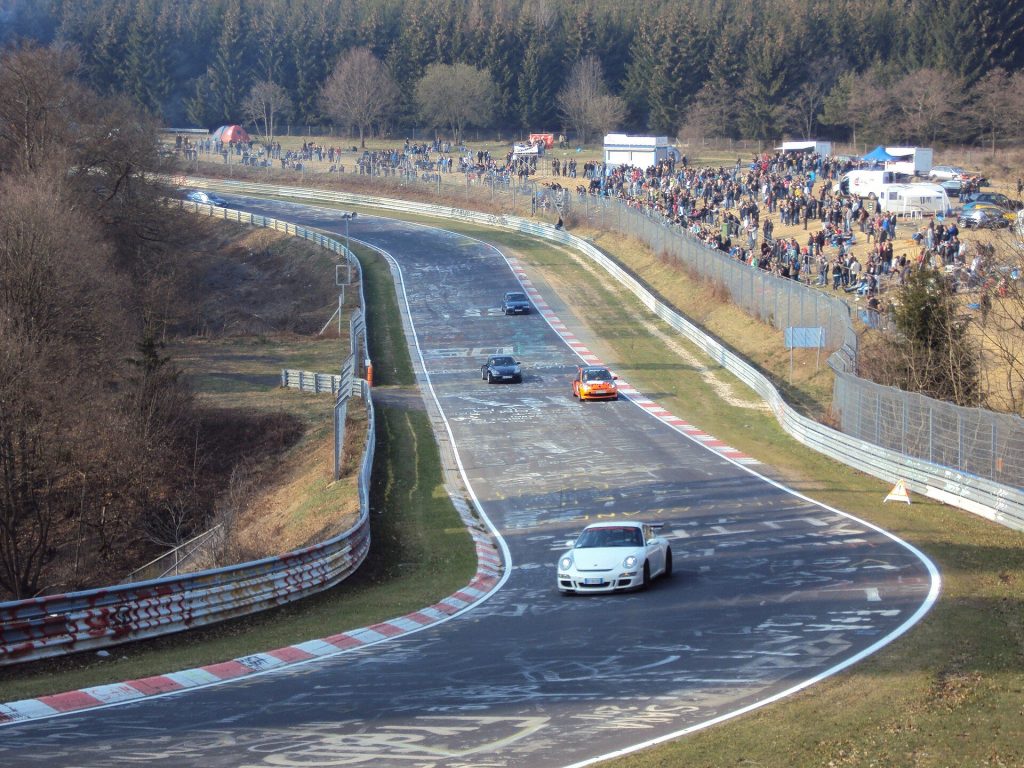

From Mayen it is half an hour (25 km) to the Nürburgring. If you want to climb higher on the way, make a detour to the Hohe Acht, a 747 m summit with the Kaiser-Wilhelm-Turm. It is also on the Volcano Route list.
At the Nürburgring you can drive the Nordschleife in your own car during the tourist drives (Touristenfahrten). How it works and what it costs is explained below. Check the opening hours in advance, as they vary from day to day.
Then it is 25 km (0h25) to Daun, home of the Eifel-Vulkanmuseum; check its opening days before you go.
Enjoy: the Rhineland kitchen gives you Himmel un Ääd and Rheinischer Sauerbraten. We could not confirm typical Eifel specialities in an official source.
Sleeping: a campsite or Stellplatz near Daun. If you sleep in your car, keep everything inside: no awning, chairs, levelling blocks or lowered legs.
Day 3: Daun – Gillenfeld – Manderscheid – Gerolstein (50 km, 1h00)
Start the day at the three Dauner Maare: the Gemündener Maar, the Weinfelder Maar, also called the Totenmaar, with its turquoise water, and the Schalkenmehrener Maar, where you can walk. In early summer the yellow broom flowers around the Weinfelder Maar.
In Gillenfeld (15 km, 0h15) lies the Pulvermaar, at 74 m the deepest maar in the Eifel according to Eifel Tourismus. You can swim and go boating there. Gillenfeld also has the Holzmaar and the Dürres Maar, a dry maar with sedges, mosses and cotton grass. In neighbouring Strohn you can see a lava bomb.
From Gillenfeld to Manderscheid is 10 km (0h15). Manderscheid has the Maarmuseum. Just to the west lies the Meerfelder Maar, at 1,700 m long the largest maar in the Eifel; the Landesblick lookout tower overlooks it. In Bettenfeld is the Vulkanerlebnispark Mosenberg, with a lava wall and a nature trail.
You finish in Gerolstein (25 km, 0h30) at the Papenkaule, a volcanic crater about 80 m wide and 20 m deep. In Roth near Gerolstein are the millstone caves of the Rother Kopf. Back to Brussels it is 220 km (2h40).
Enjoy: water from volcanic ground. Dreis-Brück has the Vulkania healing spring, and in Wallenborn the Wallender Born, a cold-water spring of 9 °C, erupts from the ground.
Sleeping: if you stay longer, the Eifel has Trekkingplätze. You book online, stay one night and only get the exact location after booking. You can only reach them on foot, so park elsewhere and walk in.
Driving the Nordschleife yourself
During the tourist drives the Nordschleife is open to your own car or motorbike. It is not a race: according to the Nürburgring, the German road traffic regulations (StVO) apply. These are the rules the Nürburgring itself lists:
- Season: in 2026 from 7 March to 15 November, according to the Nürburgring’s plans. Opening hours vary by day; on weekdays the track opens almost every evening. On the Green Hell Driving Days (in 2026: 1 to 3 May and 2 to 4 October) it is open all day. Check the calendar on the official website.
- Prices for 2026: €30 per lap Monday to Thursday, €35 at weekends and on public holidays. On the Grand Prix circuit you pay €35 for 15 minutes. We did not yet find the 2027 prices.
- Your car: it must comply with German technical rules (StVZO) and is inspected before you go on the track. Vehicles that cannot exceed 130 km/h because of their design or condition, and quad bikes, are not allowed. Noise must not exceed 130 dB(A).
- Driving rules: overtaking on the right is banned. Follow the posted speed limits and slow down at roadworks. If your car leaks coolant, oil or fuel, you must not drive on.
- Documents: your driving licence and registration document; with a car not registered in Germany, also proof of insurance.
- Filming and taking photos during the tourist drives is banned, as is offering taxi rides, paid or free.
Our advice: ask your insurer in advance whether your policy covers a drive on the Nordschleife.
Unpaved roads and off-road
Under the forest laws of the German states, driving a car on forest tracks without a permit is banned. In practice, legal off-roading happens at off-road parks, on training courses and at events.
- At the Ring: Offroad am Nürburgring offers training and experiences on tracks of different difficulty. Ask in advance whether you can bring your own vehicle.
- Further afield: off-road parks where you drive your own vehicle, such as Knüllwald in Hesse (€35 per vehicle per day in 2026), and training at Bilster Berg near Bad Driburg (4h25 from Brussels).
Everything by country is in our guide to legal off-road driving in Europe.
Where to sleep
- Campsites and Stellplätze: Germany has around 2,900 campsites. PiNCAMP and Stellplatz-Radar help you find them.
- Sleeping in your car or campervan: you may sleep one night in a public car park or by the road to become fit to drive again, unless a sign bans it. The well-known “10-hour rule” is not in any law. Your vehicle must always be ready to leave. It is not allowed in nature reserves (Naturschutzgebiete) or national parks, and supermarket car parks are private property.
- Roof tent: there is no rule. With the roof tent unfolded your vehicle is not ready to leave, so it probably counts as camping. That is our interpretation. Choose a Stellplatz that accepts roof tents, or a campsite.
- Wild camping is banned in principle. The legal alternative is the Trekkingplätze, which you can only reach on foot.
- Fires are banned in principle in the forest, except at designated spots.
More in our guides to sleeping in your car, campervan or roof tent and wild camping in Europe.
When to go
- Summer: the season for the Volcano Route. Eifel Tourismus specifically mentions summer for swimming in the Pulvermaar and walking around the Schalkenmehrener Maar.
- Early summer: the broom flowers around the Weinfelder Maar.
- March to November: the tourist drive season (in 2026 from 7 March to 15 November). Laps cost more at weekends.
- Spring to autumn: most Trekkingplätze are open from April or May to October.
- Winter: expect to need winter tyres as soon as conditions turn wintry. Museums have their own opening days, so check them.
We found no official figures on how busy the route gets.
Shorter or longer
- Weekend (2 days): drive straight to the Nürburgring (3h05 from Brussels) and follow days 2 and 3: the Ring, Daun and the maars.
- Longer, the whole Volcano Route: the full 280 km route also takes you to the Tuffsteinzentrum in Weibern, where you can join stone-working courses, the spa town of Bad Bertrich with its thermal water at 32 °C, and the Vulkangarten in Steffeln.
- Longer, with the Moselle: Cochem is 3h20 from Brussels. Near Bremm lies the Calmont, according to the German National Tourist Board the steepest vineyard in Europe.
Another road trip nearby? Read our guide to the Semois Valley and the Gaume.
Frequently asked questions
Can I drive the Nordschleife in my own car?
Yes, during the tourist drives. Your car must meet German technical rules and be able to exceed 130 km/h. German road traffic rules apply, overtaking on the right is banned and filming is not allowed. With a car not registered in Germany, also carry proof of insurance.
How much does a lap of the Nordschleife cost?
In 2026 a lap cost €30 from Monday to Thursday and €35 at weekends and on public holidays. The 2027 prices had not been published when we checked.
Can you swim in the maars?
In summer, yes. Eifel Tourismus specifically mentions swimming and boating at the Pulvermaar in Gillenfeld. For the other maars, check the signs on site.
Can I sleep in my car in the Eifel?
You may rest for one night in a public car park or by the road, as long as you put nothing outside and no sign bans it. It is not allowed in nature reserves or national parks. With a roof tent, use a campsite or a Stellplatz that accepts roof tents.
Official sources
- Route: Eifel Tourismus – German Volcano Road
- Nürburgring: Nürburgring – tourist drives news, Nürburgring – safety regulations
- Traffic rules and low-emission zones: Your Europe – Germany, Umweltbundesamt – Umweltzonen in Deutschland (German)
- Equipment: § 53a StVZO (German)
- Overnight stays: promobil – Wohnmobil parken und übernachten (German), DAV – Zelt-Trekking (German)
- Off-road: Offroadpark Knüllwald – prices (German)