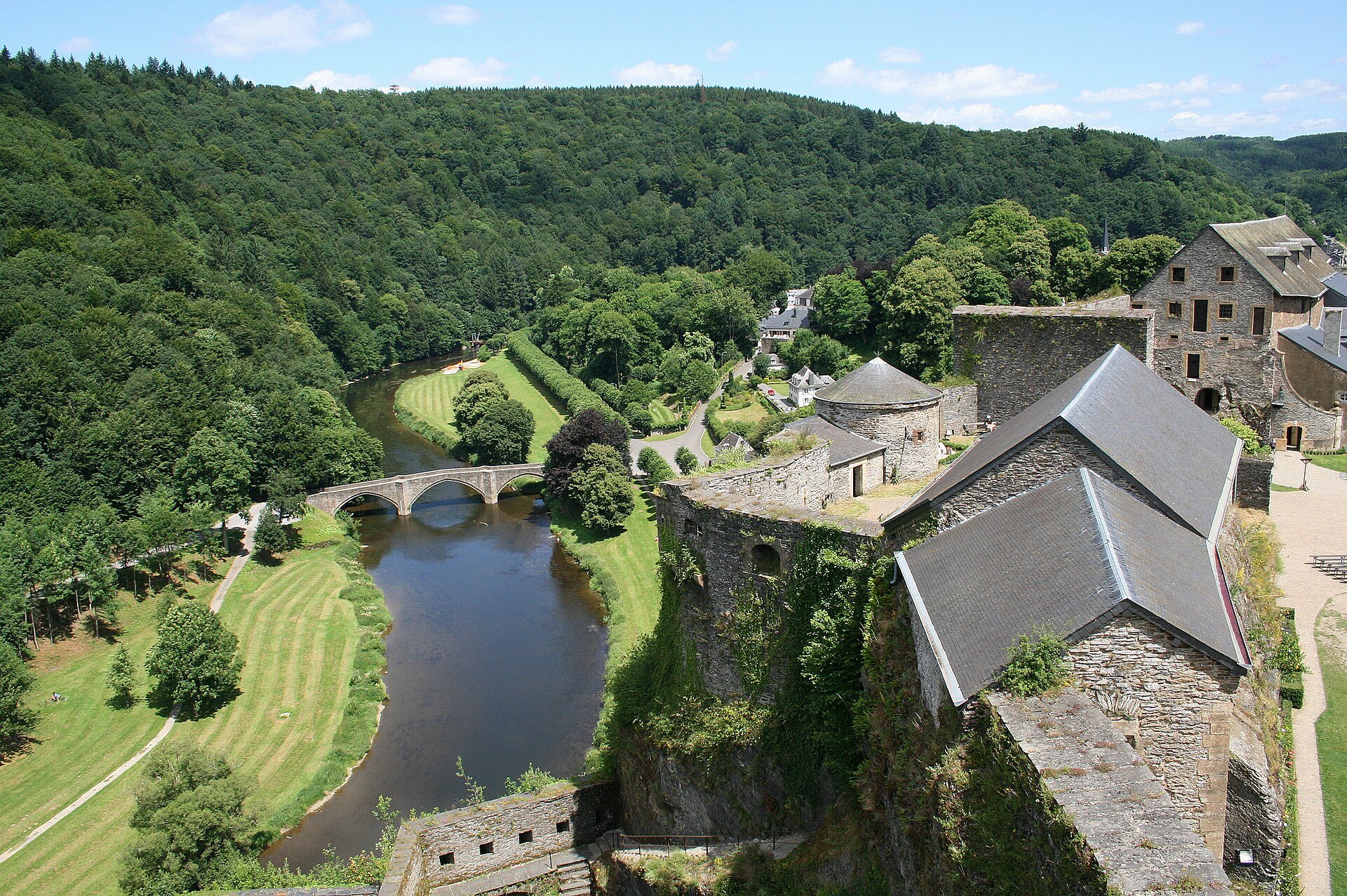
Photo above: Bouillon castle above the Semois. Jean-Pol GRANDMONT, Wikimedia Commons, CC BY-SA 3.0, cropped.

The Semois winds from Arlon to the French border through a national park that is more than 80% forest. Along the way you drive through the Gaume, past Orval Abbey and the castle ruins of Herbeumont, to Bouillon and the old tobacco villages around Vresse. The stages are short and the start is just over two hours from Brussels, which makes this an easy long weekend by car, or a gentle first leg of a longer trip through the Ardennes.
Last checked on 24 November 2026. Rules and opening hours change: check the official source listed at the bottom just before you leave.
The route at a glance
| Topic | What you need to know |
|---|---|
| Start and finish | Arlon – Vresse-sur-Semois, via Virton, Orval, Florenville, Herbeumont and Bouillon |
| Distance | About 125 km, without detours |
| Pure driving time | About 2h20 |
| Number of days | 3 days (2 nights); the stages are short, so you have time to walk or kayak |
| From Brussels | To Arlon 2h15 (190 km); back from Vresse 2h00 (150 km). Bouillon is 2h00 away |
| Best time | Spring to autumn. There are no passes or toll roads that close |
| Road type | Tarmac: regional roads and narrow lanes through forest and villages |
| Suitable for | Any ordinary car. You do not need an SUV or 4×4: the route stays on paved roads |
| Tolls, vignette and costs | No tolls and (as yet) no vignette. What you pay for are mainly the visits, such as the Orval ruins (€8 for an adult when we checked) |
| Sleeping | Campsites, aires d’accueil pour motor-homes (motorhome areas) and approved farm campsites (camping à la ferme). Camping on the public road is not allowed in Wallonia |
Driving times are model values from a route planner, without breaks or traffic. We use Brussels as the reference point; add your own journey to get there.
Before you go
- Vignette and tolls: Belgian motorways are free today. Flanders has announced a digital road vignette from 1 May 2027, for Belgian and foreign cars up to 3.5 tonnes, and Brussels has announced it too. We found no official confirmation for Wallonia. It all still needs final approval from the Flemish Parliament. More in our guide to vignettes, tolls and low-emission zones in Europe.
- Low-emission zone: if you set off from Brussels, you drive through the Brussels LEZ. Foreign cars register there for free, separately from the Flemish LEZs of Antwerp and Ghent. Since 1 January 2026, Euro 5 diesels and Euro 2 petrol cars have been banned. Wallonia has no regional LEZ.
- Equipment: with a foreign-registered car you need a warning triangle, and the driver wears a hi-vis vest after a breakdown. Belgian cars also carry a first-aid kit and a fire extinguisher. See our page on mandatory car equipment by country.
- Winter: winter tyres are not compulsory, snow chains may only be used on snow or black ice, and studded tyres are banned. The Ardennes can be wintry while it is only raining in Brussels. More in our guide to winter tyres and snow chains.
- Speed: outside built-up areas the default limit is 90 km/h in Wallonia and 70 km/h in Flanders. In built-up areas it is 50 km/h.
- Language: French is the language of Wallonia. A few basic phrases go a long way.
All the rules by region, from priority to the right to the new highway code of 2027, are in our guide to driving in Belgium.
The route, day by day
Day 1: Arlon – Virton – Orval – Florenville (55 km, 1h10)
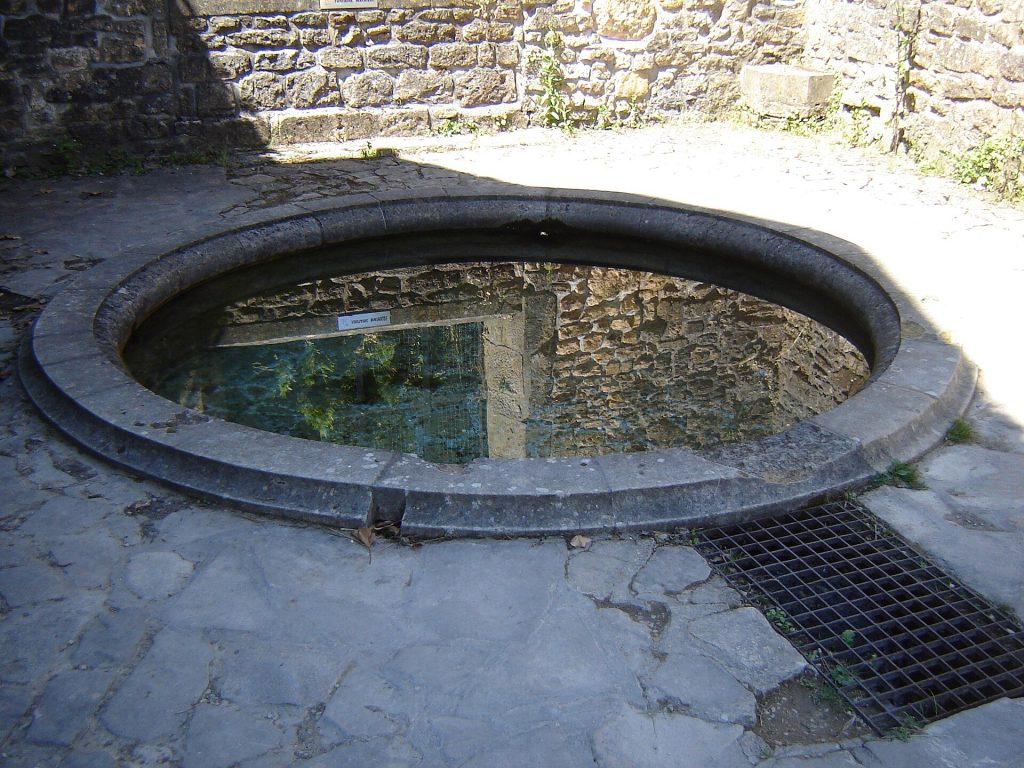

Arlon is your starting point, 2h15 from Brussels. It is also where the GR 16 begins, the long-distance footpath that follows the Semois for 209 km to Monthermé in France. The path passes Herbeumont, Bouillon and Rochehaut later on the route.
First you head south into the Gaume (25 km, 0h30). The area around Virton is often 1 to 3 °C warmer than the rest of Luxembourg province, and it has a dialect of its own, gaumais.
From Virton it is 20 km (0h25) to Orval Abbey. You can visit the ruins of the Cistercian abbey and the museum rooms, and the abbey shop keeps the same hours. When we checked, a ticket cost €8 for an adult and €3 for children aged 7 to 14. From November to February it is open from 10.30 to 17.30 (last ticket at 16.30), from March to May and in October from 9.30 to 18.00, and from June to September until 18.30. Florenville is then another quarter of an hour away (10 km).
Enjoy: the abbey has its own cheese dairy and a brewery. The Ardennes are also known for ham and pâté, often made from game.
Sleeping: choose a campsite, an aire d’accueil pour motor-homes or a camping à la ferme near Florenville. Apps such as Park4Night and CamperContact show what is available. Camping on the public road is not allowed in Wallonia.
Day 2: Florenville – Herbeumont – Bouillon (40 km, 0h40)
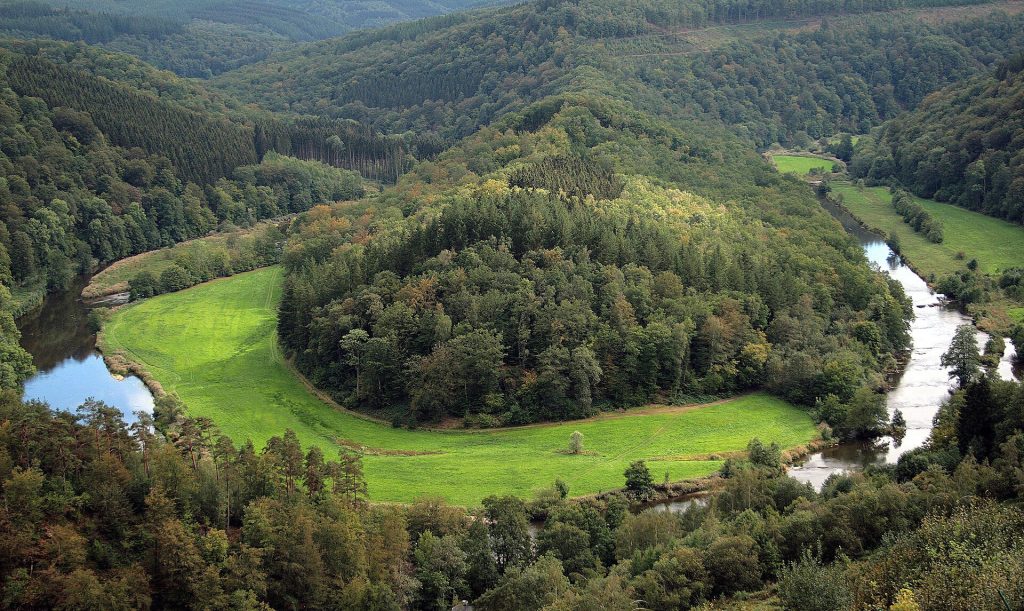

Today you drive into the heart of the valley. In Herbeumont (15 km, 0h15) the ruins of a castle stand on a rocky ridge above the meanders. According to the local tourist guide (2020), the towers are free to visit and look out over the bends of the Semois.
Between Herbeumont and Bouillon (25 km, 0h25) the river loops past villages such as Cugnon and Mortehan. Make a detour via Botassart to the Tombeau du Géant. From this viewpoint you look down on a hill in the middle of a loop of the Semois: the “giant’s tomb”. Legend has it that a giant leapt from the rocks rather than be taken prisoner by the Romans. The tourist office says the view is at its best at dusk, when mist gathers around the hill.
In Bouillon the castle sits on a rocky spur above the town. The tourist office calls it the oldest surviving remnant of feudalism in Belgium. Check the opening hours before you go.
Enjoy: Bouillon has charcuterie, and the whole area has cheese made from goat’s, sheep’s and raw cow’s milk by small producers. There are a few local breweries too.
Sleeping: there are campsites along the river, for example in Mortehan. A tent in the forest is only allowed on a designated aire; anywhere else you risk a fine of €25 to €100.
Day 3: Bouillon – Rochehaut – Vresse-sur-Semois (25 km, 0h30)
After 15 km (0h20) you reach Rochehaut, with its panorama over Frahan on the Semois. If you want to stretch your legs, the Les Échelles walk (5 km) is a challenge: it follows steep paths with fixed ladders and, according to the tourist office, is not suitable for young children.
Then you drive on to Vresse-sur-Semois (10 km, 0h10). The tourist office calls the village the cradle of tobacco growing, at the end of the 19th century. Tobacco-drying barns still stand in Vresse and in the villages of Laforêt and Gros-Fays. Vresse also drew painters, known as the École de Vresse, and an art centre shows around 300 of their works.
Fancy getting on the water? You can hire kayaks in places such as Alle-sur-Semois, Vresse, Poupehan, Bouillon and Mortehan. Check beforehand whether the river is open to kayaks; the tourist office refers to the Walloon kayaking website for this.
Enjoy: Semois tobacco is part of the local heritage; in Corbion and Bohan two businesses still process local tobacco. The area also has honey, herbs, fruit wine and jam from small producers.
Sleeping: again, choose a campsite, a motorhome area or a camping à la ferme. Back to Brussels it is 150 km (2h00).
Unpaved roads and off-road
This route stays on tarmac, and in Walloon forests that is also the rule. By car you may only use paved roads there, not chemins (earth or gravel tracks) or sentiers (paths). For an offence, the Walloon authorities can propose a settlement of €50 to €150.
- What is allowed: joining an organised drive on a temporarily waymarked route. You recognise one by an official sign with a date and permit number. The organiser applies for the waymarking at least 45 days in advance.
- Off-road sites: there is no public list of approved 4×4 sites. The only concrete example we found is not far from the route: a club weekend in 2025 on a hired site in Bertrix.
- Firebreaks, logging tracks and hunting paths are not public roads, even where there is no sign.
If you want real gravel under your tyres, neighbouring countries offer more. Everything by country is in our guide to legal off-road driving in Europe.
Where to sleep
- Campsite: the safest choice, and the only place where a roof tent is never in question.
- Aires d’accueil pour motor-homes and camping à la ferme: motorhome areas and approved farm campsites. Park4Night and CamperContact show motorhome areas and private pitches.
- Sleeping in your car: camping on the public road is banned in Wallonia, except on the motorhome aires. Never put anything outside your car.
- Roof tent: no rule mentions them. From the definition of camping, an unfolded roof tent probably counts as camping. That is our interpretation, not a written rule.
- With a tent in the forest: only on a designated aire, with permission and the owner’s consent. Two nights in a row in the same spot are not allowed. The fine is €25 to €100, doubled at night, in a group, between 1 March and 30 June and in protected nature areas. You can find bivouac sites on bivakzone.be.
- Fires: banned in Walloon forests, except at spots set up for them.
More in our guides to sleeping in your car, campervan or roof tent and wild camping in Europe.
When to go
- Spring to autumn: the season for the Semois Valley.
- Summer: the time for kayaking. Do check whether the river is open.
- Autumn: during a hunt, traffic in the Ardennes forests can be restricted or banned. Watch for the signs.
- Winter: winter tyres are not compulsory, but the Ardennes can be wintry. Orval stays open in winter, with shorter hours.
- From 1 March to 30 June the fine for camping in a Walloon forest is doubled.
We found no official figures on how busy the valley gets.
Shorter or longer
- Weekend (2 days): leave out the Gaume and Orval. Drive straight to Bouillon (2h00 from Brussels), do Herbeumont and the Tombeau du Géant on day 1, and Rochehaut and Vresse on day 2.
- Longer, with the Ourthe: combine the Semois with the Ourthe Valley around Durbuy (1h35 from Brussels), or start with the Meuse Valley around Dinant (1h15). Both are in our guide to driving in Belgium.
- Longer, across the border: the Semois flows on into France, and the GR 16 continues to Monthermé. What you need to arrange in France is in our guide to driving in France.
Another road trip nearby? Read our guide to the Eifel and the German Volcano Route.
Frequently asked questions
How many days do you need for the Semois Valley?
Allow three days. Pure driving time from Arlon to Vresse is only about 2h20 for 125 km, but you will want to stop at Orval, Herbeumont, Bouillon and Rochehaut. Two days also works if you start in Bouillon.
Can I sleep in my car or roof tent in the Semois Valley?
Not just anywhere by the road: camping on the public road is banned in Wallonia, except on the motorhome aires. The law says nothing about roof tents, but an unfolded one probably counts as camping. A campsite or a motorhome aire is the safe choice.
Can I drive off-road in the Semois Valley?
Not on your own. In Walloon forests you may only drive on paved roads. What you can do is join an organised drive on a temporarily waymarked route, marked by an official sign with a date and permit number.
Can I kayak on the Semois?
Yes, businesses hire out kayaks in places such as Alle-sur-Semois, Vresse, Poupehan, Bouillon and Mortehan. Check beforehand whether the river is open to kayaks.
Official sources
- Route and sights: Maison du Tourisme du Pays de Bouillon en Ardenne – visitor guide (PDF, 2020, French), Orval Abbey – practical information
- Vignette and low-emission zones: Vlaanderen.be – road vignette from 1 May 2027 (Dutch), LEZ.brussels
- Equipment and winter: Your Europe – Belgium, Touring – winter tyres and snow chains in Belgium (Dutch)
- Overnight stays and off-road: Wallex – Code forestier (French), Wallonie.be – Circuler en forêt (French), Wallonie.be – temporary waymarking (Dutch)