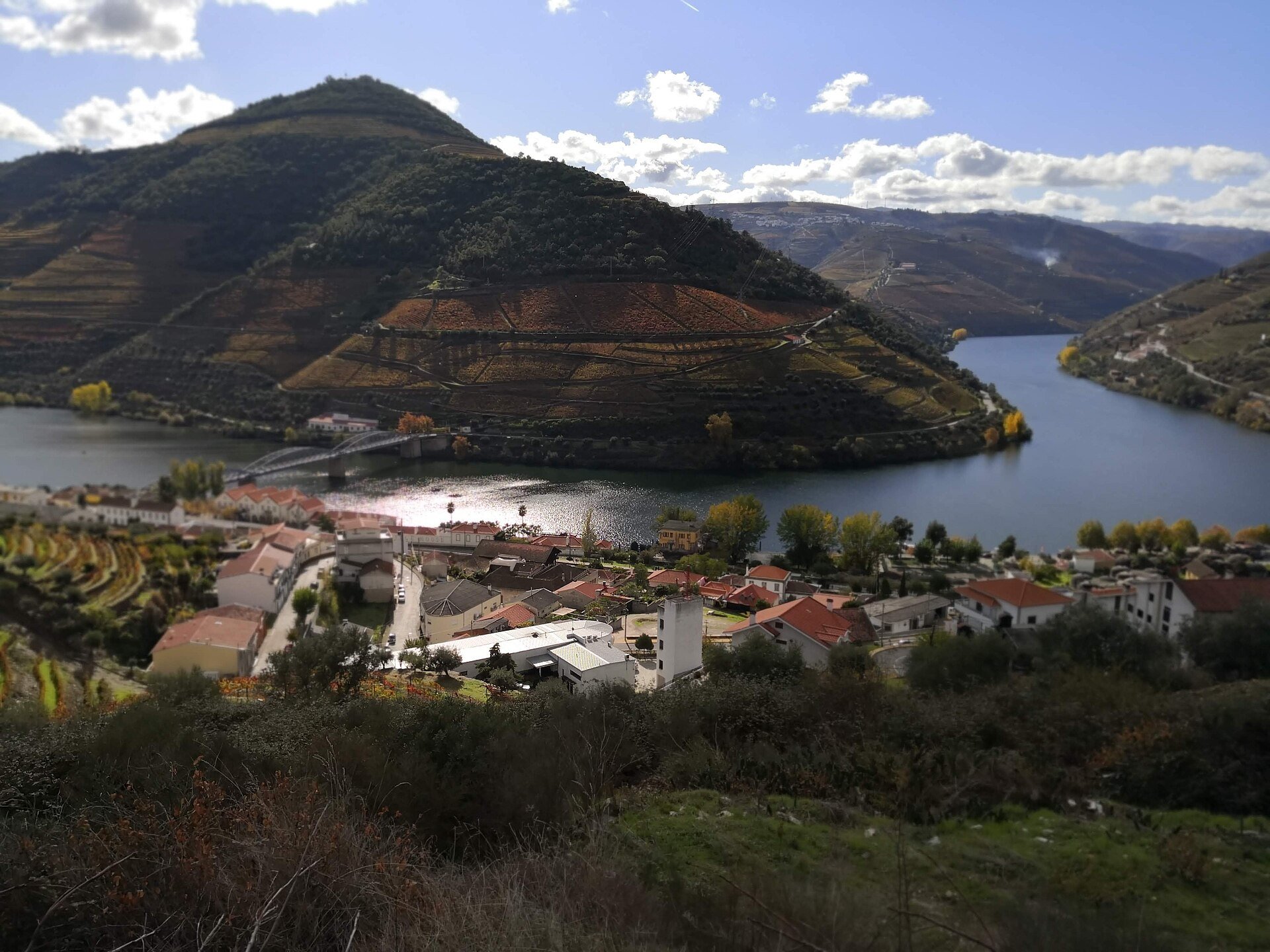
Photo above: Pinhão on the Douro. sanjorgepinho, Wikimedia Commons, CC BY-SA 4.0, cropped.

The Douro Valley is a wine landscape of terraces built into steep slopes, with the river far below. You drive from Porto to Peso da Régua, follow the N222 to Pinhão and then climb to the wine villages on the hillsides. The distances are short, so most of your time goes on stopping.
Last checked on 24 November 2026. Rules and tolls change: check the official sources listed at the bottom just before you leave.
The route at a glance
| Topic | What to expect |
|---|---|
| Start and finish | Porto – Peso da Régua – Pinhão, and back to Porto via Vila Real |
| Distance | About 290 km |
| Pure driving time | About 4h20 |
| Suggested length | 3 days; 2 days if you only want to see Peso da Régua and Pinhão |
| From Brussels | Porto 19h45, Peso da Régua 19h00; allow three days’ driving |
| Best time | Spring and autumn; the grape harvest is in September. The fire season (período crítico) usually runs from 1 July to 30 September |
| Road type | Motorway into the valley, then tarmac with many bends; narrower roads to the wine villages |
| Suitable for | Any car |
| Tolls, vignette and costs | No vignette; electronic tolls on some motorways, about 951 km toll-free since 2025. The N222 is an ordinary national road |
| Sleeping | Campsites, motorhome areas (ASA, 72 hours at most) and rooms at wine estates; a tent only at a campsite or with a permit from the municipality |
Driving times are model values, calculated with OSRM on OpenStreetMap data, without breaks, traffic jams or waiting times. On the N222 and in the wine villages you will stop often: allow far more time each day than the pure driving time.
Before you go
- Tolls: Portugal has no vignette. Roads with electronic tolls only have no toll booths: cameras record your number plate. With foreign plates you can use EasyToll (you link your bank card to your number plate at a machine at the border), TollCard, TollService or Via Verde Visitors. Since 1 January 2025 about 951 km of motorway has been toll-free, including the A24 and, on the A4, the Transmontana and Marão Tunnel sections beyond Amarante. So not all of the A4 is toll-free: expect tolls between Porto and Amarante. We have not checked every stretch between Porto and the Douro, so set up your toll payment in advance. More on our page about vignettes, tolls and low-emission zones.
- Equipment: sources contradict each other on whether a warning triangle and a hi-vis vest are mandatory with foreign plates. Carry both and you are covered. A V-16 light does not replace the triangle in Portugal. See mandatory car equipment by country.
- Winter: winter tyres are not mandatory. At the D9 sign, chains are required on the two driven wheels. Read more about winter tyres and snow chains.
- Fire risk: if you drive in summer, check the daily fire risk on ipma.pt. At very high or maximum risk, campfires are banned.
- Alcohol: 0.5 g/l, and 0.2 g/l for novice and professional drivers. On a wine route that matters: agree who drives.
Speed limits, tolls and overnight stays are covered in our guide to driving in Portugal.
The route, day by day
Day 1: Porto – Amarante – Peso da Régua (about 99 km, 1h21)
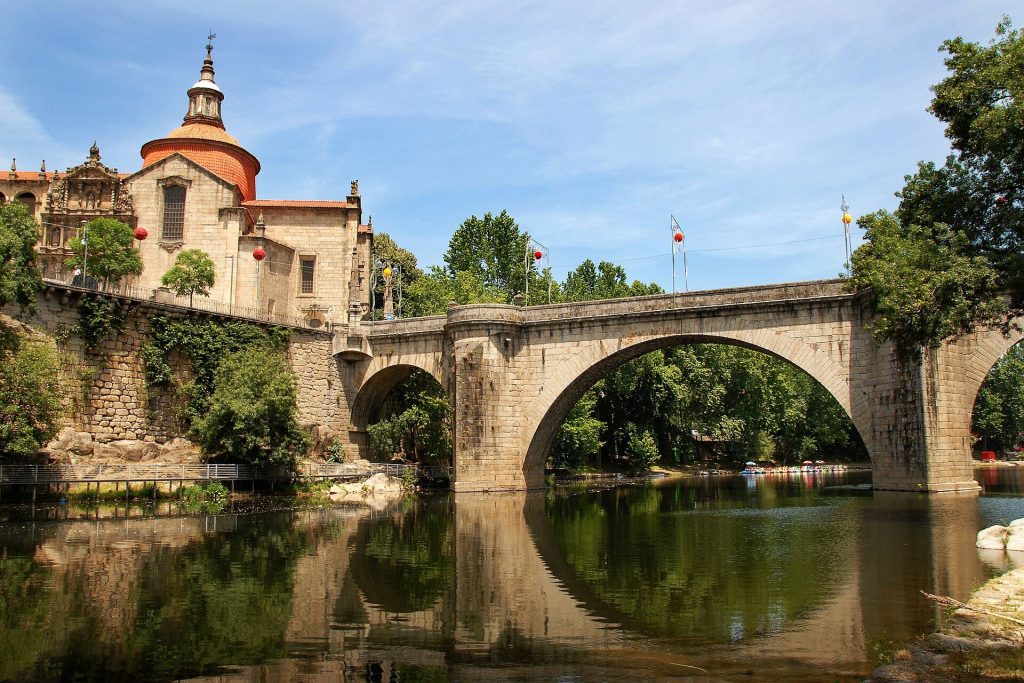

You set off from Porto, where the Douro flows into the Atlantic. On the motorway you reach Amarante in 44 minutes (61 km), a small town on the river Tâmega and a good place for a first stop. From Amarante to Peso da Régua is another 38 km (37 minutes). Driving direct, Porto–Peso da Régua is 95 km (1h17).
Peso da Régua sits on the Douro and is the gateway to the wine region. From here you see what makes the valley so recognisable: terraces on steep slopes, the oldest narrow and held up by schist walls, the later ones wider, from the late 19th and early 20th centuries. The area is on UNESCO’s World Heritage List as the Alto Douro Wine Region.
Enjoy: in Porto, a francesinha and a pastel de nata. Wine has been made in the Douro for some 2,000 years, and port has been known worldwide since the 18th century.
Sleeping: in or around Peso da Régua, at a campsite, a motorhome area (ASA, 72 hours at most, without unpacking anything) or in a room at a quinta, a wine estate.
Day 2: Lamego and the N222 to Pinhão (about 54 km, 1h00)
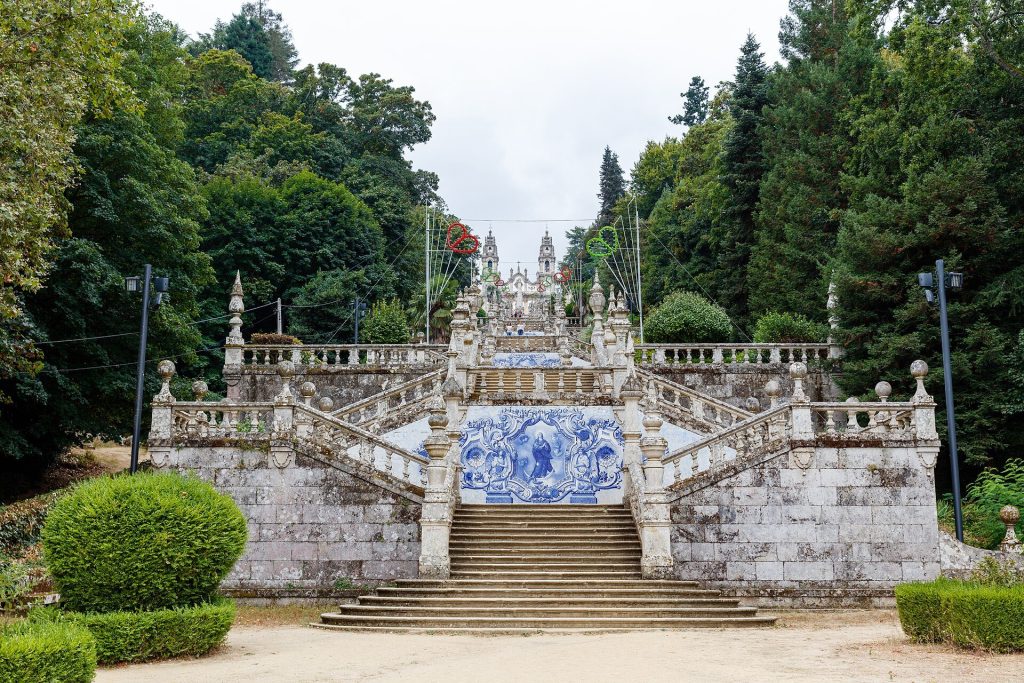

Start with a trip to Lamego, 13 km (15 minutes) south of Peso da Régua, with its long stairway up to the sanctuary of Nossa Senhora dos Remédios. Back in Peso da Régua, it is time for the highlight of the route.
On the N222 you drive from Peso da Régua to Pinhão: 27 km and 27 minutes by our calculation, but you will stop often. The road follows the valley between the terraces. Drive it in daylight and take your time on the bends: pull over in a lay-by or a village, never on a bend.
Pinhão sits on the Douro, surrounded by vineyards. The wine estates nearby are typical quintas: a main house with farm buildings and wineries. You can also get out on the water on a boat trip.
Enjoy: port and Douro wine at a wine estate. If you taste, let someone else drive.
Sleeping: in Pinhão or one of the villages above it, at a campsite, a motorhome area or a wine estate with rooms.
Day 3: Favaios, Vila Real and back to Porto (about 137 km, 2h03)
Climb from Pinhão to the wine villages on the slopes. Favaios is 14 km away (16 minutes), and around Provesende too the roads wind up through the vineyards. Here you see the whitewashed villages typical of the valley: halfway up the slope, often grouped around an 18th-century parish church.
From Favaios, drive to Vila Real (30 km, 38 minutes) and from there back to Porto (94 km, 1h09). If you want another night in the valley, push the return back by a day.
Enjoy: the cooking of the north, such as folar de Chaves, and from Trás-os-Montes posta mirandesa and sopa transmontana.
Sleeping: back in Porto, or an extra night in the valley. There is no national rule on simply sleeping in a car: the municipality decides, so watch the signs.
Unpaved and off-road
This route is paved throughout, and you will not need a 4×4 anywhere. Tracks between the vineyards often cross a wine estate’s land: only drive on them with the owner’s permission. We found no national ban on unpaved public roads in Portugal, but no official confirmation either. In protected areas, recreational off-roading is only allowed on existing roads and tracks. At fire danger level “muito elevado” or “máximo”, public forest areas and forest roads are off limits. More in our guide to legal off-road driving in Europe.
Where to sleep
- Campsite: the safest choice everywhere, and the only place where a roof tent is never in question.
- Motorhome areas (ASA): 72 hours at most, without unpacking anything. Apps such as park4night and CamperContact show them, and through Portugal EasyCamp you can stay at farms and wine estates.
- Campervan: vehicles officially registered as motorhomes may stay overnight for up to 48 hours in the same municipality (between 10 pm and 7 am), outside protected areas, Natura 2000 sites and coastal zones. Fines: €60 to €300, in protected areas €120 to €600.
- Ordinary car or roof tent: these fall outside the motorhome law. There is no national rule on simply sleeping in a car, and the rules say nothing about roof tents: the municipality decides.
- Tent: outside a campsite you always need a permit from the municipality and the landowner’s permission. The fine is €150 to €200, according to the 2002 legal text.
All the conditions are on our pages about sleeping in your car, campervan or roof tent and wild camping in Europe.
When to go
- Spring and autumn: the most pleasant seasons. The grape harvest is in September.
- Summer: hot in the valley. The fire season (período crítico) usually runs from 1 July to 30 September, and the government can extend it.
- Winter: December and January are the coldest and wettest months, and in the north it can then freeze and snow.
Shorter or longer
- Two days: Porto – Peso da Régua – the N222 to Pinhão, and back from Pinhão to Porto (124 km, 1h34).
- In reverse, from Brussels: Peso da Régua is closer to Brussels (19h00) than Porto (19h45). So drive the route in reverse and finish in Porto.
- Longer: continue up the valley to São João da Pesqueira (21 km, 20 minutes from Pinhão). Or head north: Chaves, where the national road EN2 begins, is 72 km (55 minutes) from Vila Real. The EN2 runs from Chaves (kilometre 0) to Faro (kilometre 738), through 35 municipalities.
Another road trip nearby? On the way to Portugal you cross Spain, where in the Bardenas Reales you can legally drive your own car through a semi-desert.
Frequently asked questions
How do I pay tolls on the way to the Douro in a foreign car?
Set it up in advance or at the border. With EasyToll you link your bank card to your number plate at a machine at the border. There are also TollCard, TollService (3 days unlimited for €20 plus €0.74) and Via Verde Visitors. The N222 itself is an ordinary national road.
Do I need a special car for the N222?
No. The N222 and the roads to the wine villages are paved and suitable for any car. They are winding, though, and narrow in the villages.
When is the grape harvest in the Douro?
In September. Spring and autumn are the most pleasant seasons for this route anyway; summer is hot, and it is also the fire season.
Can I sleep in my roof tent outside a campsite?
There is no national rule on it: the 48-hour rule only applies to officially registered motorhomes, and the rules say nothing about roof tents. The municipality decides. To be safe, put your roof tent up at a campsite.
Official sources
- Wine landscape: UNESCO – Alto Douro Wine Region
- Tolls and traffic rules: gov.pt – traffic rules and tolls, Your Europe – Portugal
- Overnight stays in a motorhome: Lei n.º 66/2021 (pdf)
- Wild camping: Decreto-Lei 310/2002
- Off-road: Diário da República – DL 218/95
- Fire risk: IPMA – daily fire risk
- EN2: Portuguese government – 738 km along the EN2 (24/10/2025)