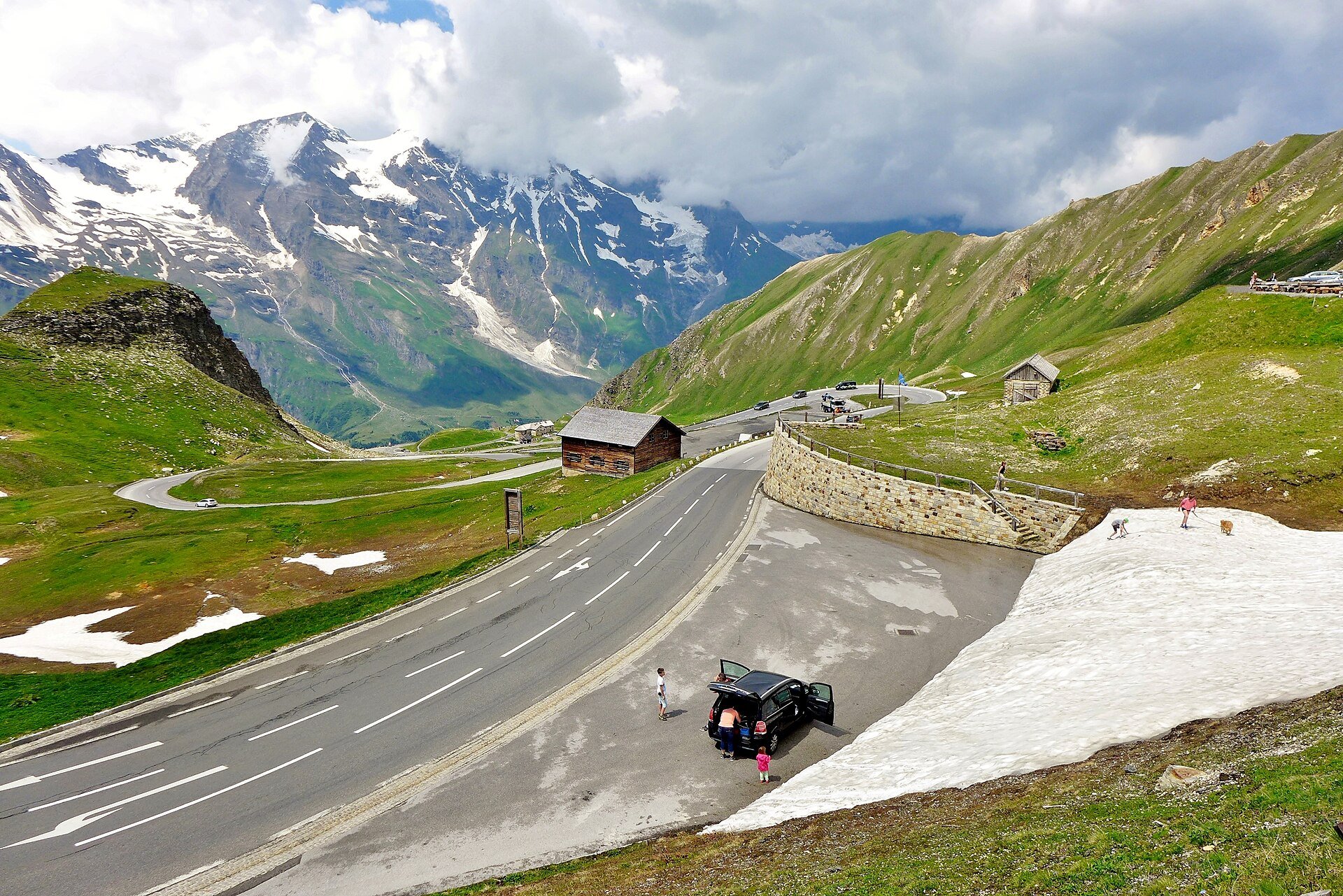
Photo above: The Grossglockner High Alpine Road at the Fuscher Törl. Bahnfrend, Wikimedia Commons, CC BY-SA 4.0, cropped.

The Großglockner High Alpine Road is Austria’s classic mountain road: 48 km and 36 hairpin bends up to 2,571 metres, with views of the Großglockner and the Pasterze glacier. Return via East Tyrol and the Felbertauernstraße and it becomes a loop of about 205 km, which you can drive in three relaxed days or one long summer day. It is tarmac all the way, so any car will do.
Last checked on 24 November 2026. Tolls and opening hours change every year: check the official sources listed at the bottom just before you leave.
The route at a glance
| Topic | What you need to know |
|---|---|
| Start and finish | Zell am See, as a loop via the Großglockner, Heiligenblut, Lienz, Matrei in Osttirol and Mittersill |
| Distance | About 205 km, including the side road to the Kaiser-Franz-Josefs-Höhe (the side road to the Edelweißspitze comes on top) |
| Pure driving time | 3h55 |
| Suggested number of days | 3 days, or 1 long summer day |
| From Brussels (our reference point) | Zell am See 9h55; Heiligenblut 11h05 if you drive over the Glockner |
| Best time | Early May to early November, when the High Alpine Road is open. Opening hours are longest from 1 June to 31 August (5.30 am to 9 pm) |
| Road type | Tarmac. On the High Alpine Road 36 hairpins and a 70 km/h limit; otherwise valley roads and the Felbertauernstraße |
| Suitable for | Any car. Campervans and caravan combinations up to 3.5 t pay the car rate |
| Tolls, vignette and costs | Digital vignette on the motorway; Großglockner €46.50 a day, Felbertauernstraße €13.50, combined ticket for both €56 (2026 rates) |
| Sleeping | Campsites, guesthouses and hotels in the valleys, mountain huts and Schau aufs Land farms. Not along the Glockner road, and no wild camping in the national park |
The driving times are model values from the OSRM route planner, without breaks, traffic jams or border checks. They assume the Großglockner is open. Coming from elsewhere? Plan your own approach to Zell am See.
Before you go
- Vignette: if you drive on Austrian motorways, you need a digital vignette linked to your number plate. From 1 January 2027 a 10-day vignette costs €13.10 and an annual vignette €108.90 (€106.80 if you buy it in 2026). An annual or two-month vignette bought online only becomes valid 18 days after purchase. A 10-day vignette bought online is valid immediately, as is one from a sales point such as the ÖAMTC, ARBÖ or ADAC.
- Tolls on the loop: the Großglockner costs €46.50 a day, €36.50 after 6 pm, €40 in an electric car. Advance tickets are cheaper, from the ÖAMTC, ARBÖ and ADAC, even without membership; at the ÖAMTC a day ticket cost €41.50 in 2026. The Felbertauernstraße costs €13.50. If you drive the whole loop, look at the €56 combined ticket: one trip over the Glockner and one over the Felbertauernstraße within 30 days. Discounts cannot be combined. These are the 2026 rates; the 2027 rates have not been published yet.
- In your car: a warning triangle, a hi-vis vest for the driver (put it on before you get out) and a first-aid kit. Carry your original driving licence and registration document.
- Winter: from 1 November to 15 April you need winter tyres on all wheels in snow, slush or ice. If you drive in May or late October, bear in mind that it can snow at this altitude.
All the rules for the country are in our guide to driving in Austria. More on the vignette and the 18-day rule in our guide to vignettes, tolls and low-emission zones, the packing list in mandatory car equipment by country and the winter rules in winter tyres and snow chains in Europe.
The route, day by day
Day 1: Zell am See – Heiligenblut over the Großglockner (70 km, 1h50)

From Zell am See you head south into the Fusch valley, to Fusch an der Großglocknerstraße. The toll road starts at the pay point in Ferleiten. Set off early: in summer the road opens at 5.30 am. Last entry is 45 minutes before closing, and outside opening hours there is a night-time driving ban.
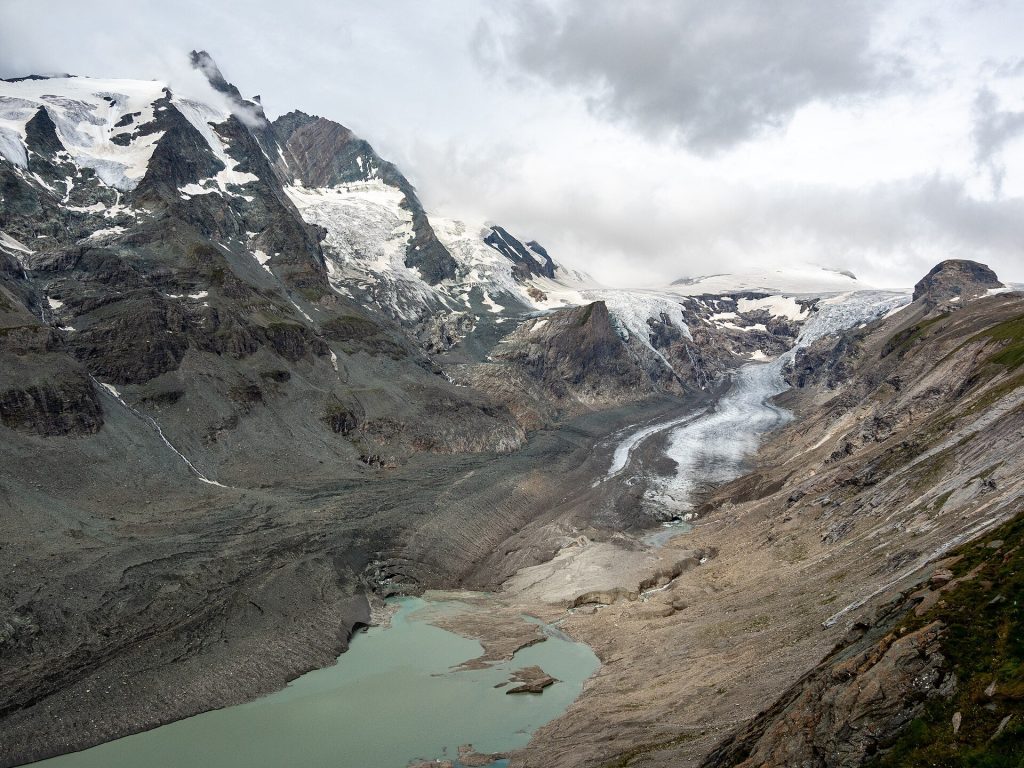
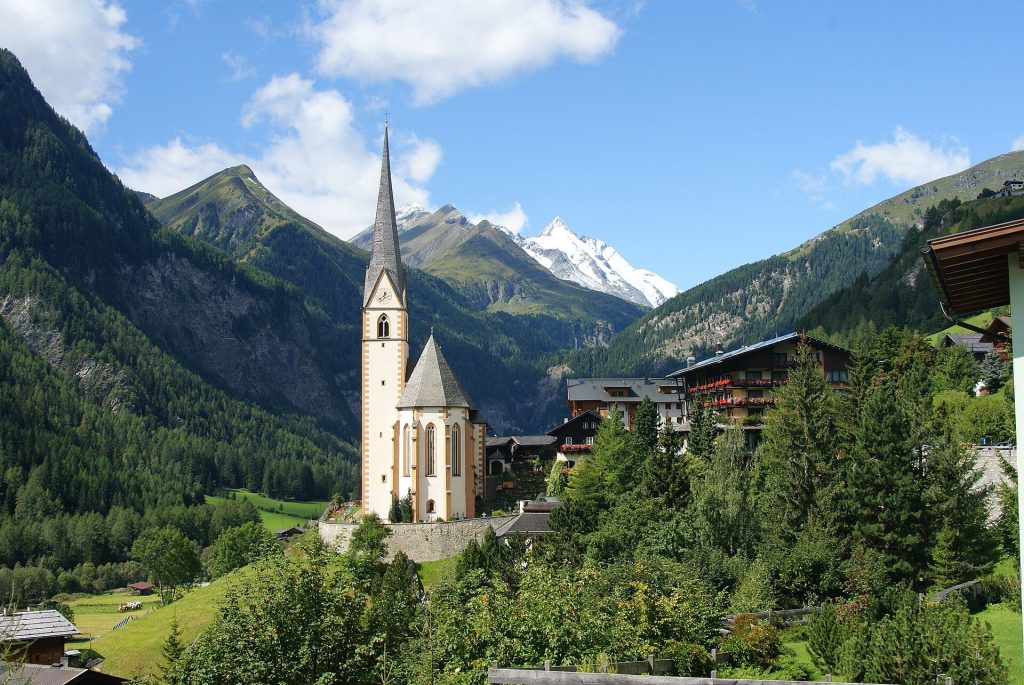
On the way up, stop at the Fuscher Törl, the photo spot on the north side, and at the Fuscher Lacke, with an exhibition on how the road was built. A side road takes you to the Edelweißspitze: at 2,571 metres the highest point, with a panorama of 30 peaks above 3,000 metres. On the south side, take the side road up to the Kaiser-Franz-Josefs-Höhe, with its visitor centre (daily from 10 am to 5 pm) and views of the Großglockner and the Pasterze glacier. Then descend to Heiligenblut and its Gothic church.
Enjoy: Kaiserschmarren, or coffee and cake with a view on the way, Bauernkrapfen and alpine cheese on the Salzburg side, and Carinthian cheese noodles (Kärntner Kasnudeln) once you are in Carinthia.
Sleeping: a guesthouse, hotel or campsite in the valley around Heiligenblut, or up on the pass: the road operator mentions overnight stays at the Edelweißspitze or the Kaiser-Franz-Josefs-Höhe. Camping along the Glockner road is not allowed, and wild camping and fires are banned in the Hohe Tauern National Park. Heiligenblut is in Carinthia, where short-term parking is allowed, but nothing says whether a whole night in your car still counts as short.
Day 2: Heiligenblut – Lienz – Matrei in Osttirol (65 km, 1h05)

A short driving day, with time for a walk. If you want to go back up to the Kaiser-Franz-Josefs-Höhe because the weather let you down yesterday: a second day cost an extra €17.50 in 2026. You follow the Möll valley down and cross the Iselsberg to Lienz, with its historic old town. Then you head north to Matrei in Osttirol, at the foot of the Felbertauernstraße.
Enjoy: East Tyrol is part of Tyrol. That means Tyrolean speck, Graukäse and alpine cheese, Schlutzkrapfen and Tiroler Gröstl, or a Marend: a cold platter of speck, bread and cheese.
Sleeping: a campsite, a guesthouse or an Alpenverein mountain hut (book through hut-reservation.org). In Tyrol, sleeping in your car or roof tent is banned outside campsites and zones the municipality opens up. Wild camping is banned too, with fines of up to €600.
Day 3: Matrei in Osttirol – Mittersill – Zell am See (65 km, 1h00)
The Felbertauernstraße (€13.50, or included in the combined ticket) takes you back to the Salzburg side. In Mittersill, the Hohe Tauern National Park visitor centre shows a 360° film about the park. Then follow the Salzach valley east, back to Zell am See. If you have time, first drive west to the Krimml Waterfalls (see “Shorter or longer”).
Enjoy: in the Pinzgau, the valley of Mittersill and Zell am See, look for Bauernkrapfen, Muas or game. For more, follow the Via Culinaria, a culinary route through the Hohe Tauern. Look out for a Hofladen, a farm shop, for alpine cheese to take home.
Sleeping: in the state of Salzburg you may sleep in your car unless the municipality bans it. You are certainly legal on a campsite or at a Schau aufs Land farm.
Unpaved and off-road
This loop is tarmac only, and that is no accident. In Austria you may only drive on a forest road (Forststraße) with the permission of the owner or the road operator, and many gravel roads have a no-entry sign or a barrier. Driving onto a clearly closed forest road costs up to €730, and up to €3,630 in serious cases. In Carinthia, driving off roads and car parks is explicitly banned.
Want to test your SUV or 4×4 anyway? The ÖAMTC runs SUV training with your own car at its training centres. One of them is in Saalfelden, north of Zell am See; ask there what is on the programme. Free driving with your own 4×4 is possible at the Red Bull Ring in Spielberg, from €132 for 3 hours; 2027 dates are not out yet. More in our guide to legal off-road driving in Europe.
Where to sleep
The loop runs through three states, each with its own rules. In Salzburg (Zell am See, Fusch, Mittersill) you may sleep in your car unless the municipality bans it. In Carinthia (Heiligenblut) it is unclear. In Tyrol (Lienz, Matrei) it is banned, roof tents included. Austria has no general “one night to rest” rule. So plan your nights at a campsite, a guesthouse or mountain hut, or at a Schau aufs Land farm: a network of some 900 farms where you may stay for up to 24 hours, roof tents included. Membership costs from €19.90 a year.
Every state is covered in our guide to sleeping in your car, campervan or roof tent. With a tent, see wild camping in Europe: in forests it is banned everywhere without the owner’s permission.
When to go
- Season: the High Alpine Road is open from early May to early November. It is closed now; the operator announces the reopening for early May 2027, without a fixed date.
- Opening hours (2026): until 31 May from 6 am to 8 pm, from 1 June to 31 August from 5.30 am to 9 pm, from 1 September from 6 am to 7.30 pm. Last entry is 45 minutes before closing.
- Summer: the long days give you the most leeway. Leave early if you want to take the pass at your own pace.
- Early and late season: in May and October it can snow up high. From 1 November to 15 April, winter equipment is required in wintry conditions. Outside the season, Heiligenblut can only be reached from the south, which makes the drive from Belgium longer.
Shorter or longer
In one day
The whole loop from Zell am See is 205 km and 3h55 of pure driving. With the summer hours, that fits into one day with stops on the pass. Take the combined ticket for the Glockner and the Felbertauernstraße.
Longer: the Krimml Waterfalls and the Gerlos Alpine Road
On day 3, drive west from Mittersill to Krimml and its waterfalls, and carry on over the Gerlos Alpine Road if you like. It is open all year and costs €13 a day (2026), with a discount if you hold a Glockner ticket for the same day. The road operator also suggests a bigger loop, the Großglockner Royal Tour: about 320 km and 6 hours of driving, taking in Lienz, the Pustertal high road and the Gailberg saddle, among others.
On to Carinthia: the Nockalmstraße
From Heiligenblut you can also head east to the Nockalmstraße: 34 km and 52 hairpins up to 2,042 metres, through the Nockberge UNESCO biosphere park. It is open from early May to late October and costs €25 a day (2026). Motorbikes are banned there from 6 pm to 8 am.
Another road trip nearby? Drive the three passes of Grimsel, Furka and Susten in Switzerland, or the gravel road of the Alta Via del Sale in Italy.
Frequently asked questions
How much does the Großglockner High Alpine Road cost?
In 2026 a car day ticket cost €46.50, €36.50 after 6 pm and €40 for an electric car. Advance tickets from the ÖAMTC, ARBÖ or ADAC are cheaper. The combined ticket with the Felbertauernstraße cost €56. The 2027 rates have not been published yet.
When is the Großglockner open?
From early May to early November, during the day: in summer from 5.30 am to 9 pm, shorter in the early and late season. Driving at night is not allowed. The 2027 reopening has been announced for early May.
Can I sleep in my car or roof tent along the way?
Not along the Glockner road, and not in East Tyrol either, because Tyrol bans it outside campsites and designated zones. In Salzburg it is allowed unless the municipality bans it; in Carinthia it is unclear. You are certainly legal on a campsite or at a Schau aufs Land farm.
Do I need a vignette for this loop?
The loop itself uses toll roads and ordinary roads. If you arrive on an Austrian motorway, you do need a digital vignette. For a short trip a 10-day vignette is enough, and it is valid immediately when bought online.
Official sources
- Route and tolls: Großglockner – prices and opening times, Großglockner – Roadtrips brochure, ÖAMTC – Großglockner advance tickets, Gerlos Alpine Road – prices, Nockalmstraße
- Vignette: oesterreich.gv.at – Vignette, ÖAMTC – Vignette 2027
- Equipment and winter: § 102 KFG, ÖAMTC – winter equipment requirement
- Overnight stays: oesterreich.gv.at – Campen, Hohe Tauern National Park – FAQ, Schau aufs Land
- Off-road: oesterreich.gv.at – Betreten des Waldes, ÖAMTC – SUV Onroad & Offroad Training