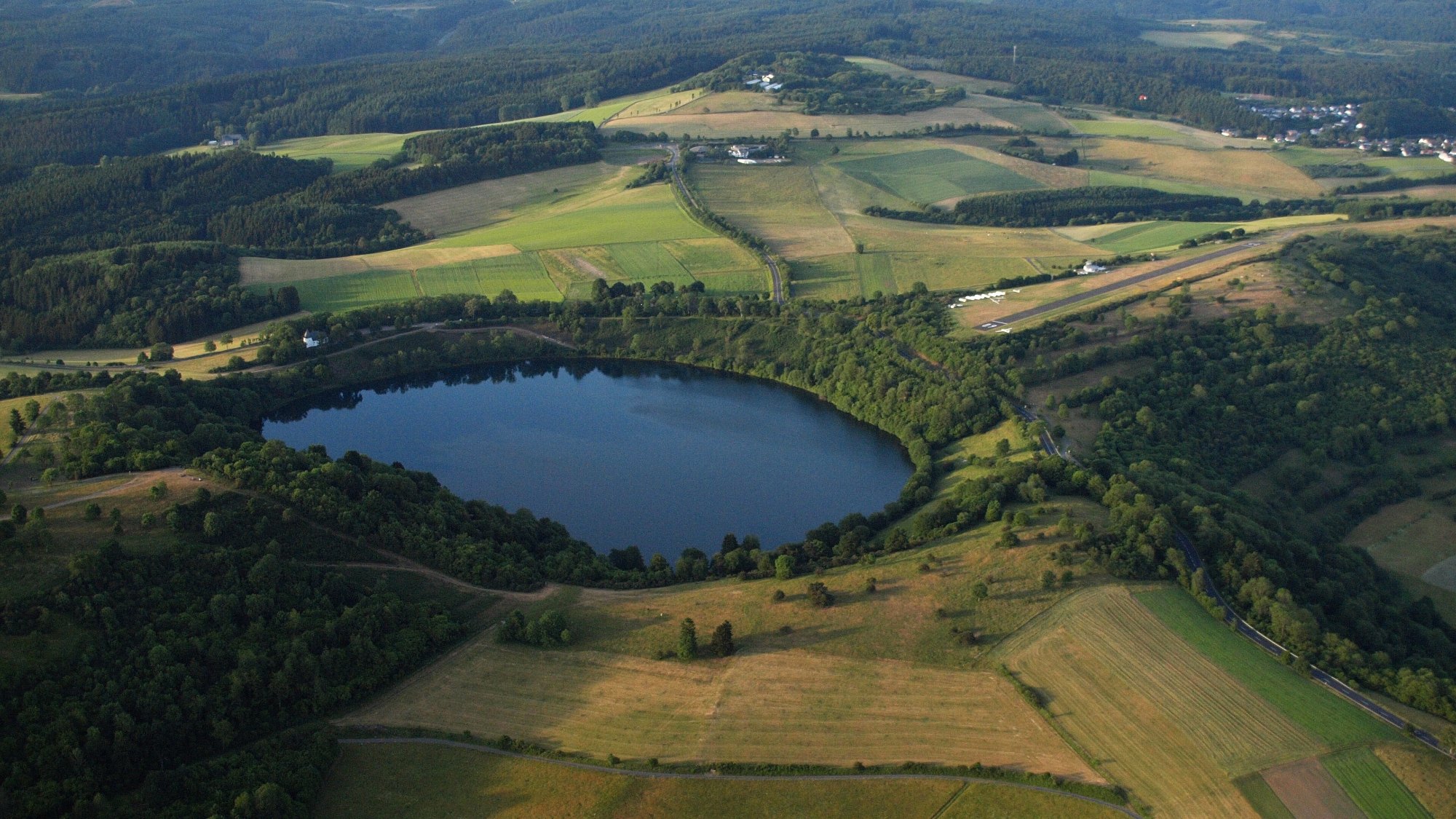
Photo above: The Weinfelder Maar near Daun, in the Volcanic Eifel. Wolkenkratzer, Wikimedia Commons, CC BY-SA 4.0, cropped.

Germany is close at hand: from Brussels you reach the Eifel in just over three hours, and the Black Forest or the Bavarian Alps in a long day’s drive. Along the way you use motorways without tolls or a vignette, and holiday routes past volcanic lakes, vineyards and castles. Off-road driving is possible too, but at a dedicated site, on a training course or at an event.
- From BrusselsEifel in 3h05
- Vignette and tollsNone, apart from two tunnels
- Low-emission zonesUmweltplakette in 35 zones
- AutobahnNo limit, 130 advised
On this page: Regions Road trip Rules When to go Food Questions
The best regions and routes for a road trip
With the driving time from Brussels, without breaks or traffic.

3h05
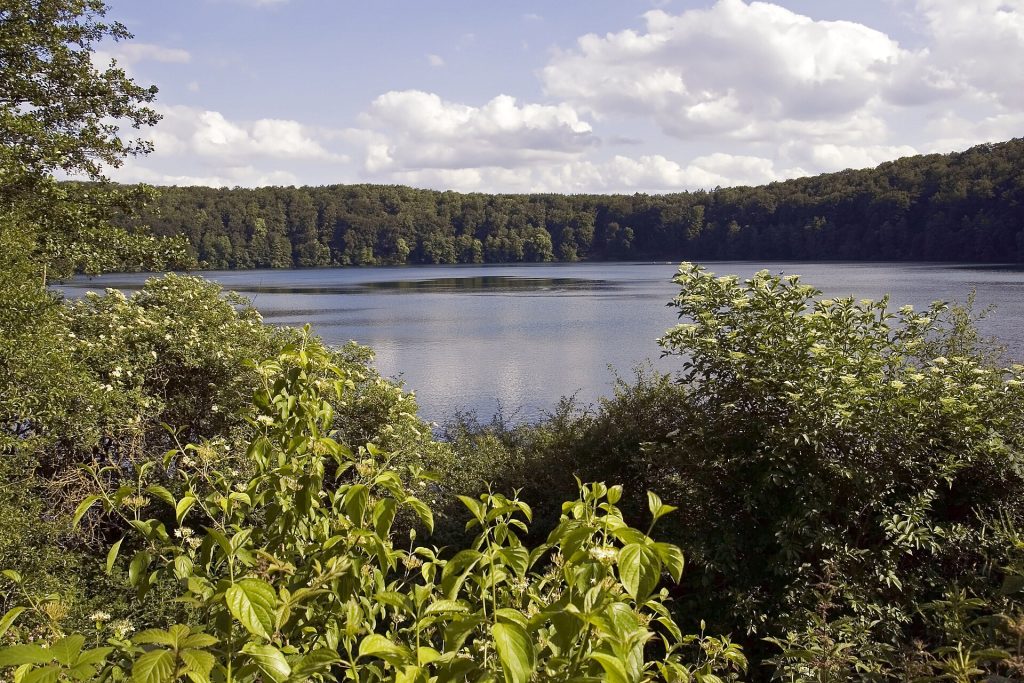
Eifel: the German Volcano Route
280 km past crater lakes and volcano museums, starting at the Laacher See. Easy to combine with an off-road course at the Nürburgring.
More about this region
From the Laacher See, the Deutsche Vulkanstraße winds 280 km past crater lakes (Maare) and volcano museums. In summer you can swim in some of the maars, such as the Pulvermaar. Combine the drive with an off-road course at the Nürburgring; Nürburg is 3h05 from Brussels.

3h20
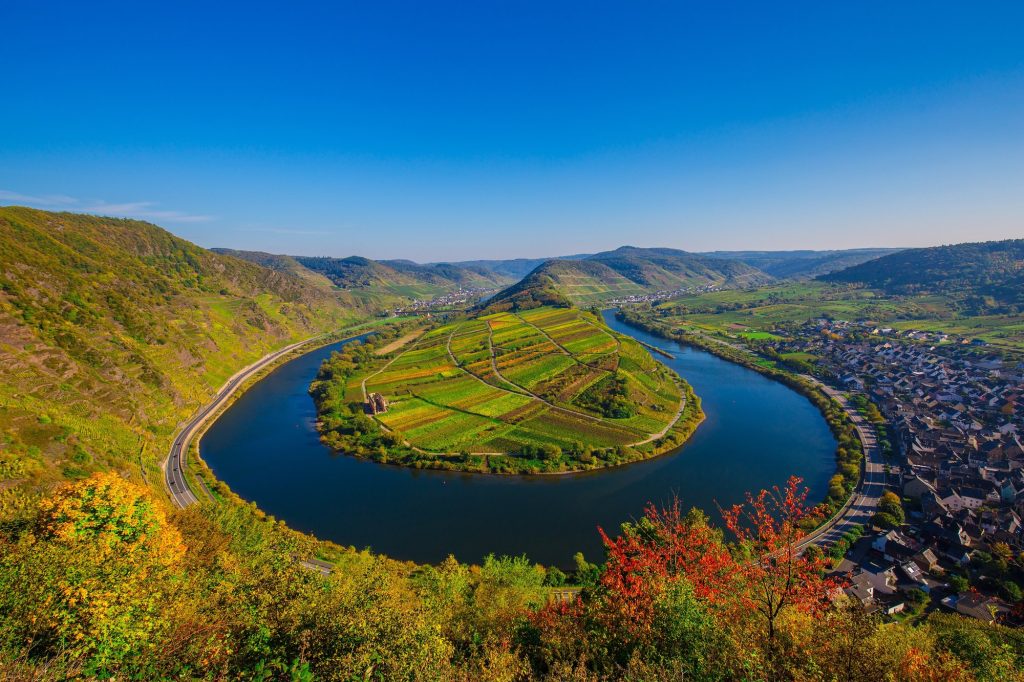
The Moselle
Steep vineyards along the river, with the Calmont near Bremm and campsites by the water.
More about this region
Steep vineyards along the river: near Bremm lies the Calmont, which the German National Tourist Board calls the steepest vineyard in Europe. There are campsites along the river, for example in Burgen. Cochem is 3h20 from Brussels.

4h35
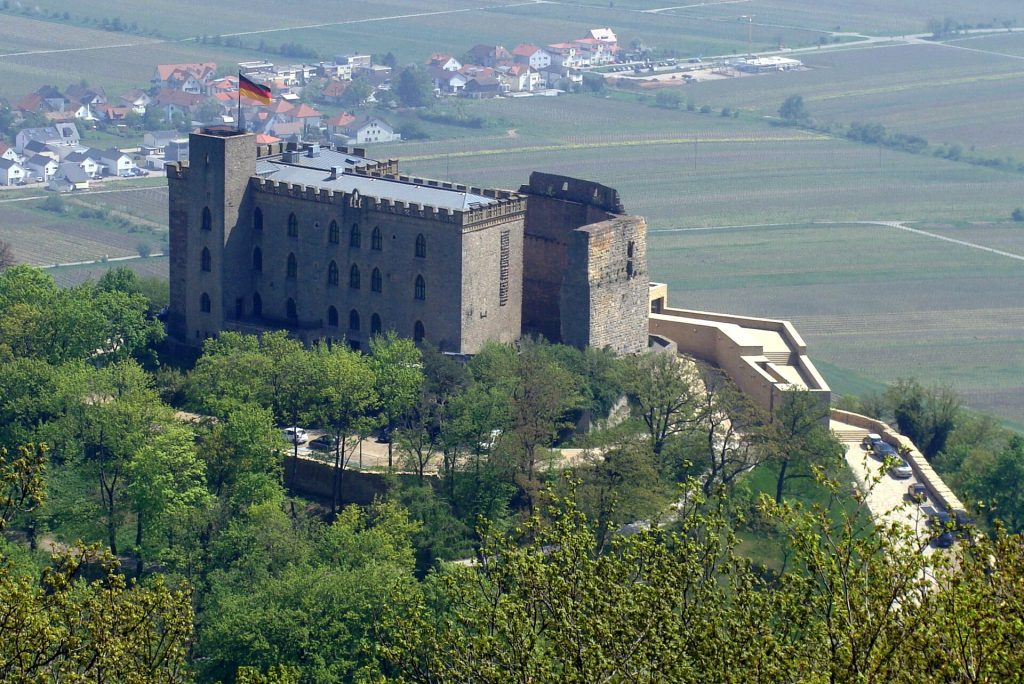
Palatinate: the German Wine Route
85 km from Bockenheim to Schweigen, past the Hambacher Schloss and the Palatinate Forest. At its best in late summer.
More about this region
A short route of 85 km, from Bockenheim to Schweigen, past the Hambacher Schloss and along the edge of the Palatinate Forest, a biosphere reserve. At its best in late summer. For a night in nature, the Palatinate Forest has Trekkingplätze. Neustadt an der Weinstraße is 4h35 from Brussels.

5h45
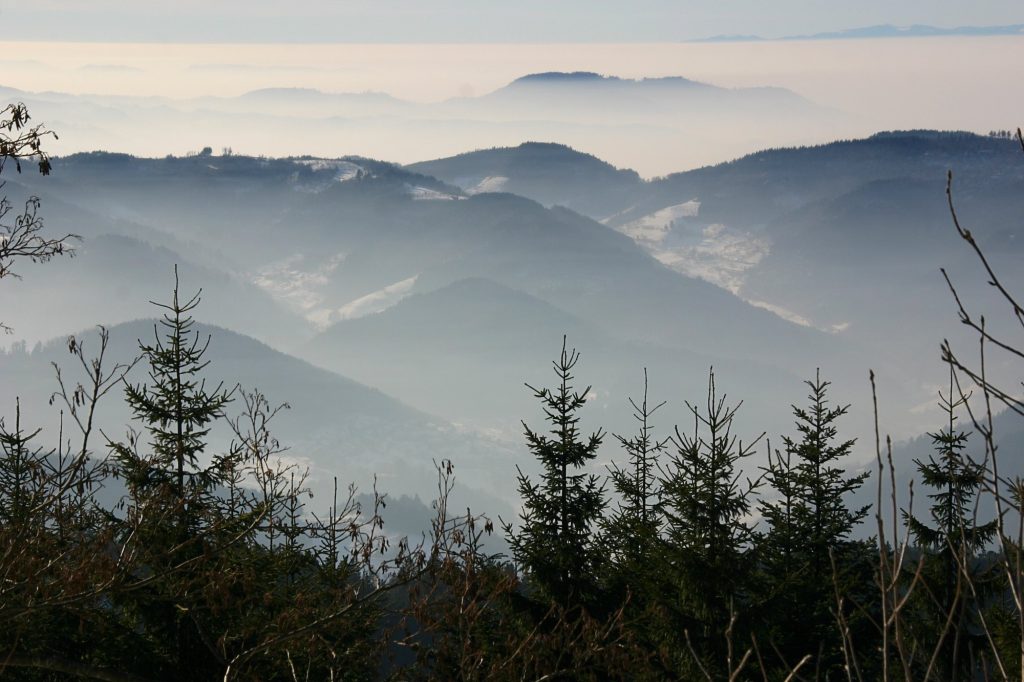
Black Forest: the Black Forest High Road
The B500 from Baden-Baden to Freudenstadt, which in 1932 became Germany’s first holiday route.
More about this region
The B500 between Baden-Baden and Freudenstadt is 60 km long and in 1932 became Germany’s first holiday route. You can combine it with the Tälerstraße (100 km). Freudenstadt is 5h45 from Brussels.

5h15
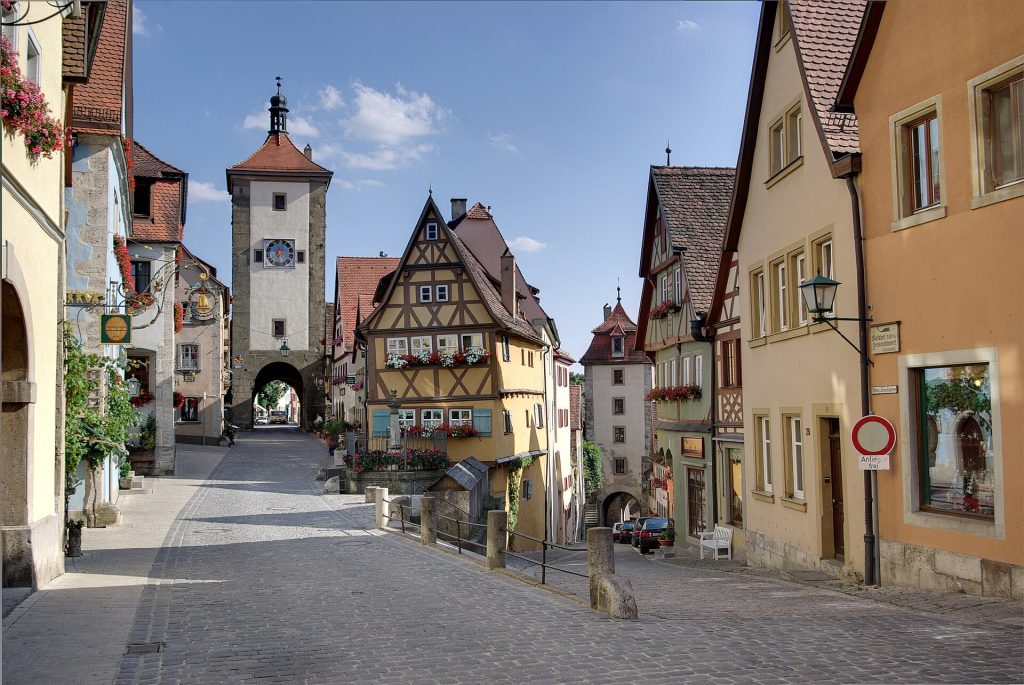
The Romantic Road
460 km from Würzburg to Füssen, past Rothenburg, the Wieskirche and Neuschwanstein.
More about this region
The Romantische Straße runs 460 km from Würzburg to Füssen, past Rothenburg, the Wieskirche and Neuschwanstein. Follow the brown signs, which partly take you along minor roads. Würzburg is 5h15 from Brussels, Füssen 7h50.

450 km
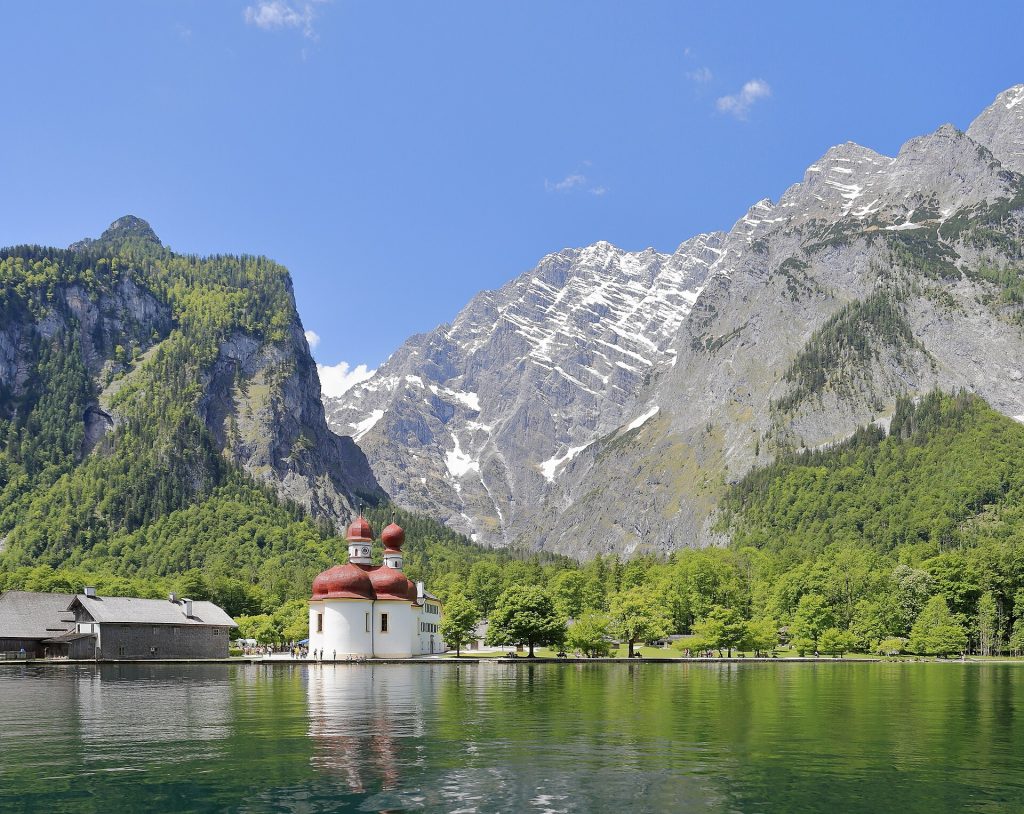
The German Alpine Road
From Lake Constance to the Königssee, with mountain lakes, views of the Zugspitze and more than 25 castles.
More about this region
Around 450 km from Lindau on Lake Constance to Schönau am Königssee, with mountain lakes, views of the Zugspitze and more than 25 castles. Most popular in summer.
Road trip guide
Eifel and the German Volcano Route in 3 days
3 days · maars, craters and the Nürburgring
Day by day past the maars and craters of the Volcanic Eifel: driving times, where you can legally sleep and what not to miss on the way.
The rules at a glance
Last checked on 24 November 2026. Rules change: check the official source listed at the bottom just before you leave.
Driving in Germany
Autobahn: no fixed limit, 130 advised
50 in built-up areas, 100 outside. In a traffic jam you form a rescue lane straight away.
All rules
- Autobahn: for cars up to 3.5 tonnes there is no fixed limit, but there is an advisory speed (Richtgeschwindigkeit) of 130 km/h. Going faster breaks no rule, but if you have an accident you can be held partly liable. Where a sign shows a limit, that limit applies.
- With a caravan or trailer the limit is 80 km/h outside built-up areas and on the motorway, or 100 km/h with a Tempo 100 exemption. If visibility is below 50 m, everyone drives at 50 km/h at most.
- Keep right unless overtaking, and merging in turn (zip merging) is mandatory.
- Rettungsgasse: in a traffic jam, form an emergency corridor straight away. Drivers in the far-left lane move to the left; all other lanes move to the right.
- Distance: keep a gap in metres of at least half your speed, so 50 m at 100 km/h. The police check this strictly.
- Speed camera warnings in your sat nav or in an app are banned.
- In towns, priority to the right applies at junctions without signs. More and more cities are introducing 30 km/h.
- Phones hands-free only. Children up to 12 years or 150 cm travel in a child seat.
- Alcohol: between 0.5 and 1.09 g/l you pay €500 and lose your licence for a month. From 1.1 g/l, or from 0.3 g/l with signs of impairment, it is a criminal offence.
- Fines: the German penalty points system also applies to foreign drivers. The police can collect fines on the spot and ask for a deposit, and fines can be sent to your home address.
Vignette, tolls and low-emission zones
No vignette or tolls, but the Umweltplakette
A green sticker in 35 Umweltzonen, also for foreign cars. Without one you pay €100.
All rules
Germany has no vignette and no tolls for cars. Only two private tunnels charge a toll: the Warnow Tunnel in Rostock and the Herren Tunnel in Lübeck. What you do need to think about is the emissions sticker.
- Umweltplakette: in 35 Umweltzonen (as of October 2026) you need a green sticker, also with a foreign car. Driving without one costs €100.
- Fewer zones: since late 2024, 11 have gone, including Hanover, Mannheim and Ulm. Stuttgart still requires the sticker.
- Crit’Air does not count: a French sticker is not valid in Germany.
- Order in good time: before you leave, from an approved issuer such as TÜV or DEKRA. Zones can also change during your trip.
- Heading further south? Austria and Switzerland do require a vignette.
All countries side by side, with prices and official sales channels, are in our guide to vignettes, tolls and low-emission zones in Europe.
What you need in the car
Triangle, vest and first-aid kit
Sources disagree on whether this applies to foreign plates, so simply carry all three.
More details
- Triangle, vest and first-aid kit: § 53a StVZO requires a warning triangle and a vest. According to ADAC and ANWB, a first-aid kit meeting DIN 13164 is also required.
- Does it apply to your car? Sources disagree. Your Europe lists all three as mandatory; the motoring clubs ADAC, ANWB and TCS say the requirement only applies to German-registered cars. In practice, carry all three anyway. The ANWB recommends a vest for every occupant.
- Fire extinguisher: not required in Germany. If your car is registered in Belgium, you must carry one anyway.
- Documents: your driving licence, the vehicle registration certificate and proof of insurance. Within the EU, a number plate with the EU band and your country letter is enough.
This assumes an EU-registered car. The full packing list is on our page about mandatory car equipment by country.
Winter
3PMSF winter tyres in wintry conditions
No fixed period: the weather decides. Tyres marked only M+S no longer count.
More details
In winter there is no fixed period. In black ice, snow, slush, ice or frost you need winter tyres on all four wheels, also with a foreign car. Since 1 October 2024 only tyres with the 3PMSF symbol count; tyres marked M+S only are no longer enough. The fine is €60 to €100. Snow chains are mandatory where a sign says so, and studded tyres are banned. If you drive through Germany to the Alps, this rule applies along the way too. More in our guide to winter tyres and snow chains.
Where to stay overnight
One night to rest is allowed
Without camping behaviour and not in nature reserves. Trekkingplätze are the legal way to camp in nature.
All rules
- Campsites and Stellplätze: Germany has around 2,900 campsites. The ADAC platform PiNCAMP lists campsites and motorhome areas (Stellplätze), and promobil’s free Stellplatz-Radar app shows motorhome areas along your route.
- Sleeping in your car or campervan: you may sleep one night in a public car park or by the road to become fit to drive again, unless a sign bans it. The well-known “10-hour rule” is not in any law. Your vehicle must always be ready to leave: no awning, chairs, levelling blocks or lowered legs. It is not allowed in nature reserves or national parks, and supermarket car parks are private property.
- Roof tent: there is no rule. With the roof tent unfolded your vehicle is not ready to leave, so it probably counts as camping. That is our interpretation. Choose a Stellplatz that accepts roof tents, or a campsite.
- Wild camping is banned in principle. It is not allowed in national parks or Naturschutzgebiete (nature reserves), and in principle not in forests either (in Brandenburg only with the owner’s written permission); each state regulates the rest. In Brandenburg you may pitch a tent for one night if you travel on foot, by bike, on horseback or by canoe. In Mecklenburg-Vorpommern, walkers without a motor vehicle may camp for one night, but not in national parks or nature reserves. If you travel by car, these rules do not cover you in either state.
- Trekkingplätze are the legal alternative, for example in the Palatinate Forest, the Eifel, the Black Forest and Saxon Switzerland. You book online, stay one night and only get the exact location after booking. You can only reach them on foot, so park elsewhere and walk in.
- Fires are banned in principle in the forest, except at designated spots.
Read more in our guides to sleeping in your car, campervan or roof tent and wild camping in Europe.
Off-road and unpaved roads
Forest roads are banned without a permit
Legal options are off-road parks, training courses and events, such as Böser Wolf in Hesse.
All rules
Under the forest laws of the federal states, driving a car on forest roads is banned without a permit. In Brandenburg the fine can reach €20,000. In practice, legal off-road driving happens at off-road parks, on training courses and at events. A few places where you can bring your own vehicle (2026 prices):
- Böser Wolf, Knüllwald (Hesse, on the A7): €35 per vehicle per day, €60 per weekend, camping €13 per person per night. Open on selected weekends. A roof or roll bar and liability insurance are mandatory. Winter break until 26 March 2027.
- Karenz and Steinhagen (Mecklenburg-Western Pomerania): €40 and €20 a day with your own vehicle.
- Training and events: Bilster Berg near Bad Driburg (training in your own car, 4h25 from Brussels), Offroad am Nürburgring (check whether you can drive your own car there) and the ADAC Offroad Event in Malente, with a roadbook drive on gravel roads.
What is legally possible in the other countries is in our guide to legal off-road driving in Europe.
Everything in one table: Germany at a glance
| Topic | What applies |
|---|---|
| Driving time from Brussels | Nürburg (Eifel) 3h05 · Würzburg 5h15 · Füssen 7h50 |
| Speed limits | 50 km/h in built-up areas, 100 outside; Autobahn: no fixed limit, advisory speed 130 |
| Alcohol limit | 0.5 g/l; 0.0 under 21 and during the probationary period |
| Vignette and tolls | None, except two private tunnels |
| Low-emission zones | Umweltplakette in 35 Umweltzonen, also for foreign cars |
| Mandatory in the car | Conflicting for foreign plates; carry a triangle, vest and first-aid kit |
| Winter rules | Winter tyres with the 3PMSF symbol in wintry conditions; no fixed period |
| Sleeping in the car/roof tent | One night to rest, without camping behaviour; roof tent: no rule (probably camping) |
| Wild camping | Banned in principle; Trekkingplätze as a legal alternative |
| Off-road | Banned, forest roads included; off-road parks, training and events |
| Emergency number | 112 (fire and ambulance), 110 (police) |
The driving times are route-planner model values, without breaks or traffic jams.
When to go
- Spring to autumn: most Trekkingplätze are open from April or May to October.
- Early June: the Abenteuer & Allrad 4×4 show in Bad Kissingen, with a test course and camping area. In 2026 it ran from 4 to 7 June; the 2027 dates have not been announced.
- Summer: the Volcano Route and the German Alpine Road.
- Late summer: the German Wine Route.
- Autumn: the Deutsche Alleenstraße, the avenue route, in autumn colours.
- Advent: Christmas markets in the Ore Mountains (Erzgebirge) and along the Silver Road in Saxony.
- Winter: expect to need winter tyres as soon as conditions turn wintry. The Knüllwald off-road park has a winter break until 26 March 2027.
Food along the way
- Bavaria: Weißwurst, Leberkäse and a Brotzeit in the beer garden, where you may bring your own food.
- Black Forest: Black Forest gateau (Kirschtorte), Black Forest ham and trout. There are also fruit festivals, for example for bilberries and plums.
- Württemberg: Maultaschen and Spätzle.
- Palatinate: liver dumplings, sausage and Saumagen. Many family winegrowers sell direct.
- Rhineland: Himmel un Ääd and Rheinischer Sauerbraten.
- Thuringia and Saxony: Rostbratwurst, Dresdner Stollen and Eierschecke.
Frequently asked questions
Can you drive as fast as you like on the German Autobahn?
Not quite. Where there is no sign, cars up to 3.5 tonnes have an advisory speed of 130 km/h rather than a legal limit. If you drive faster and have an accident, you can be held partly liable. With a caravan or trailer the maximum is 80 km/h, or 100 km/h with an exemption.
Do I need a vignette or an emissions sticker in Germany?
Not a vignette: Germany has no vignette and no tolls for cars, apart from two private tunnels. If you drive into a city with an Umweltzone, you do need a green Umweltplakette. Order it before you leave.
Can I sleep in my car or roof tent in Germany?
In your car you may rest for one night in a public car park or by the road, as long as you put nothing outside and no sign bans it. The law says nothing about roof tents, but with the tent unfolded your car is not ready to leave. Use a campsite or a Stellplatz that accepts roof tents.
Where can I legally drive off-road in Germany?
At off-road parks, on training courses and at events. With your own vehicle you can go to Knüllwald (€35 a day), Karenz (€40) or Steinhagen (€20), for example, or take a course at Bilster Berg. Forest roads are off limits without a permit.
Useful words
- Richtgeschwindigkeit: advisory speed (130 km/h)
- Rettungsgasse: emergency corridor
- Umweltzone / Umweltplakette: low-emission zone / emissions sticker
- Stellplatz: motorhome area
- Trekkingplatz: legal, basic tent pitch in nature
- Naturschutzgebiet: nature reserve
- Wiederherstellung der Fahrtüchtigkeit: resting to become fit to drive again
- Waldbrandgefahrenstufe: forest fire danger level
Official sources
- Traffic rules: Your Europe – Germany, ADAC – traffic rules in Germany
- Emergency numbers: Federal Government – 110 and 112 (German)
- Low-emission zones: Umweltbundesamt – Umweltzonen in Deutschland
- Equipment: § 53a StVZO, § 31d StVZO
- Sleeping in the car: promobil – Wohnmobil parken und übernachten
- Wild camping and fires: Brandenburg – Forest Act, Baden-Württemberg – barbecues in the forest, DAV – Zelt-Trekking
- Off-road: Offroadpark Knüllwald – prices
- Routes: germany.travel – holiday routes, germany.travel – Moselle, Schwarzwald Tourismus – Ferienstraßen
Driving on?