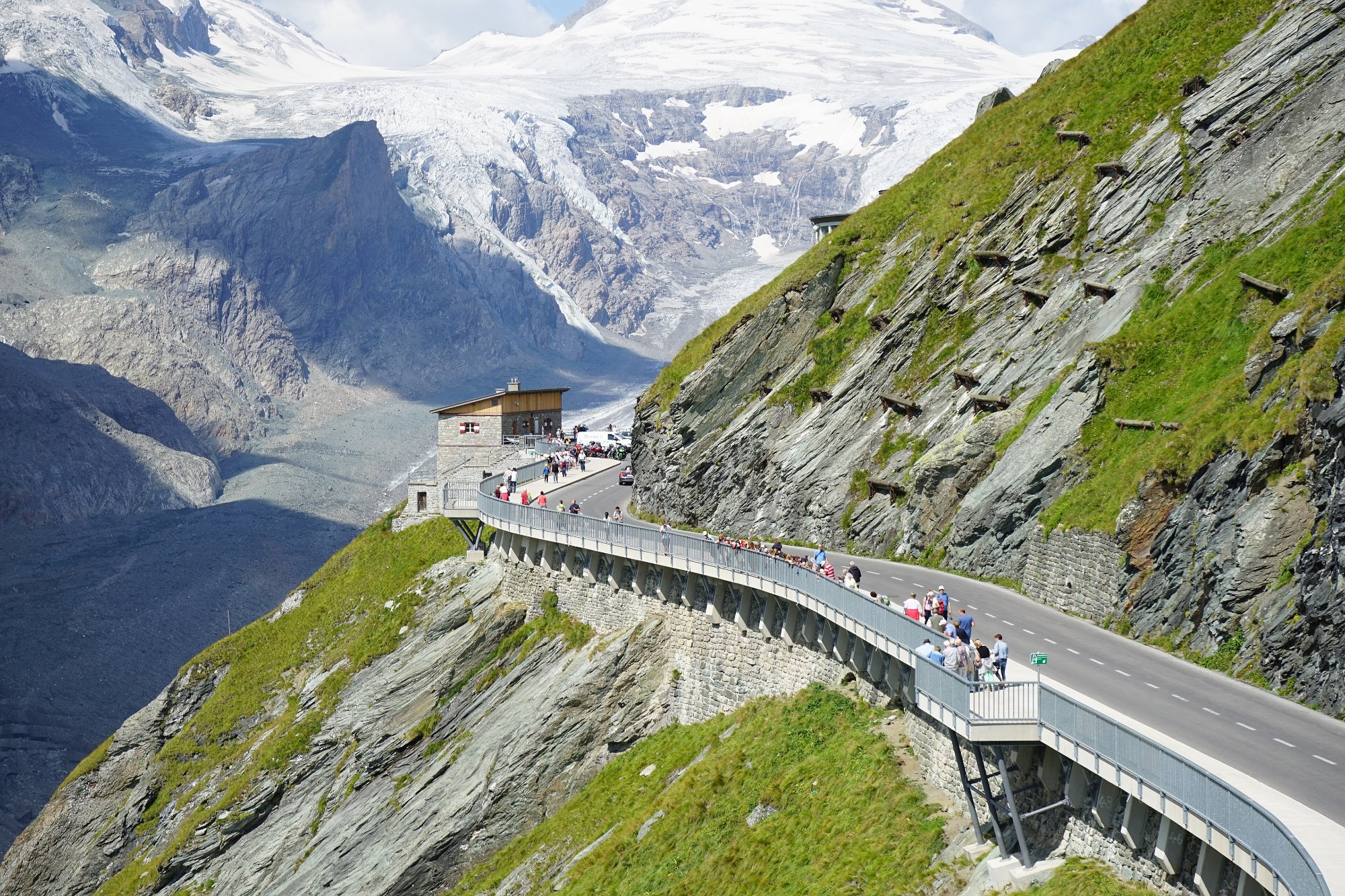
Photo above: The Grossglockner High Alpine Road. PantheraLeo1359531, Wikimedia Commons, CC BY-SA 4.0, cropped.

Austria is the land of panoramic roads: hairpins climbing above 2,500 metres, mountain huts by the roadside and wine roads in the south. Its motorways are fast and well kept, but you pay for almost every one of them, and sleeping anywhere other than a campsite is more tightly regulated than in Germany. Below you will find what to arrange before you go, what has to be in your car and where the best routes are.
- From BrusselsSalzburg in 9h10
- VignetteDigital, €108.90 a year
- Autobahn130 km/h
- Panoramic roadsUsually May to October
On this page: Regions Road trip Rules When to go Food Questions
The best regions and routes for a road trip
With the driving time from Brussels, without breaks or traffic.
The high panoramic roads are the heart of an Austrian road trip. Most are only open from May to October or early November and charge their own toll. The prices below are 2026 rates.

11h05
The Großglockner and the Glockner loop
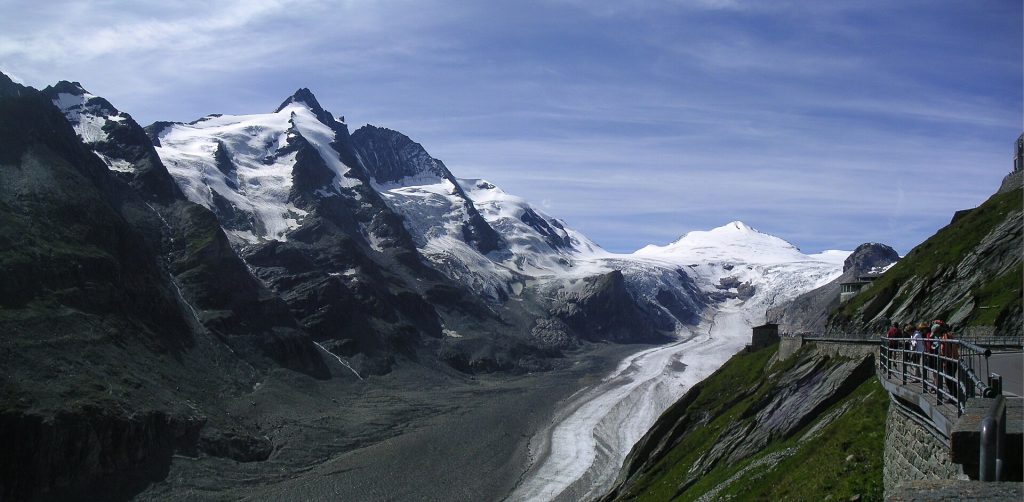
48 km and 36 bends up to 2,571 metres, with views of the Pasterze. Open from early May to early November, €46.50 a day.
More about this region
The classic: 48 km and 36 bends up to 2,571 metres, with views of the Großglockner and the Pasterze glacier. The road is open from early May to early November and costs €46.50 per day, €36.50 after 6pm. Make a loop via the Felbertauernstraße between Mittersill and Matrei (€13.50), or drive past the Krimml Waterfalls on the Gerlos Alpine Road, which is open all year (€13 per day, with a discount if you hold a Glockner ticket for the same day). Heiligenblut, on the south side of the pass, is 11h05 from Brussels if you drive over the Glockner itself.

9h35
The Timmelsjoch: from the Ötztal to South Tyrol
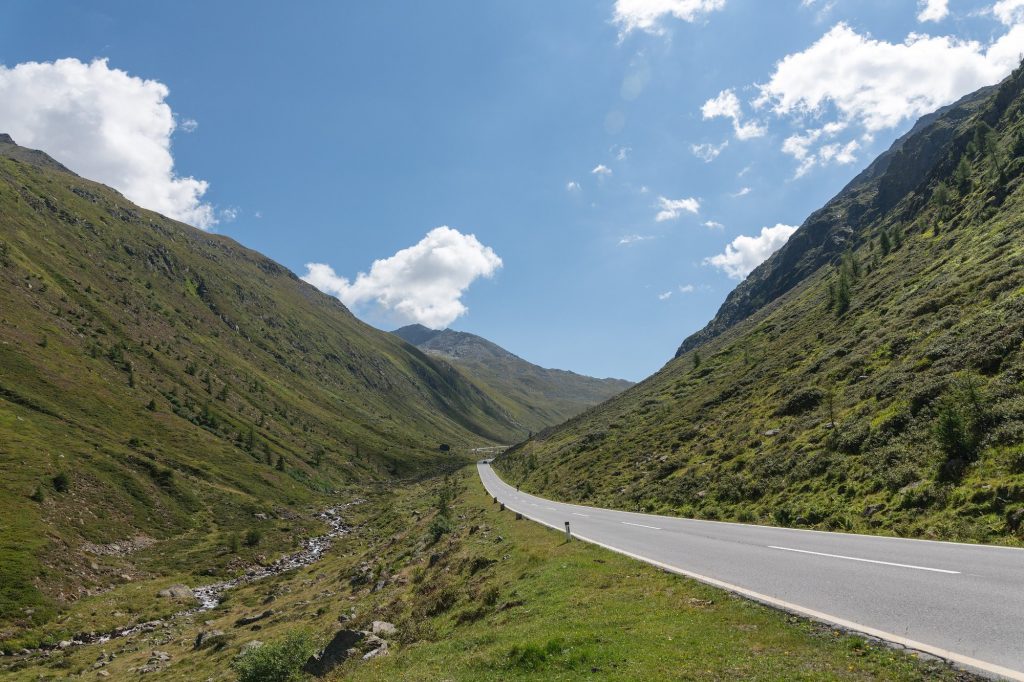
A border pass up to 2,509 metres with around 30 hairpins. Usually open from late May to October.
More about this region
A border pass up to 2,509 metres, with around 30 hairpins. Usually open from late May to October; €20 single, €28 return. On the Italian side, trailers longer than 4.5 metres are banned. Sölden, in the Ötztal, is 9h35 from Brussels.

34 km
Carinthia: the Nockalmstraße and the Alpe-Adria route
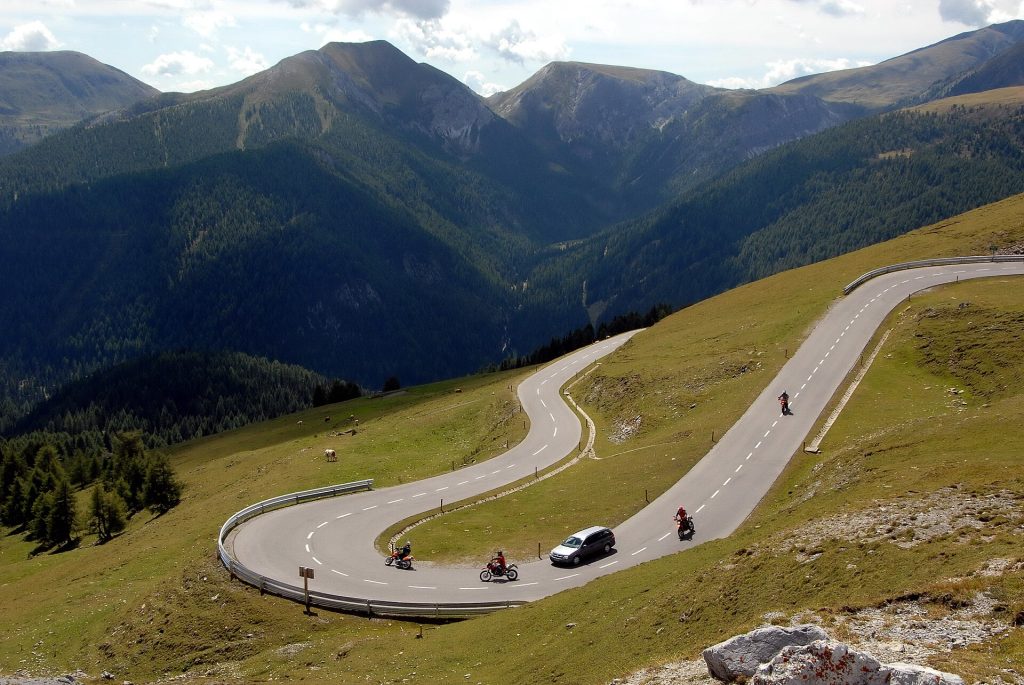
Alpine huts by the road in the Nockberge biosphere park, and further on the Alpe-Adria route to Trieste.
More about this region
The Nockalmstraße (34 km, €25 per day) winds through the Nockberge UNESCO biosphere park, with mountain huts along the road. It is open from early May to late October. If you want to go further, follow the Alpe-Adria Roadtrip: six stages from the Carinthian mountains via Hermagor, Klagenfurt and Tarvisio to Trieste on the Adriatic.

11h20
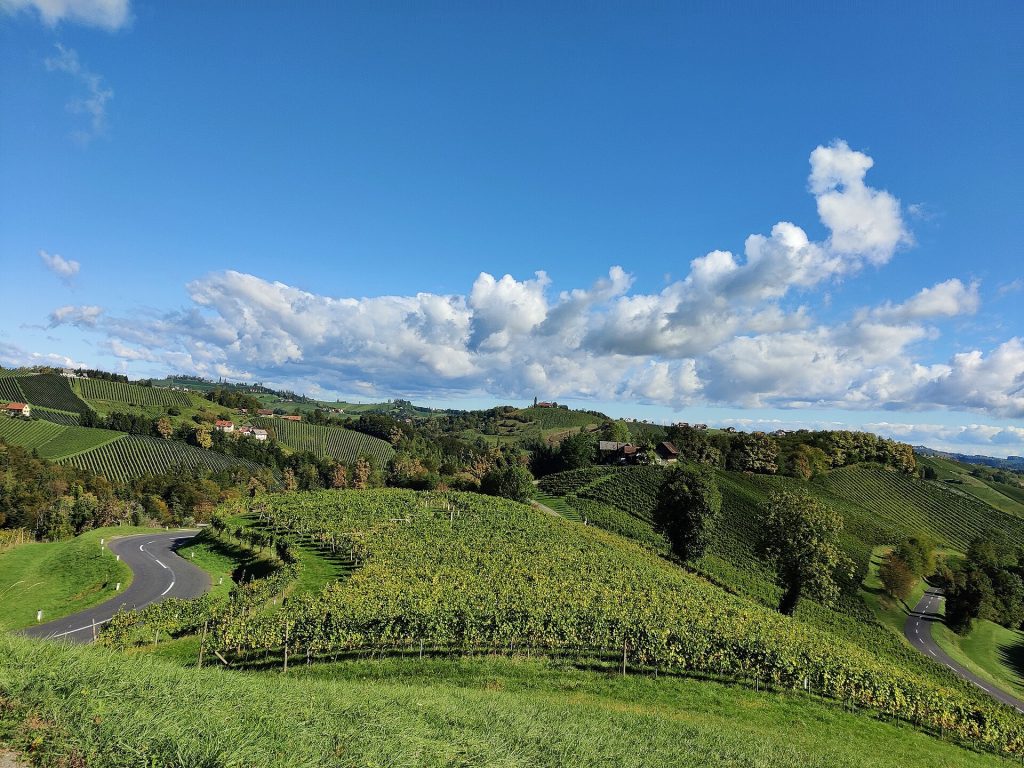
Styria: the wine roads
Eight wine routes, with the South Styrian Wine Road as the oldest. Stop at a Buschenschank for wine from the grower.
More about this region
Eight routes through the wine country in the south, with the South Styrian Wine Road as the oldest wine route in Austria. Stop at a Buschenschank, where the winegrower serves his own wine. The season runs from spring until late autumn. Graz is 11h20 from Brussels.

11h05
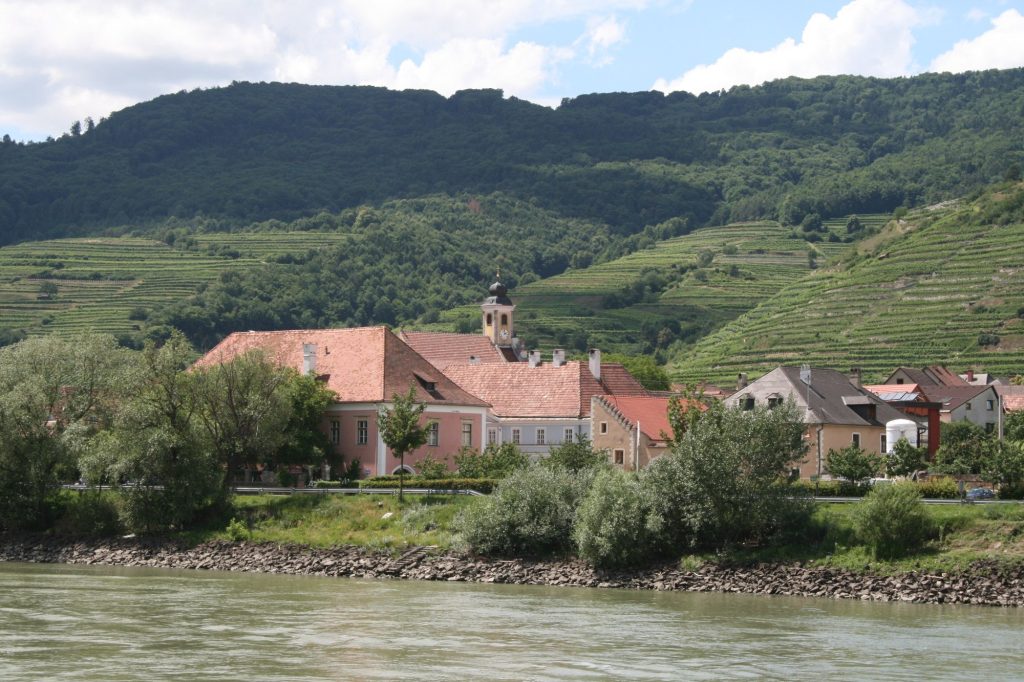
The Wachau: wine terraces along the Danube
A UNESCO World Heritage valley on the Danube, with wine terraces, Wachau apricots and Heurigen.
More about this region
A UNESCO World Heritage landscape in Lower Austria, with wine terraces, Wachau apricots (Wachauer Marille) and Heurigen. There is an online Heurigen calendar, and the Welterbesteig trail lets you walk part of the valley. For reference: Vienna is 11h05 from Brussels.

7h50
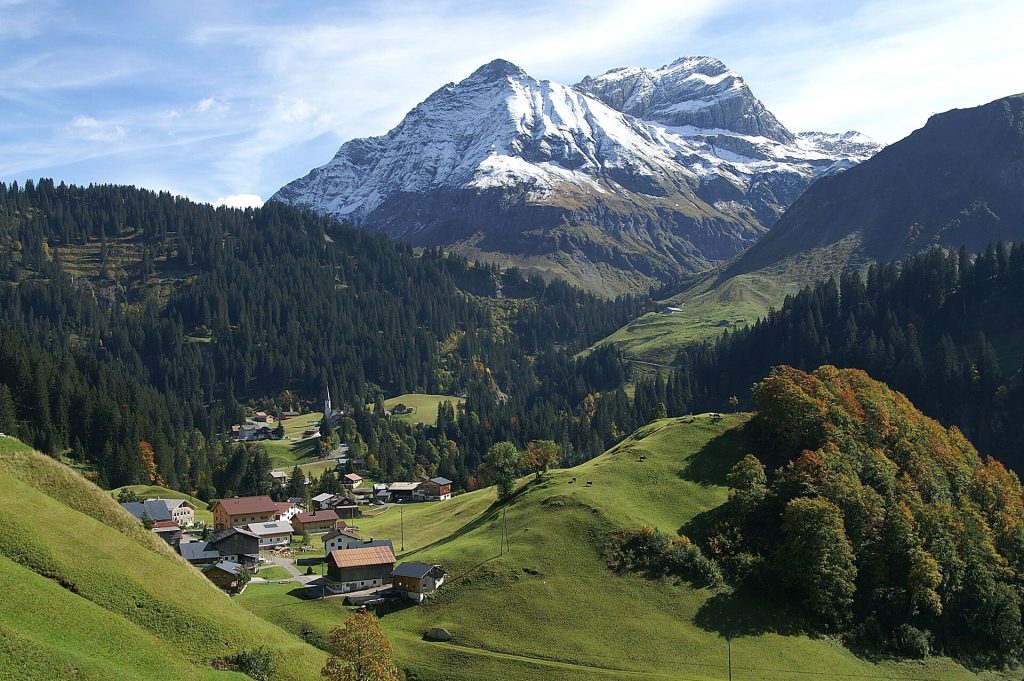
Vorarlberg: the Bregenzerwald
The closest Austrian destination, with the KäseStrasse cheese route through the region.
More about this region
Bregenz is the closest Austrian destination: 7h50 from Brussels. In the Bregenzerwald, the KäseStrasse takes you along the region’s cheese culture. Note: the Silvretta High Alpine Road is expected to stay closed on the Vorarlberg side until 2030. From the Paznaun in Tyrol it can be reached toll-free in summer.
Road trip guide
The Glockner loop in 3 days
approx. 205 km · loop from Zell am See via East Tyrol
Over the Großglockner High Alpine Road and back via East Tyrol, day by day: driving times, where you can legally sleep and when the road is open.
The rules at a glance
Last checked on 24 November 2026. Prices and rules change, often on 1 January: check the official source listed at the bottom just before you leave.
Driving in Austria
130 on the Autobahn, 100 outside towns
An IG-L sign lowers the limit on some stretches. The alcohol limit is below 0.5 g/l.
All rules
- Speed: 50 km/h in built-up areas, 100 km/h on ordinary roads outside them and 130 km/h on the Autobahn. On an Autostraße (expressway) the limit is 100 km/h unless a sign says otherwise.
- IG-L limits: an “IG-L” plate under a speed sign lowers the limit on some stretches, for air quality. On motorways these limits are sometimes switched on flexibly.
- Alcohol: the limit is below 0.5 per mille. Holders of an Austrian probationary licence may have no more than 0.1. We found no confirmation of whether that also applies to novice drivers with a foreign licence.
- Emergency corridor (Rettungsgasse): as soon as traffic starts to queue, clear a lane between the far left lane and the lane to its right. Failing to do so can be heavily penalised.
- Brenner (A13): at the Lueg bridge, traffic has used one lane in each direction since 1 January 2025. On busy days a second lane may be opened temporarily.
- Panoramic roads have fixed opening hours. On the Großglockner, driving at night outside those hours is banned.
- Salzburg’s city centre was closed to tourists arriving by car in July and August 2026, with hotel guests exempt. Whether this returns in 2027 has not been announced.
- Children under 14 and shorter than 135 cm travel in a child seat. The government still recommends one up to 150 cm.
- Traffic news: the radio station Ö3 broadcasts traffic updates every half hour.
Vignette, tolls and low-emission zones
Digital vignette only: €108.90 a year
Bought online, an annual or two-month vignette is only valid after 18 days. The Brenner and Tauern have separate tolls.
All rules
From the 2027 vignette year onwards, only the digital vignette exists, linked to your number plate. Enter it correctly: a wrong plate counts as an offence. The 2027 annual vignette is valid from 1 December 2026 up to and including 31 January 2028 and costs €108.90. Buy it in 2026 and you still pay €106.80. From 1 January 2027, a 1-day vignette costs €9.80, 10 days €13.10 and 2 months €32.64.
- The 18-day rule: an annual or two-month vignette bought online by a consumer, through the ASFINAG webshop or app, only becomes valid 18 days after purchase. Buy in good time, or at a sales point such as the ÖAMTC, ARBÖ or ADAC, where it is valid immediately. You can buy a 1-day or 10-day vignette online with immediate effect.
- Section tolls: the A13 Brenner (€12.50), A10 Tauern (€15), S16 Arlberg (€13) and A11 Karawanken (€9) are charged separately (2026 rates, single trip). You do not need a vignette on those sections.
- Vignette-free: the A1 Walserberg–Salzburg-Nord, the A12 Kiefersfelden–Kufstein-Süd and the A14 Hörbranz–Hohenems. Watch out for the Altach exit.
- Without a valid vignette you pay a substitute toll (Ersatzmaut). If you do not pay it, you risk a fine of €300 to €3,000.
- Low-emission zones: we found no sticker zones for cars. The IG-L limits above do apply.
Only buy from ASFINAG or an official sales point. Prices, the 18-day rule and section tolls in one place: Austria vignette 2027. All countries side by side are in our guide to vignettes, tolls and low-emission zones in Europe.
What must be in your car?
Triangle, hi-vis vest and first-aid kit
Put the vest on before you get out, and carry your documents in the original.
More details
Austrian law (§ 102 KFG) requires the driver to carry three things: first-aid material in a sturdy, dust-tight container, a warning triangle and warning clothing meeting EN 471 or EN ISO 20471. The law makes no exception for foreign cars. Our reading: the requirement applies to you too. Austria does not require a fire extinguisher, although the country where your car is registered may.
- Put your hi-vis vest on before you get out: you wear it when placing the triangle and when you are outside the car on a motorway or Autostraße. Keep it in the door pocket.
- Carry your driving licence and registration certificate in the original. A copy is not enough, says the ÖAMTC.
The full packing list is in our guide to mandatory car equipment by country.
Winter
1/11 to 15/4: winter tyres in wintry conditions
M+S with at least 4 mm tread or the snowflake symbol. Chains are only an alternative on a snow-covered road.
More details
In winter, from 1 November to 15 April, you need winter tyres on all wheels in snow, slush or ice: M+S tyres with at least 4 mm of tread, or tyres with the snowflake symbol. Snow chains on at least two driven wheels are allowed as an alternative, but only on a (nearly) fully snow-covered or icy road. At the “Schneeketten” sign they are mandatory. The fine is around €100. If you drive through Germany, only tyres with the 3PMSF symbol count there. More in our guide to winter tyres and snow chains in Europe.
Where to stay overnight
Sleeping in your car: by state
Banned in Vienna and Tyrol. With Schau aufs Land you can stay legally at some 900 farms and winegrowers.
All rules
Campsites are the safest choice, especially with a roof tent. There are also good legal alternatives:
- Schau aufs Land: a network of some 900 farms and winegrowers where you may stay for up to 24 hours, roof tents included. Membership starts at €19.90 a year.
- Mountain huts: through hut-reservation.org you can book more than 500 huts in Austria and neighbouring countries. At the Austrian Alpenverein, members of foreign alpine clubs get the same member discount.
- Municipal zones: some municipalities designate a site. Galtür (Tyrol) does so from 1 May to 31 October, for up to 6 days.
Sleeping in your car cannot be taken for granted in Austria. A general “one night to rest” rule, as in Germany, does not exist: each state decides. It is banned in Vienna, even in an ordinary car. In Tyrol the ban also covers cars and roof tents, except in zones the municipality opens up. In Upper Austria and the rest of Salzburg it is allowed unless the municipality bans it; the city of Salzburg bans camping in all public places, with fines of up to €10,000. Every state is covered in our guide to sleeping in your car, campervan or roof tent.
Wild camping with a tent is banned in forests everywhere without the owner’s permission. Tyrol, Carinthia, Burgenland, Lower Austria and Vienna also ban it outside the forest, with fines of up to €600 in Tyrol and up to €7,300 in Lower Austria. Tyrol makes an exception for zones the municipality opens up, such as in Galtür, and for a bivouac above the tree line. In the Hohe Tauern National Park, wild camping and fires are banned. The rules by state are in our guide to wild camping in Europe.
Off-road and unpaved roads
Banned off the road and on forest roads
Legal options are dedicated sites, such as the ÖAMTC centre in Stotzing or the Red Bull Ring, from €132 for 3 hours.
All rules
Driving off the road is banned. On a forest road (Forststraße), too, you may only drive with the permission of the owner or whoever maintains the road. For the public, that permission usually shows from a sign, and in practice many gravel roads have a no-entry sign or a barrier. Driving on a clearly closed forest road can cost up to €730, and up to €3,630 in serious cases. In Carinthia, driving off roads and car parks is expressly banned.
Legal off-roading happens on dedicated sites. The ÖAMTC Offroad Zentrum Stotzing in Burgenland always works with an instructor. The ÖAMTC centres run SUV courses in your own car. At the Red Bull Ring in Spielberg you can drive your own 4×4 freely from €132 for 3 hours; no 2027 dates are listed yet. More in our guide to legal off-road driving in Europe.
Everything in one table: Austria at a glance
| Topic | What applies |
|---|---|
| Driving time from Brussels | Salzburg 9h10, Innsbruck 9h25, Heiligenblut (Großglockner) 11h05 via the summer route |
| Speed limits | 50 km/h in built-up areas, 100 km/h outside them, 130 km/h on the Autobahn; lower where IG-L signs apply |
| Alcohol limit | Below 0.5 per mille; 0.1 on an Austrian probationary licence (Probeführerschein) |
| Vignette and tolls | Digital only; 2027 annual vignette €108.90 (€106.80 if bought in 2026); section tolls (Brenner and others); tolls on panoramic roads |
| Low-emission zones | No sticker zones; IG-L speed limits |
| Mandatory in the car | Warning triangle, hi-vis vest (driver) and first-aid kit; original documents |
| Winter rules | Winter tyres in wintry conditions from 1/11 to 15/4; chains as an alternative on a snow-covered road, mandatory at a sign |
| Sleeping in a car or roof tent | By state; banned in Vienna and Tyrol. Roof tent banned in Tyrol, unclear elsewhere |
| Wild camping | By state; banned in forests. Also banned in Tyrol, Carinthia, Burgenland, Lower Austria and Vienna |
| Off-road | Forest roads only with permission; sites such as Stotzing and the Red Bull Ring |
| Emergency number | 112; mountain rescue 140; breakdown ÖAMTC 120 and ARBÖ 123 |
We use Brussels as a fixed reference point. The driving times are model values from the OSRM route planner, without breaks, traffic jams or border checks.
When to go
Schilcher seasonopen or good timewinter equipment required in wintry conditions
Details by region
- May to October: the panoramic roads are open. The Großglockner from early May to early November, the Nockalmstraße from early May to late October and the Timmelsjoch usually from late May to October. The Gerlos Alpine Road is open all year.
- Spring to late autumn: the Styrian wine roads. Autumn is the season for Schilcher.
- 1 November to 15 April: winter equipment is required in wintry conditions. The high panoramic roads are closed.
Food and drink along the way
- Tyrol: Tiroler Speck, Graukäse and alpine cheese; dumplings (Knödel), Schlutzkrapfen and Tiroler Gröstl. The Marend is a cold snack of bacon, bread and cheese.
- Styria: pumpkin seed oil, Käferbohnen (runner beans), Sterz and the Brettljause.
- Wachau: Wachau apricots and a glass at a Heuriger.
- Carinthia: Kärntner Kasnudeln and Reindling. The Slow Food Travel route takes you to restaurants, farm shops and mountain huts.
- Salzburg: Bauernkrapfen, game and alpine cheese, with the Via Culinaria through the Hohe Tauern.
- Vorarlberg: Käsknöpfle and Riebel.
Frequently asked questions
How do I avoid the 18-day wait for the vignette?
Buy the annual or two-month vignette online at least 18 days before you cross the border, or buy it at a sales point such as the ÖAMTC, ARBÖ or ADAC, where it is valid immediately. For a short trip you can also buy a 1-day or 10-day vignette online, with immediate effect.
Can I sleep in my car in Austria?
It depends on the state. Not in Vienna or Tyrol, not even in an ordinary car. In Upper Austria and Salzburg (outside the city) it is allowed unless the municipality bans it. In Carinthia and Burgenland it is unclear. You are sure to be legal at a campsite or on a Schau aufs Land farm.
Which tyres do I need in winter?
From 1 November to 15 April, in snow, slush or ice: M+S tyres with at least 4 mm of tread, or tyres with the snowflake symbol. If you drive through Germany, choose tyres with the 3PMSF symbol, because only those count there. Carry chains as well for the “Schneeketten” signs.
Where can I drive off-road in Austria?
On dedicated sites and courses, such as Stotzing in Burgenland and the Red Bull Ring in Spielberg. Forest roads are only open with the owner’s permission, which usually shows from a sign. If there is a barrier or a no-entry sign, you go no further.
Useful words
- Pickerl: vignette
- Streckenmaut: toll for a specific section
- Forststraße: forest road
- Alm: alpine pasture
- Hütte: mountain hut
- Jause: cold snack (in Tyrol: Marend)
- Buschenschank or Heuriger: winegrower serving his own wine
- Hofladen: farm shop
Official sources
- Vignette and tolls: oesterreich.gv.at – Vignette, ÖAMTC – Vignette 2027, ÖAMTC – digital section toll
- Traffic rules: oesterreich.gv.at – speed limits, oesterreich.gv.at – drink-driving, austria.info – travelling by car and motorbike (Dutch)
- Equipment and winter: oesterreich.gv.at – Warneinrichtung und Warnkleidung, § 102 KFG, ÖAMTC – winter equipment requirement
- Overnight stays: oesterreich.gv.at – Campen
- Off-road: oesterreich.gv.at – Betreten des Waldes, Red Bull Ring – free driving
- Routes: Großglockner – prices and opening times, Gerlos Alpine Road – prices, Nockalmstraße
Driving on?